
Unbiased headlines. Facts, not spin.
Every story is an unbiased news briefing written from 110+ sources across the spectrum — sources linked so you can verify it yourself.
 economy
Low Interest (4/10)
June 6, 2026 at 05:55 AM
economy
Low Interest (4/10)
June 6, 2026 at 05:55 AM
Boeing Opens Fourth 737 Max Assembly Line July 6, Targets 52 Jets Per Month as FAA Cap Remains in Place
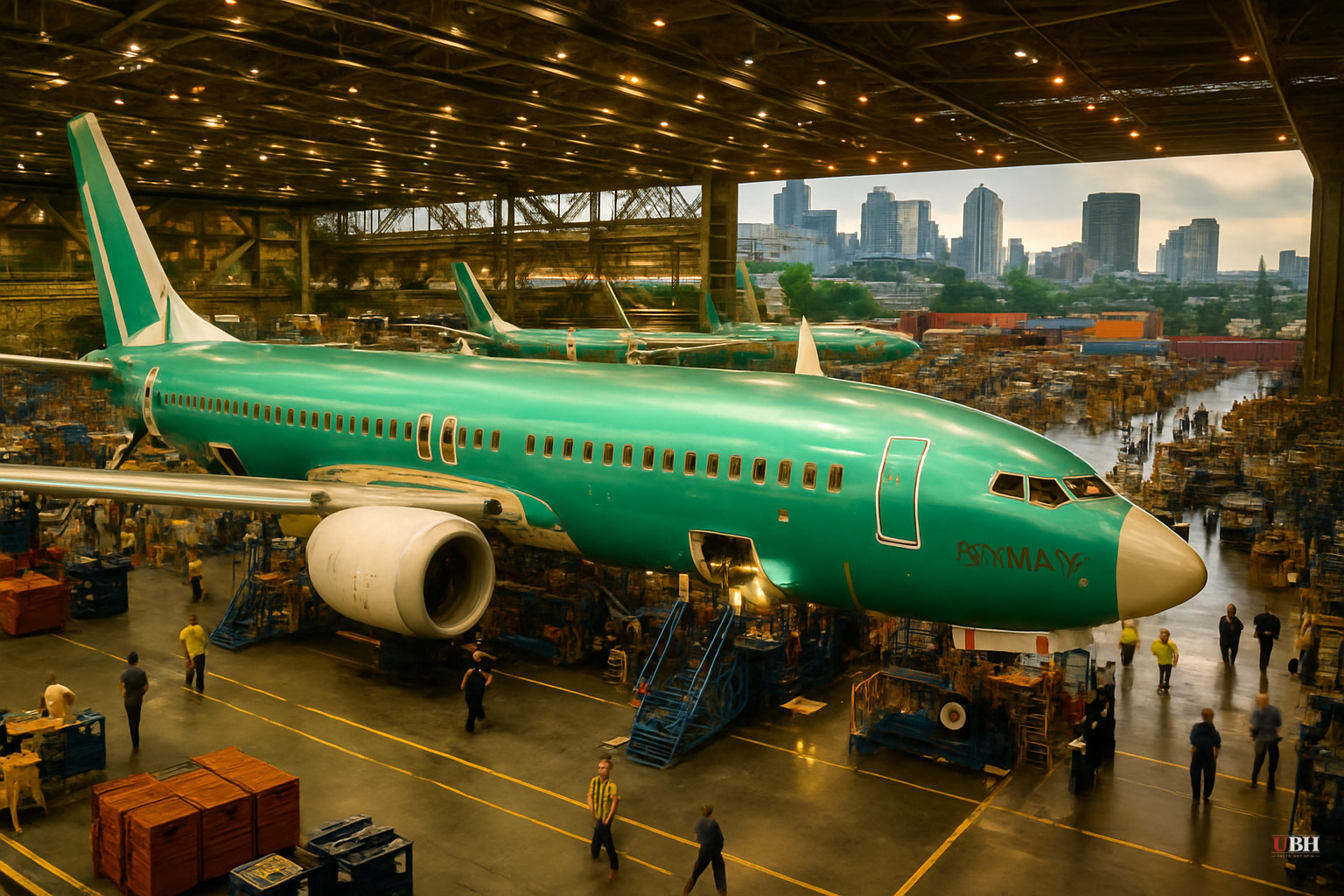
Since the January 2024 Alaska Airlines door plug blowout triggered federal scrutiny of Boeing's manufacturing safety, the company has been climbing a slow, supervised road back to full production capacity — and that climb is still ongoing as of this week.
What's Actually New
Boeing CEO Kelly Ortberg told CNBC on Friday that the company will load its first 737 Max onto a brand-new, fourth final assembly line in Everett, Washington on July 6.
A fourth line means Boeing is building physical infrastructure for higher output — not just talking about it. Ortberg called the new Everett facility "a carbon copy" of the existing Renton, Washington line. Same layout, same process — just more capacity.
The Numbers, Straight
Boeing is currently producing 47 737 Max jets per month, up from 42 earlier this year.
The new Everett line is the mechanism to reach 52 per month — a pace Ortberg says is expected to kick in next year.
Long-term, Boeing leadership has set a goal of 63 per month, contingent on the supply chain being able to keep up.
The FAA Is Still Running the Show
Boeing does not control its own production ceiling right now.
The FAA imposed manufacturing limits on Boeing after the Alaska Airlines incident in January 2024. Those limits are still in effect. Boeing cannot simply ramp to 52 or 63 jets per month because it wants to — it has to earn that through demonstrated quality and safety consistency, and the FAA decides when that bar has been cleared.
Ortberg acknowledged this directly, saying the company is "trying to reset that track record" and emphasized that they're "not pushing work down the production line like we were before."
That's a tacit admission of what went wrong before. Rushing jets through production — moving planes before they were ready — is what created the safety disasters that cost Boeing billions and killed its reputation.
The 737 Max 10 Factor
The new Everett line will start by producing the 737 Max 10, a stretched variant of the single-aisle jet.
The Max 10 still needs FAA certification, which Ortberg told CNBC is expected before the end of this year. No certification, no deliveries. This is another external variable Boeing doesn't fully control.
Airlines that ordered the Max 10 have been waiting. The timeline for first deliveries depends entirely on how fast the FAA moves — and given Boeing's recent history, the agency isn't exactly in a rush to rubber-stamp anything.
What the Coverage Is Missing
CNBC's reporting treats this as unambiguously positive news, which is fair on the surface. A fourth production line is a real investment in real capacity.
What's consistently underplayed in the mainstream coverage: Boeing has made big promises before. The company has been in a cycle of announcing production targets, missing them, and resetting expectations for years. The 2024 machinist strike didn't help. Supply chain delays haven't gone away.
Ortberg himself is careful with the language — "expected to begin next year," "if the supply chain can support it." Those qualifiers are doing a lot of work.
The Gulf War Context Nobody's Connecting
With U.S.-Iran tensions running hot — reports of Iranian missile activity in the Gulf region in early June remain unconfirmed and are being contested by independent analysts — the Middle East is NOT a stable environment for airline expansion right now.
Regional carriers, which are among Boeing's biggest 737 Max customers, operate in an environment where airports are genuine targets. Air traffic in the Gulf has been disrupted. How that affects near-term delivery schedules and order confidence isn't something Boeing or the financial press is addressing head-on.
What Comes Next
If you fly domestically on a single-aisle jet, you're almost certainly going to end up on a 737 Max sooner or later — it's the most common narrow-body in the American fleet.
Boeing's recovery matters. More production capacity, done right, means more competition, which keeps ticket prices from being entirely dictated by Airbus.
But "done right" is the key phrase. The FAA's production cap exists because Boeing cut corners and people got hurt. July 6 is a start. It's not a finish line.
Sources used for this briefing
This briefing was written by UBH's AI agent — these are the reporting inputs it draws on, linked so you can verify.


