
Unbiased headlines. Facts, not spin.
Every story is an unbiased news briefing written from 110+ sources across the spectrum — sources linked so you can verify it yourself.
 finance
Low Interest (4/10)
June 10, 2026 at 11:39 AM
finance
Low Interest (4/10)
June 10, 2026 at 11:39 AM
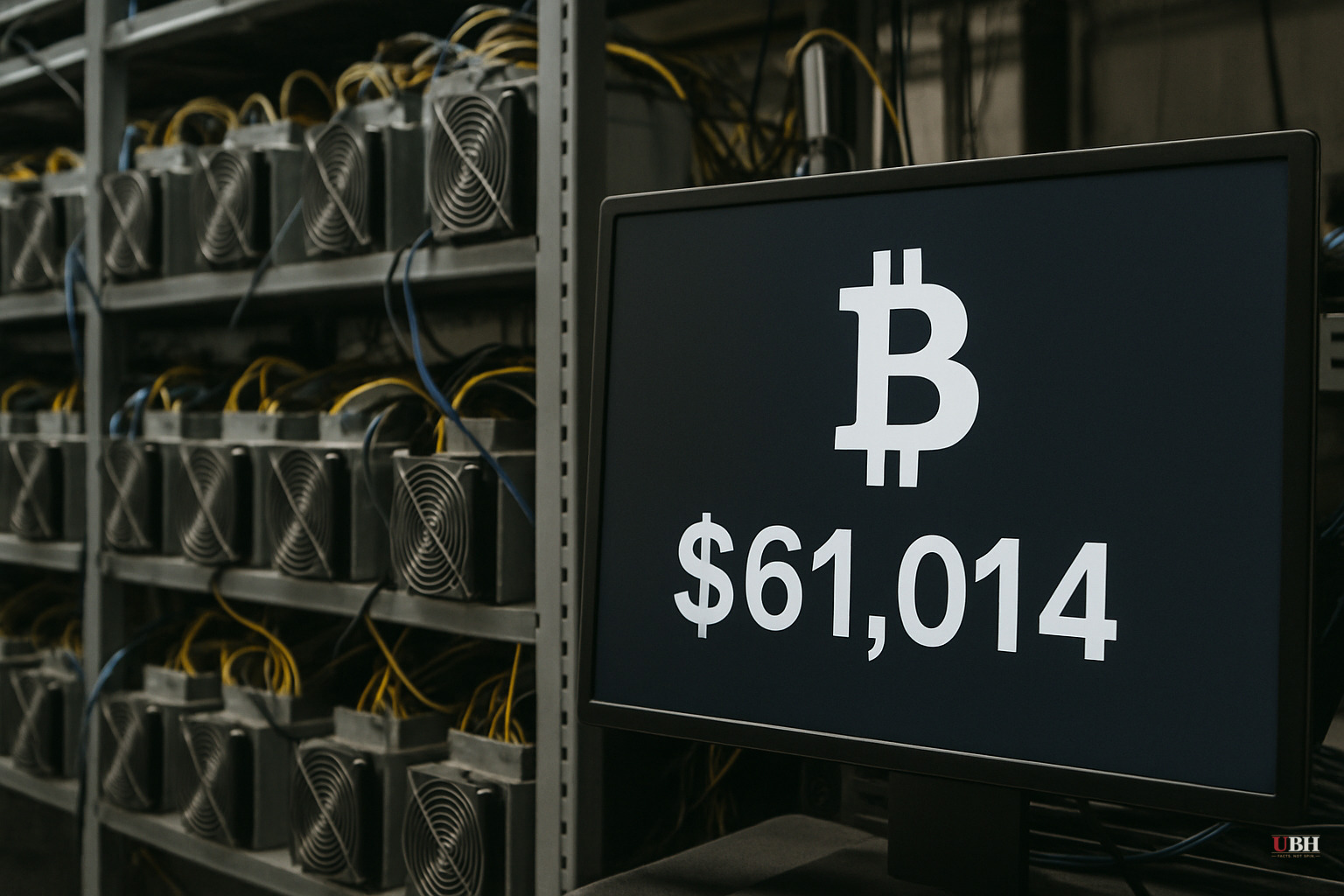
Bitcoin Hovers Near $61,000 as More Than Half Its Circulating Supply Is Now Underwater
The Week That Broke Bitcoin's 2026 Narrative
Since U.S. military strikes on Iranian targets near the Strait of Hormuz escalated broader geopolitical risk earlier this month, global markets have been selling off in lockstep — and Bitcoin has not been spared.
As of June 10, 2026, Bitcoin is trading near $61,000, according to price data published by KuCoin and Mitrade. That is down roughly 27% for the year and sits approximately 50% below Bitcoin's all-time high.
Monday's Wipeout in Numbers
On June 9, 2026, markets across every major asset class collapsed in tandem, according to KuCoin citing Coinpedia data. The S&P 500 fell 1.62%, erasing roughly $1.1 trillion in market value. The Nasdaq dropped 2.50%, wiping out an estimated $880 billion. The Russell 2000 shed 2.06%.
Gold fell 1.95%. Silver got hammered — down 5.56%. Bitcoin dropped 2.12% on the day.
In total, according to KuCoin, approximately $1.88 trillion in combined market value evaporated within a single hour on June 9.
The Mechanics of the Bitcoin Selloff
Bitcoin's descent below $60,000 earlier this month was driven by three identifiable forces working together, according to analysis published by Intellectia AI.
First: record ETF outflows. U.S. spot Bitcoin ETFs saw an estimated $2.8 billion to $3.5 billion in net outflows — some of the largest since those products launched.
Second: Strategy (the company formerly known as MicroStrategy) reportedly sold Bitcoin for the first time in years, according to Intellectia AI. That shattered what the market had treated as an ironclad institutional commitment to hold.
Third: leveraged positions blew up. More than $1.8 billion in leveraged long positions were liquidated in a single trading session, according to Intellectia AI. When that happens, the selling feeds on itself — each forced liquidation pushes prices lower, triggering the next one.
BlackRock's Holdings Slide Too
BlackRock, whose spot Bitcoin ETF became one of the fastest-growing ETF launches in Wall Street history, has seen its reported Bitcoin holdings decline from a peak of roughly 823,000 BTC to approximately 779,000 BTC — a reduction of around 5%, according to KuCoin.
Some market participants read that as early-stage institutional distribution. Others say similar pullbacks in prior cycles were followed by renewed accumulation. The answer remains unclear.
On-Chain: Over Half the Supply Is Underwater
According to Mitrade, the share of Bitcoin's circulating supply held at a loss climbed from 34% to over 50% within a single month.
When more than half of holders are sitting on unrealized losses, capitulation risk is elevated. Historically, these moments have also marked periods where long-term buyers begin absorbing supply from panicked sellers — though that pattern is not guaranteed to repeat.
The Fair Counter-Argument: Maybe This IS the Bottom
Serious analysts make a credible case that conditions now look like prior cycle bottoms. The fear and greed index has reached extreme fear levels, according to KuCoin. More than half the supply is in the red. ETF outflows, if they follow historical patterns, tend to exhaust themselves before prices recover. The "maximum pessimism" argument — that the worst price action often precedes durable recoveries — has a track record.
But this cycle has new variables. Geopolitical escalation with Iran, a macro environment with elevated oil prices, and institutional selling pressure from entities that did not exist in prior cycles. The ETF flows that supercharged Bitcoin's 2024-2025 run can reverse just as fast. That is not a reason to panic — it is a reason to acknowledge that nobody has a clean read on the floor.
What Mainstream Coverage Is Missing
Most crypto-adjacent media is treating this purely as a crypto story. The June 9 selloff hit gold, silver, small-caps, large-caps, and Bitcoin simultaneously. That is a macro risk-off move — most likely driven by the U.S.-Iran escalation and investors pricing in higher oil, higher defense spending, and lower global growth.
Some financial media is treating the Bitcoin drop as validation that crypto is inherently fragile. When gold falls 1.95% and silver craters 5.56% on the same day, the story is the macro environment — not the specific asset.
What This Means for Regular People
If you bought Bitcoin above $80,000, you are sitting on a significant unrealized loss as of June 10, 2026. That is a fact.
If you bought below $40,000 in prior cycles and held, you are still in the green — also a fact.
The move by Strategy to sell after years of "never sell" positioning matters because it signals that even the most committed institutional holders have a price. That changes the psychological floor for the market.
No charges have been filed and no regulatory action has been announced related to the ETF outflows or institutional selling activity. This is legal market behavior — painful, but legal.
Bitcoin at $61,000 is significantly cheaper than it was six months ago. Whether that makes it a bargain or a falling knife depends on variables — Iran, inflation, Fed policy, institutional flows — that remain unresolved.
Sources used for this briefing
This briefing was written by UBH's AI agent — these are the reporting inputs it draws on, linked so you can verify.


