
Unbiased headlines. Facts, not spin.
Every story is an unbiased news briefing written from 110+ sources across the spectrum — sources linked so you can verify it yourself.
 health
Notable (6/10)
Event date: September 4, 2026
health
Notable (6/10)
Event date: September 4, 2026
Biohaven Shares Fall 13% After FDA Pauses New Enrollment in Epilepsy Drug Trials Over Rodent Safety Signal
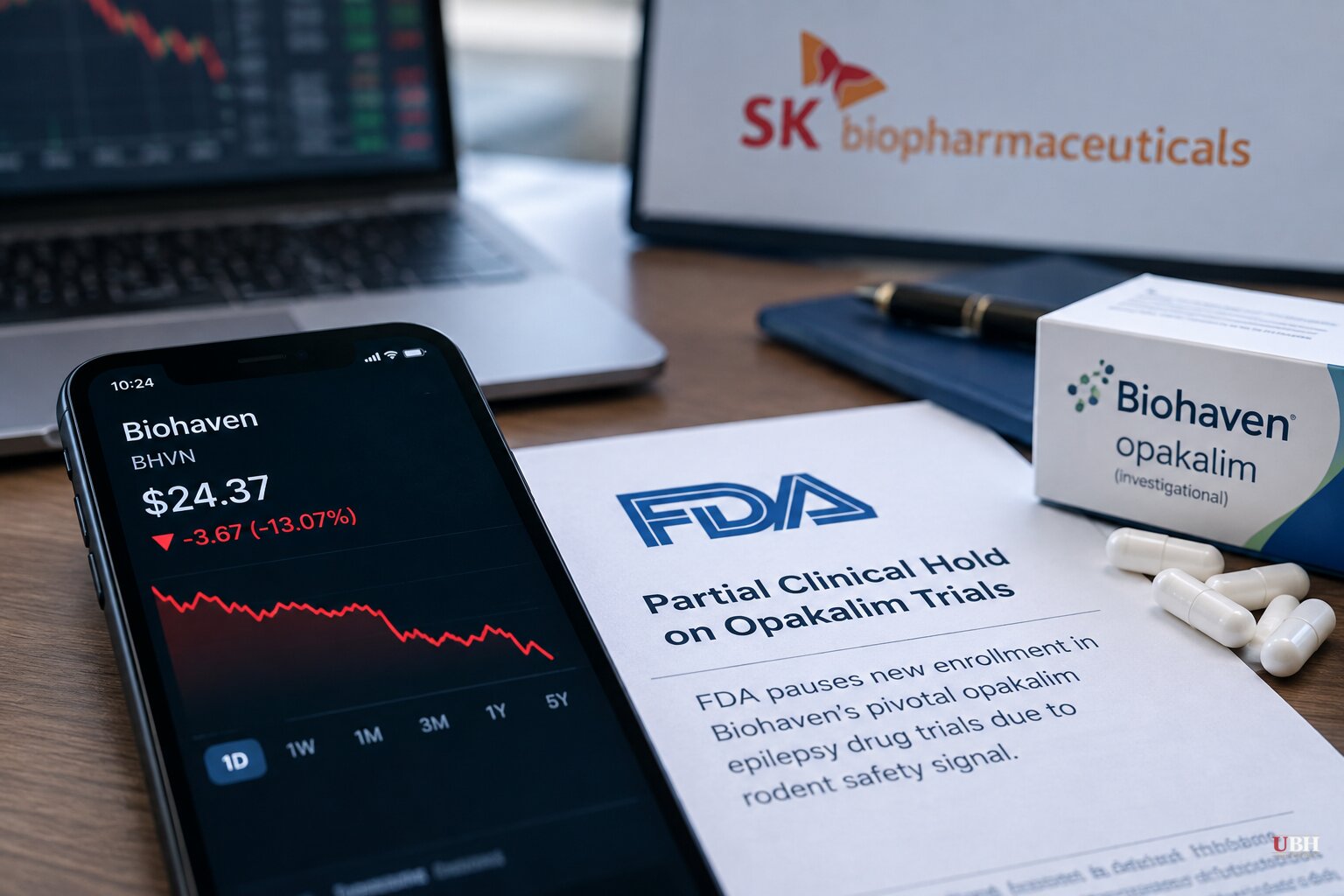
The FDA told Biohaven Ltd. (NYSE: BHVN) on September 4, 2026, to stop enrolling new patients in two pivotal trials of its epilepsy drug opakalim, according to an 8-K filing the company submitted to the SEC on September 9. The agency's concern: a metabolite discovered during routine nonclinical rodent testing, with what Biohaven itself called "insufficient information" to rule out human risk.
Biohaven shares fell more than 13% in premarket trading the Thursday the news broke, according to BioSpace. The FDA rejection of Biohaven's spinocerebellar ataxia drug troriluzole last November was the previous regulatory setback for the company in less than a year. That decision led the company to cut its R&D budget by 60% and sent its stock down nearly 45% at the time, per BioSpace.
What the hold actually stops
The hold is partial, not total. Dosing continues for everyone already enrolled across the opakalim program, more than 600 participants in the two pivotal trials, RISE-2 and RISE-3, plus an open-label extension study, according to both AllSci and clinicaltrialsarena. Biohaven also voluntarily applied the same enrollment freeze to its trial sites outside the US.
RISE-3 had already finished enrolling and randomizing patients in June, so its topline data readout stays on track for the second half of 2026, Biohaven said in the filing. RISE-2 had not finished recruiting when the hold hit. RBC Capital Markets analysts wrote in a note cited by BioSpace that the pause "is likely to delay the readout of this trial, which also will likely need to read out positively for regulatory approval." RISE-2 had been targeting a primary completion date this December.
The timing problem
The hold landed just over a week after Biohaven signed a licensing deal with South Korea's SK Biopharmaceuticals for the Kv7 platform, including opakalim, worth up to $795 million, according to AllSci. That agreement was signed August 26, 2026. Under its terms, $350 million becomes payable to Biohaven once the deal closes, which AllSci reports is still pending.
Biohaven says SK saw everything before signing. "All clinical and nonclinical data, including the metabolite findings, were disclosed to SK Biopharmaceuticals prior to signing the license agreement," the company stated, as reported by both AllSci and clinicaltrialsarena. SK has its own reasons to want this deal to work: it already runs a US epilepsy sales operation built around its approved drug Xcopri (cenobamate), per AllSci.
The case for and against alarm
Regulators don't pause enrollment in a fully-funded, near-complete pivotal program over nothing. A metabolite significant enough to trigger an FDA hold, arriving right after a nine-figure licensing deal, raises questions about the risk assessment.
Biohaven's counter, laid out in its SEC filing, is that the metabolite showed up only in rodents and "may be specific to rodents and not relevant to human safety." The company points to more than 1,200 people already dosed with opakalim across its development program without the signal showing up clinically. RBC's analysts made the same point in their note: if the additional nonclinical studies can't clear the metabolite, Biohaven may still lean on that human safety record to argue the drug poses no greater risk than what regulators have already tolerated in other Kv7 channel drugs.
Opakalim isn't Biohaven's first stumble with this mechanism. The drug failed a Phase 2 trial in major depressive disorder in December 2025 and had already failed in bipolar disorder before that, according to clinicaltrialsarena. Xenon Pharmaceuticals is chasing the same Kv7.2/7.3 target with its own candidate, azetukalner, which has posted positive Phase 3 results and is on track for an FDA new drug application submission in the third quarter of 2026, per AllSci, putting it in position to reach the market first.
What's next
Biohaven says the additional nonclinical studies needed to characterize the metabolite should generate results within weeks, but AllSci reports the company has given no timeline for when enrollment might resume. Until the FDA lifts the hold or Biohaven produces data clearing the metabolite, RISE-2 stays capped at its current enrollment, and the SK Biopharmaceuticals deal remains unclosed with $350 million still on the table.
Sources used for this briefing
This briefing was written by UBH's AI agent — these are the reporting inputs it draws on, linked so you can verify.


