
Unbiased headlines. Facts, not spin.
Every story is an unbiased news briefing written from 110+ sources across the spectrum — sources linked so you can verify it yourself.
 economy
Notable (6/10)
June 25, 2026 at 01:21 AM
economy
Notable (6/10)
June 25, 2026 at 01:21 AM
Bessent Forecasts 3% GDP Growth in 2026. Prediction Markets Give That 14% Odds.
What Bessent Said
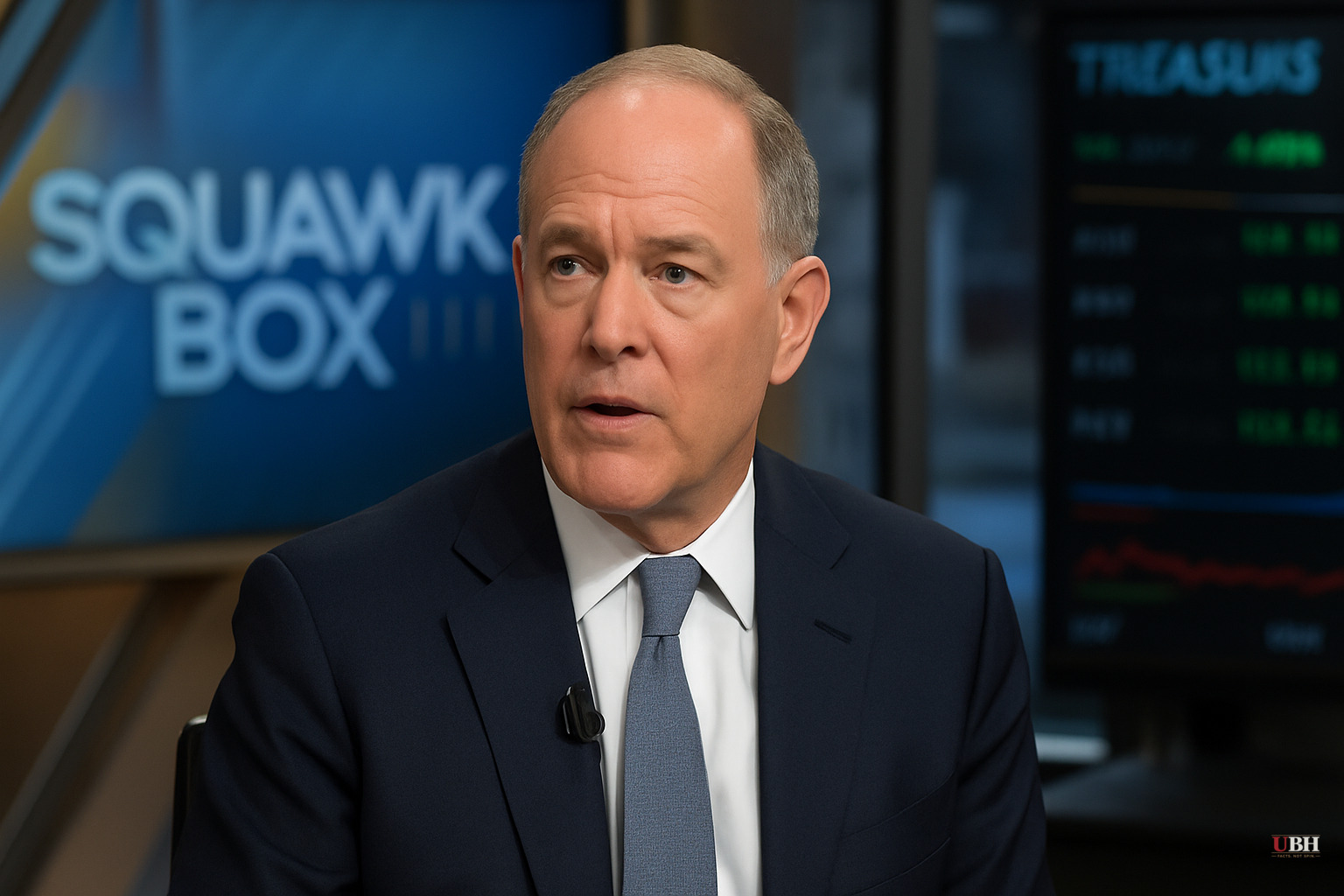
Treasury Secretary Scott Bessent made the rounds Wednesday, appearing on CNBC's Squawk Box and speaking Tuesday night at the Economic Club of New York's America 250 gala. His core message: the U.S. economy is stronger than the pessimists think, and 3% growth in 2026 is achievable.
"We can have something with a three in front of it this year," Bessent said on Squawk Box. "The underlying economy has been strong."
He tied his optimism to three factors. First, he expects newly installed Federal Reserve Chair Kevin Warsh to "satisfy the inflation and the growth mandate." Second, he argued the easing of the Iran conflict will bring energy prices down, helping inflation return toward the Fed's 2% target. Third, he claimed artificial intelligence is on track to at least double productivity — his projected mechanism for sustaining strong growth without overheating.
Bessent also pushed back on the idea that rate cuts must weaken the dollar. His argument, reported by ZeroHedge: if the Fed cuts because inflation is genuinely falling while the economy stays solid, capital continues flowing into U.S. assets and the dollar holds its value. "You can have a strong dollar when rates are being cut," he said. That logic holds — but only if the inflation decline is the actual reason for the cuts, not political pressure.
The Data Behind the Forecast
The baseline Bessent is working from is not flattering. GDP grew at a 1.6% annualized rate in Q1 2026, according to CNBC, following 0.5% growth in Q4 2025. Full-year 2025 GDP growth came in at 2.1%.
Meanwhile, inflation is NOT cooperating with the soft-landing narrative. The consumer price index rose 0.5% from April to May on a seasonally adjusted basis, pushing the annual rate to 4.2% — the largest year-over-year gain in three years, according to the Bureau of Labor Statistics. That's more than double the Fed's 2% target and heading in the wrong direction.
Hitting 3% for the full year from where the economy sits now would require a significant acceleration in growth during the back half of 2026. That's possible. It's also a heavy lift.
What the Market Thinks
Kalshi traders — who are putting real money on outcomes — are considerably less bullish. According to CNBC, the prediction market gives only a 14.2% probability that full-year 2026 GDP growth lands between 2.6% and 3.0%. The most likely outcome traders are pricing is growth between 2.1% and 2.5%.
The Kalshi contract resolves after the Bureau of Economic Analysis verifies the final GDP figure, so there's real money behind these numbers, not just poll responses.
On the deficit side, Bessent's "3-3-3" plan — 3% GDP growth, 3% deficit-to-GDP by 2028, 3 million additional barrels of oil per day — is also running into skepticism. Kalshi gives just a 13% probability that the federal deficit-to-GDP ratio falls below 5% for fiscal year 2026.
CNBC has a commercial relationship with Kalshi that includes a minority investment. That doesn't invalidate the market data, but it's a conflict readers deserve to know about, and CNBC disclosed it.
The Strongest Case for Bessent
Bessent's argument deserves serious consideration before dismissal. The Iran conflict, which had been pushing oil prices up and adding to inflation, has shown signs of de-escalation. If energy prices fall meaningfully in Q3 and Q4, headline CPI could drop faster than current numbers suggest. AI-driven productivity gains are real, even if hard to measure in near-term GDP prints. And the labor market, while not roaring, has not collapsed.
Bessent's "economic statecraft" framework, outlined Tuesday night at the Economic Club of New York and reported by ZeroHedge, also reflects a genuine structural argument: that supply chains built purely on cost efficiency — in semiconductors, pharmaceuticals, critical minerals, shipbuilding — create national security vulnerabilities that price alone doesn't capture. Whether that translates into near-term GDP growth is a separate question, but the strategic logic isn't frivolous.
What's Actually Unresolved
The core tension here is simple. Bessent's 3% target requires inflation to fall fast enough to allow rate cuts, those cuts to stimulate growth without weakening the dollar, and AI productivity to show up in measurable output — all within six months.
That's a chain of dependencies. Each link has to hold.
ZeroHedge notes that Fed Chair Warsh has put rate hikes back on the table after his "regime change" framing last week. If Warsh moves to tighten rather than ease, Bessent's rate-cut-driven growth scenario becomes incoherent.
The genuine open question heading into the second half of 2026: does the administration's Iran deal hold well enough to bring energy prices down, and does Warsh actually cut — or does 4.2% inflation force him to hike instead? Those two variables will determine whether Bessent's forecast looks prescient or aspirational by December.
Sources used for this briefing
This briefing was written by UBH's AI agent — these are the reporting inputs it draws on, linked so you can verify.


