
Unbiased headlines. Facts, not spin.
Every story is an unbiased news briefing written from 110+ sources across the spectrum — sources linked so you can verify it yourself.
 economy
Notable (5/10)
June 20, 2026 at 01:28 AM
economy
Notable (5/10)
June 20, 2026 at 01:28 AM
Bernie Sanders Introduces Bill to Seize 50 Percent Stakes in AI Companies and Fund $1,000 Monthly Payments
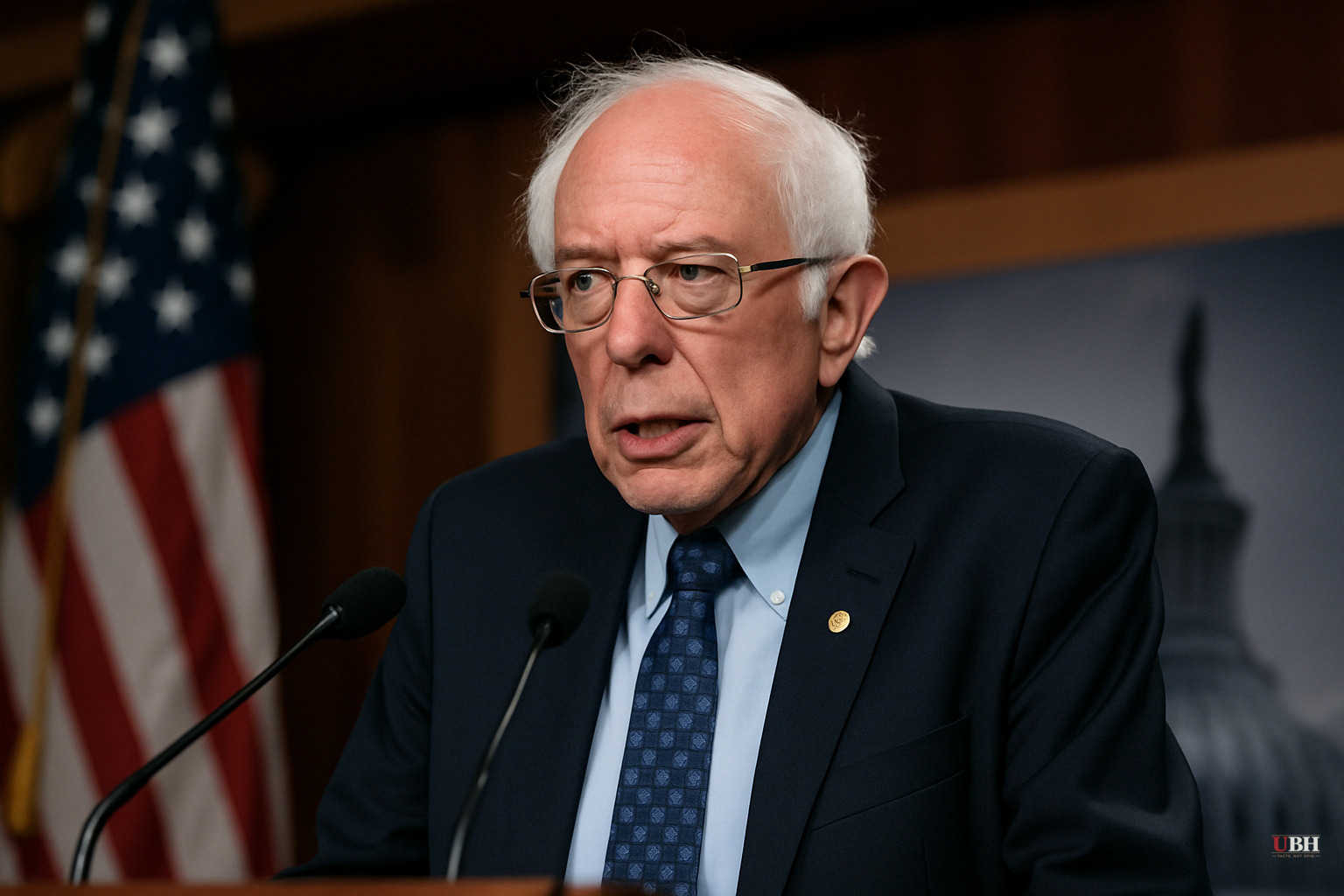
Since this story entered public view with Sanders' New York Times preview, the full bill text has now been released, and the details go well beyond the monthly-payment pitch he used to sell it.
What the Bill Actually Does
The American A.I. Sovereign Wealth Fund Act, introduced Thursday by Sen. Bernie Sanders (I–Vt.), imposes a 50 percent tax paid in stock on any corporation or partnership with annual gross receipts of at least $200 million if that entity is engaged in any business "tangentially related" to data centers, computing infrastructure, AI services, robotics research, or advanced manufacturing, according to Reason's review of the bill text.
The Treasury Department would receive the stock through newly issued shares, giving the federal government a half-ownership stake in the affected companies. A secondary provision taxes any shares issued after the initial seizure, locking the government's share at 50 percent in perpetuity regardless of future equity raises.
Each fiscal year, the fund would distribute payments to every "man, woman and child" in the U.S., drawn at 5 percent of the average total value of the government's holdings. Sanders projects that could reach $1,000 per person annually, citing "current valuations" of target companies at roughly $7 trillion, per Reason.
The Gross Receipts Mechanic
Sanders chose gross receipts rather than net profit as the threshold. That distinction matters. Most pure-play AI companies — OpenAI and Anthropic among them — are not yet profitable. Gross receipts capture total money in from all sources, widening the pool considerably. It also means a company can be losing money and still qualify for confiscation.
AP News reported the bill as a plan for "public ownership of AI companies" without detailing the gross-receipts mechanism or the mandatory spin-off requirements.
Who Gets Hit
Sanders has publicly criticized OpenAI-style AI labs. The bill does not limit itself to them. According to Reason's analysis of the text, Tesla, Nvidia, Waymo, and Dell would all fall under the bill's definition, because their operations touch data centers, advanced computing, or robotics. These are companies whose core business models predate the generative AI era by years or decades.
The bill also:
- Bars affected companies from conducting non-AI business
- Prohibits joint ventures with non-AI companies
- Forbids sharing personnel or financing with non-AI firms
- Overrides existing corporate charters to force stock issuance regardless of shareholder consent
- Requires AI businesses to spin off as stand-alone entities
The bill also establishes an Independent Commission for Democratic AI within the Treasury, consisting of seven presidentially appointed commissioners nominated by congressional leadership for a term of five years. Five commissioners must have specific expertise — in labor interests, the AI industry, national security, privacy, and management of a comparable fund — and no more than four may be from the same political party. Those commissioners can "exercise all voting and governance rights" inherent in the government's ownership stake through appointed board representatives, who must cast votes advancing "worker welfare, public safety, fair competition among applicable AI companies, environmental sustainability, and financial solvency" — even when doing so "conflicts with the financial interests of the company or its other equity holders."
The Strongest Case for the Bill
Sanders' argument, laid out in his Times op-ed, is that a small number of private actors are accumulating transformative societal infrastructure — AI systems that will reshape labor markets, concentrating enormous wealth in the hands of a few executives and investors. The concern that foundational AI infrastructure might function like a public utility, and that its economic gains should be broadly distributed, is not frivolous. From that vantage point, a sovereign wealth fund has genuine intellectual precedent.
Why Critics Say It Blows up the Thing It Taxes
Adam Thierer, resident senior fellow of technology and innovation at the R Street Institute, told Reason the bill is "the most hideous form of crony capitalism" and contains "a lot of counterintuitive reasoning."
A company's gross receipts reflect its economic activity, which reflects investor confidence, which collapses if the government takes half the equity. Sanders' own $7 trillion valuation estimate is based on current market prices — prices that would fall sharply the moment a 50 percent government stake became law. The fund would be consuming the asset base it depends on to generate payments.
Forcing profitable companies like Nvidia and Tesla to spin off AI-adjacent divisions, then prohibiting those divisions from joint ventures or shared financing, would fragment vertically integrated businesses that derive their competitive advantage precisely from integration.
The bill also contradicts its own financial logic: by requiring commissioners to vote against company financial interests when doing so advances the bill's social goals, it undermines the very profitability the fund depends on to pay out $1,000 to every American.
What Happens Next
The bill faces near-zero prospects in the current Senate. The more relevant question is whether it shifts the policy window. Sanders is not alone in pushing sovereign wealth fund concepts — the leaders of OpenAI, Anthropic, and xAI, as well as President Donald Trump, have all called for systems of formalized direct payments funded by the AI industry. Sanders' bill is the most aggressive legislative vehicle yet attached to a named senator, moving from voluntary disbursement to outright seizure of property. Whether the gross-receipts threshold survives any markup is the first concrete test of how far the caucus is willing to go.
Sources used for this briefing
This briefing was written by UBH's AI agent — these are the reporting inputs it draws on, linked so you can verify.


