
Unbiased headlines. Facts, not spin.
Every story is an unbiased news briefing written from 110+ sources across the spectrum — sources linked so you can verify it yourself.
 tech
Notable (6/10)
July 2, 2026 at 09:29 AM
tech
Notable (6/10)
July 2, 2026 at 09:29 AM
Bending Spoons Shares Closed 40% Above IPO Price on Nasdaq Debut, Valuing the Italian Tech Acquirer at $25.7 Billion
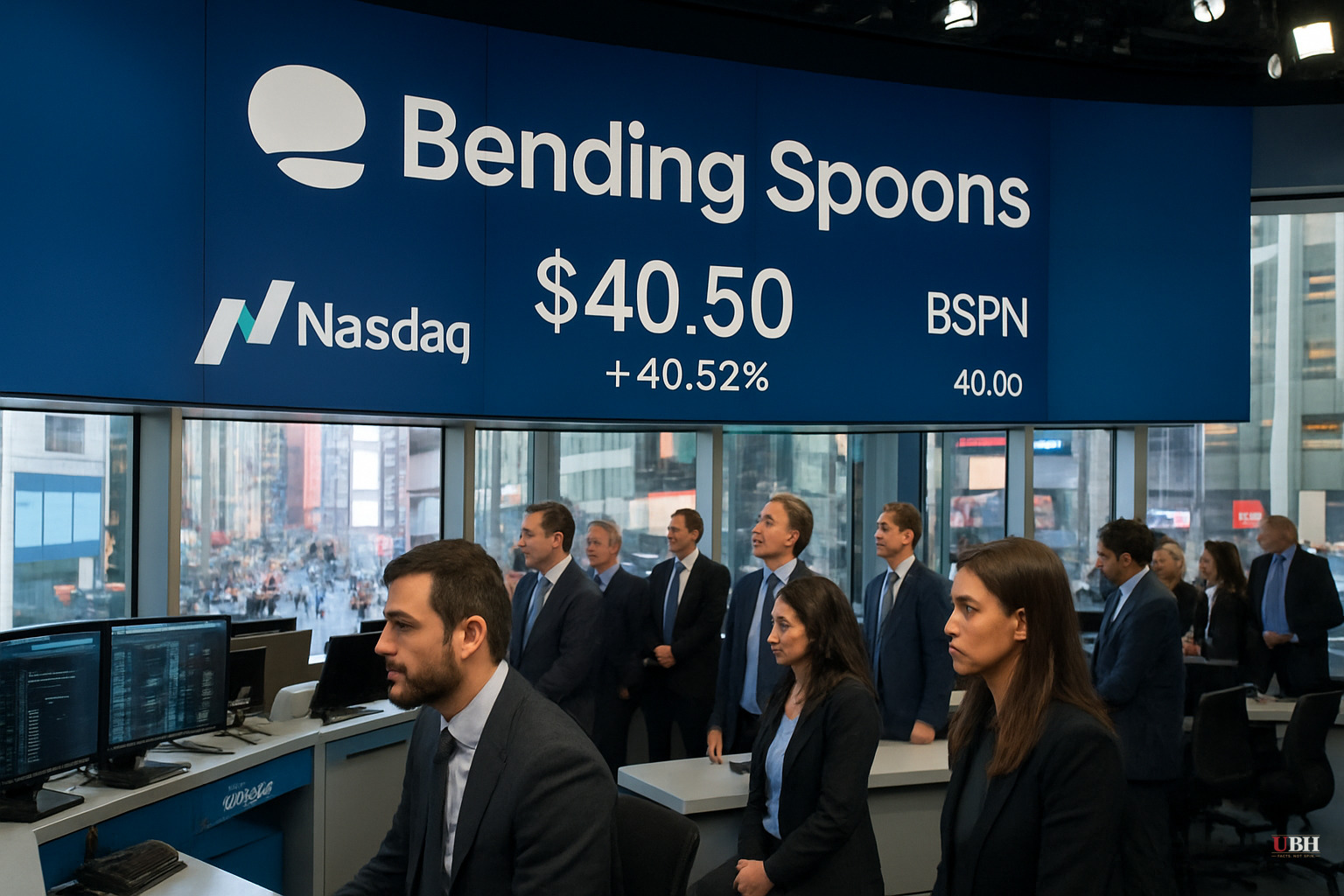
Bending Spoons listed on the Nasdaq under the ticker BSP, and its first-day close of $40.50 — a 39.7% gain over the $29 IPO price — confirmed investor appetite for the company's unusual strategy.
The shares opened at $31 before climbing through the session, according to Morningstar. At the closing price, the company's market capitalization reached $25.7 billion. Its last private valuation stood at $11 billion.
What Bending Spoons Actually Does
The company, founded in Copenhagen in 2013 and now headquartered in Milan, buys software brands that still have users but have lost momentum. Its current portfolio includes AOL, Vimeo, Evernote, WeTransfer, Eventbrite, Meetup, Brightcove, StreamYard, Remini, Komoot, Harvest, and GPS pet tracker Tractive, according to Wikipedia and Morningstar.
The five co-founders are Luca Ferrari, Francesco Patarnello, Matteo Danieli, Luca Querella, and Tomasz Greber. Danieli, the company's chief product officer, told TechCrunch that Bending Spoons' goal is to function as "an operator that takes beloved brands and makes them much better."
Sriram Krishnan, of VC firm Kearny Jackson — which invested in Bending Spoons in 2022 — described the approach to Morningstar as something traditional PE firms can't replicate. "They shrink the teams, but they also write code, they upend the back end systems, they upgrade features, they work on pricing," Krishnan said. "It takes a lot of expertise and know-how to be able to pull something like this off."
The company employs full-stack developers to rewrite acquired codebases using AI tools, Python, FastAPI, and TypeScript, according to Wikipedia.
The Financials Are Real, With a Catch
Bending Spoons reported $601 million in Q1 2026 revenue and $27.4 million in net income, per its SEC filing. That compares to a $112 million net loss on $259 million in revenue in Q1 2025, according to TechCrunch.
Full-year 2025 revenue hit $1.31 billion, up from $671.1 million in 2024 and $387.1 million in 2023, according to Morningstar. But the full-year 2025 net income figure was essentially flat at roughly negative $0.2 million, after $89 million in net income in 2024, according to Wikipedia. The acquisition spending required to fuel that revenue growth carried a real cost.
Monthly active users reached 500 million as of March 2026, up from 111 million in December 2023. Paying customers grew from 3 million to 9 million over the same period, per Morningstar.
Subscriptions drove 84% of revenue last year, according to TechCrunch.
The $683 Million Going to Existing Shareholders
Of the $1.68 billion raised, $683.6 million — nearly 41% of the total — went directly to existing shareholders who sold stock in the offering, not to the company itself, according to Morningstar. Investors backing the company long-term are getting a partial exit at the IPO price.
Prior to the listing, Baillie Gifford held 15% of the company, Italian investment firm Galileo Quattordici held 11.6%, and Cox Investment Holdings held 9.3%, per Morningstar. TechCrunch noted smaller stakes from Renaissance Partners, Durable Capital Partners, Fidelity, and T. Rowe Price.
The Legitimate Concerns
The loudest criticism of Bending Spoons centers on its workforce approach. The company's acquisition playbook routinely involves deep layoffs at target companies, and Evernote users in particular were vocal critics after Bending Spoons raised prices and cut staff after its 2023 acquisition, as TechCrunch noted. Danieli acknowledged Evernote as the toughest acquisition because "it was genuinely loved by users, so we had very strict judges."
Long-term subscribers at multiple properties have complained publicly about price increases. Danieli told TechCrunch that despite the complaints, customer retention has been "remarkably stable" — but that claim comes from the company itself, and it has not been independently verified.
The full-year 2025 net income near zero, despite $1.31 billion in revenue and strong Q1 2026 momentum, also warrants scrutiny. The company is running at scale and still absorbing the cost of aggressive acquisition activity.
What Makes This IPO Different
Bending Spoons is not a flip-and-sell operation. Unlike traditional private equity, the company has stated explicitly it does not intend to exit its acquisitions, according to TechCrunch. That makes its long-term story dependent on whether it can keep squeezing sustainable margin out of brands built in an earlier internet era and whether AI tools genuinely accelerate that process or just provide a convenient pitch.
Danieli told TechCrunch that AI has driven "an incredible acceleration in the pace at which we were able to ship new features," and the company's F-1 filing with the SEC includes a section titled "AI before it was cool," referencing its roots in machine learning before the term became a marketing buzzword.
The company's stated philosophy, quoted in its F-1, is direct: "Luck plays a big role in finding product-market fit, and luck is irrelevant when pursuing operational excellence."
The unresolved question for public investors is whether Bending Spoons can maintain Q1 2026's $27 million profit margin as it continues acquiring and integrating new brands, or whether each new deal resets the earnings clock back toward zero, as last year's full-year figures suggest.
Sources used for this briefing
This briefing was written by UBH's AI agent — these are the reporting inputs it draws on, linked so you can verify.


