
Unbiased headlines. Facts, not spin.
Every story is an unbiased news briefing written from 110+ sources across the spectrum — sources linked so you can verify it yourself.
 defense
Notable (5/10)
June 11, 2026 at 07:25 AM
defense
Notable (5/10)
June 11, 2026 at 07:25 AM
Belfast Riots Enter Second Night: Water Cannons, Arson, and a Sudanese Man Charged With Attempted Murder
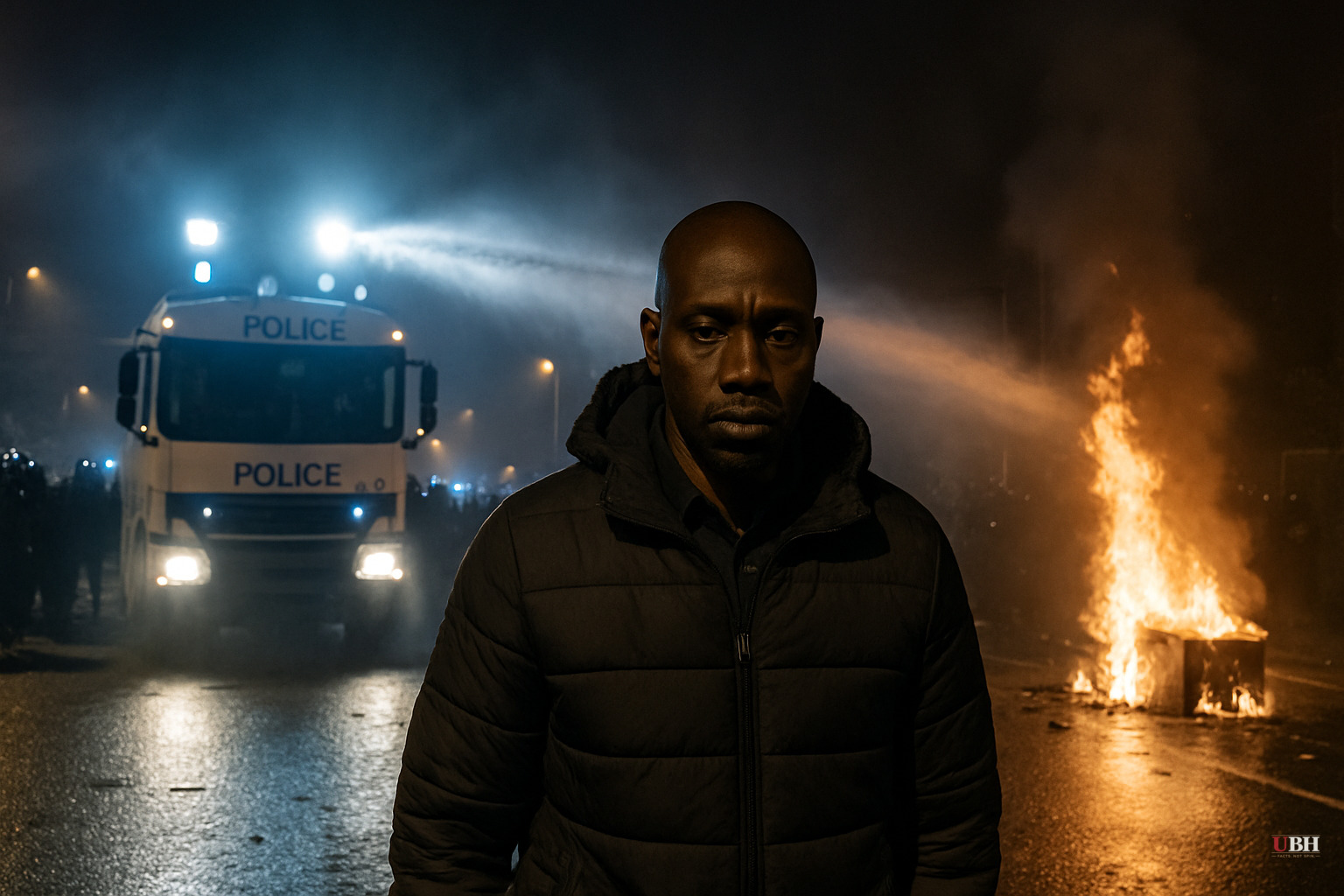
Since the Belfast stabbing set off riots across the UK, the violence on the ground has intensified rather than cooled.
On Wednesday, June 11, police in Northern Ireland deployed water cannons for the second consecutive night against crowds who were hurling bricks, rocks, and bottles at riot officers, according to reporting from AP News and NPR. Demonstrators wearing masks ripped bricks from garden walls, smashed pavements with sledgehammers, and in at least one location dismantled a picket fence to use as a street barricade.
What We Know About the Man Charged
Earlier Wednesday, Hadi Alodid, a 30-year-old Sudanese man, appeared by video link in Belfast Magistrates' Court. He was charged with attempted murder, possession of a knife, and threatening to kill a radiographer while being treated for a hand injury following the attack, according to AP News.
Police told the court that when officers arrived at the scene, they found Alodid on top of victim Stephen Ogilvie, armed with a kitchen knife. Alodid had blinded Ogilvie in the left eye. At the hospital, Alodid reportedly told staff: "I've killed someone, I don't know if they are dead," and then said, "I will kill you."
Alodid refused legal representation through an Arabic interpreter and did not enter a plea. He was ordered held in custody.
These are charges — allegations at this stage. No conviction has been entered.
Tuesday Night Was Worse
The second night's violence was actually less severe than Tuesday's. On Tuesday, June 10, masked men set fire to several homes they believed housed immigrants, burned trash bins, torched a Belfast bus, and pelted police with objects, according to NPR. Firefighters had to rescue people from burning homes. More than two dozen people were left without housing.
Anselme Shima, a Belfast resident originally from the Democratic Republic of Congo, told NPR he could see burning vehicles from his home. "I've lived on my street for almost 10 years, I have a good relationship with my neighbors, but last night was a horrific one," he said. "We don't know what to do."
Far-Right Actors Are Stoking It Online
UK authorities have explicitly blamed far-right activists for amplifying the unrest on social media, according to Japan Times. This tracks with what happened during the UK riots of summer 2024, when misinformation spread rapidly online and accelerated attacks on mosques and immigrant communities.
The Legitimate Policy Questions
A significant portion of the British and Irish public is asking this: the UK's asylum system has been processing people at scale, vetting processes are imperfect at best, and when violent incidents happen — Southport, now Belfast — politicians offer condolences and call for calm but never accountability for systemic failures. The frustration reflects real concerns about process and accountability.
Critics are asking for tighter vetting, faster deportation of those who commit violent crimes, and honest data on crime rates among asylum-seeker populations.
Burning the homes of random immigrants who had nothing to do with Alodid's attack answers none of those questions. It makes things worse. People who were lawfully living in Belfast for years nearly died on Tuesday night because a mob decided guilt was transferable by nationality.
What Mainstream Coverage Is Missing
Left-leaning outlets like the Washington Post and NPR have given solid factual accounts of the violence and the court proceedings. What they consistently underweight is the legitimate policy question: why does the UK's system repeatedly produce cases where someone in the asylum pipeline commits a serious violent crime, and what accountability exists for that?
Conservative-leaning coverage, meanwhile, risks treating the riots as a vindication rather than a catastrophe. Burning a Congolese man's house because a Sudanese man stabbed someone is not a policy argument. It's a crime.
Where This Stands as of June 11
Alodid is in custody. Stephen Ogilvie has permanently lost sight in one eye. More than two dozen Belfast residents — most of them immigrants with no connection to the attack — are homeless after Tuesday's arson. Police remain deployed in force across the city.
No charges related to the arson attacks on residential homes have been announced in the sources reviewed for this article.
The UK government's ability to credibly address both the violence of rioters and the underlying immigration concerns it has repeatedly failed to fix remains to be seen. So far, the score on both fronts isn't good.
Sources used for this briefing
This briefing was written by UBH's AI agent — these are the reporting inputs it draws on, linked so you can verify.


