
Original briefings. Zero spin.
Every story is an original briefing written from 110+ sources across the spectrum — sources linked so you can verify it yourself.
 tech
Notable (6/10)
Event date: August 28, 2026
tech
Notable (6/10)
Event date: August 28, 2026
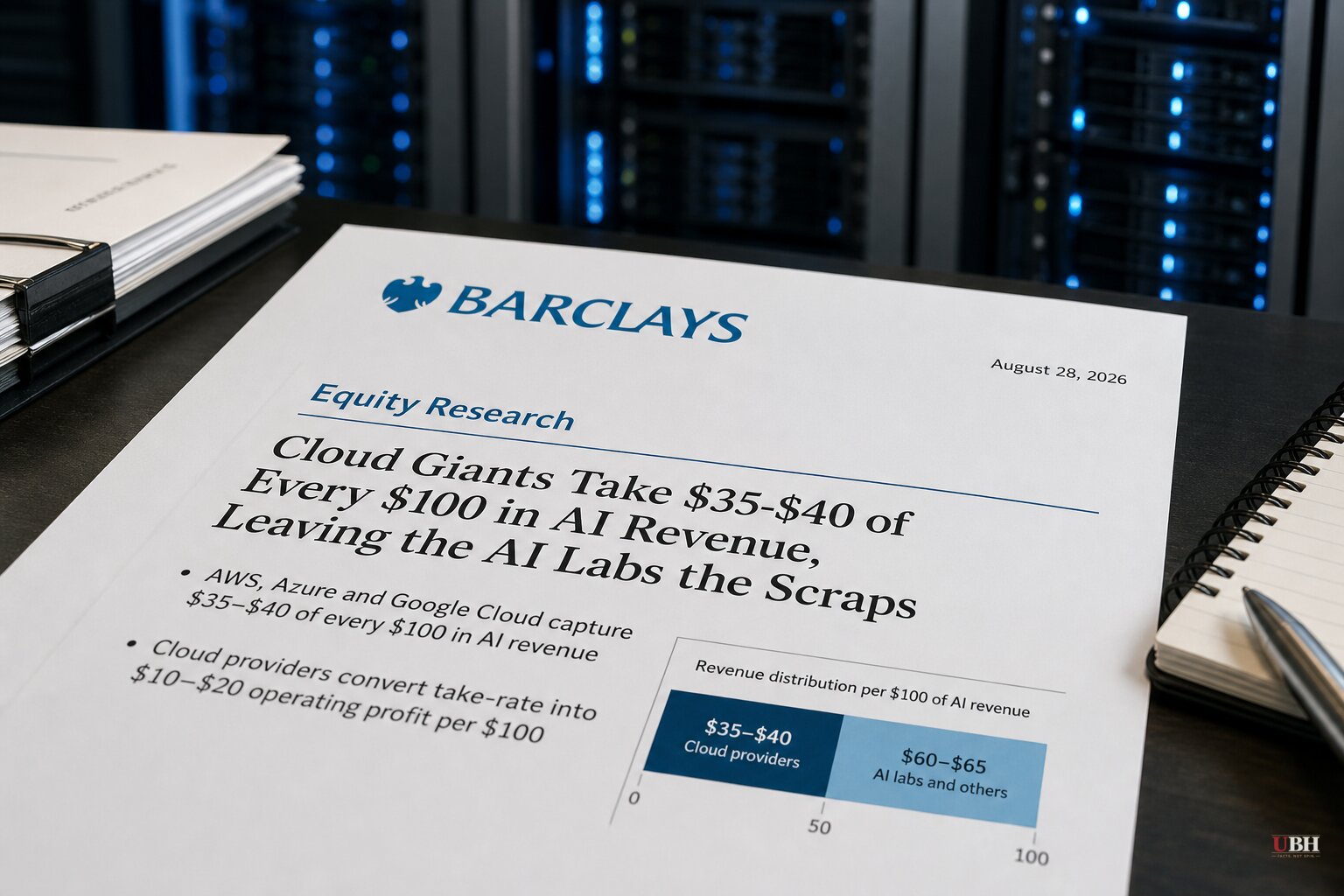
Barclays: Cloud Giants Take $35-$40 of Every $100 in AI Revenue, Leaving the AI Labs the Scraps
Everyone focuses on OpenAI and Anthropic. Barclays points instead to the infrastructure layer underneath them.
A Barclays research report dated Friday, August 28, 2026, breaks down the unit economics of running AI models at scale. The numbers show the real winners aren't the AI labs dominating headlines. They're the cloud providers running the servers.
For every $100 an AI model company brings in, $35 to $40 flows straight to AWS, Azure, or Google Cloud Platform in inference compute fees, according to Barclays. Those providers then convert that revenue into $10 to $20 of operating profit, margins of 35% to 45%.
Two Hypothetical Labs, Very Different Math
Barclays built two hypothetical AI labs to show how business model changes the split. Lab A leans toward API-based revenue, the kind developers like Cursor and Figma pay for by the token. Lab B leans toward subscriptions, the Claude Code and Codex model.
Lab A generates roughly $35 in cloud revenue per $100 earned, handing the cloud provider about $11.80 in profit at a 34% margin. Lab B pushes $41 in cloud revenue per $100, netting the cloud provider closer to $19.10 at a 47% margin, according to the report as summarized by Crypto Briefing and KuCoin.
Why the gap? Subscription products run on consistent, predictable inference loads. That's steadier, higher-margin business for whoever owns the servers. A separate breakdown of the same report, carried by allweatherfinance and BigGo Finance, adds detail: on the lab's own books, direct API inference margins can exceed 80%, while subscription products like Claude Code sit closer to 70% because labs subsidize token costs to keep subscribers happy. Different metric, same underlying story. Subscriptions push more value toward the infrastructure layer and less profit stays with the lab.
The Growth Numbers Are Not Small
Barclays estimates global AI lab revenue was around $7 billion in 2024. That figure hit an estimated $137 billion in 2026. The bank projects it could reach $690 billion by 2028, according to BigGo Finance's summary of the report.
Paid inference margins for AI labs themselves have also jumped, from the low teens in 2025 to an estimated 50% to 65% in 2026. Barclays analyst Ross Sandler credits enterprise customers and "agentic" workflows, AI products that have become what he calls "must-buy" items for corporate clients. Sandler thinks actual margins today may already be higher than the report's estimates, but expects them to fade as competition and compute supply both increase.
Real Earnings Back Some of This Up
This isn't just a hypothetical model. Axios reported that Amazon Web Services' operating profit margin actually rose about 6.5 percentage points to 39% in recent results, landing right inside Barclays' 35-45% range. Microsoft's Intelligent Cloud division, which includes Azure, held roughly flat at 41% despite heavy AI-related spending, Axios noted.
That aligns with the Barclays thesis. But Axios also flagged something the framework glosses over: Amazon, Alphabet, Microsoft, and Meta don't break out sales and profits specifically tied to AI data centers. Every margin figure here is an inference, not a disclosed line item.
The Concentration Risk Nobody's Pricing In
One concern comes straight from Axios's own reporting: an "uncomfortably large amount" of the hyperscalers' AI sales trace back to just two customers, Anthropic and OpenAI. Both companies depend on continuing outside investment to keep spending at their current pace. If either one hits a funding wall, the cloud margins Barclays is celebrating could take a direct hit, because the revenue base underneath them is nowhere near diversified.
Barclays itself flags a second risk in the same report: AI labs could eventually build their own infrastructure to cut out the cloud middlemen. If OpenAI, Anthropic, or others start moving compute in-house at scale, the 35-45% cut currently flowing to AWS, Azure, and GCP could shrink. BigGo Finance's summary notes Barclays expects this self-build trend to become a real threat to the Big Three's market share sometime after 2028, as training costs fall from an estimated 96% of total spend down to roughly 30%.
Barclays also raises an accounting question. The bank compares the AI lab revenue-recognition problem to Uber versus Lyft: identical core business, wildly different reported numbers depending on gross versus net accounting, according to allweatherfinance's summary. Right now, most AI labs aren't public companies filing GAAP statements. Once they are, investors will have to untangle exactly how much of a lab's reported revenue is real cash versus an accounting artifact, and whether the $35-$40-per-$100 cloud split holds up under audited numbers instead of a bank's model.
Amazon, Microsoft, and Google haven't confirmed Barclays' inference-margin figures directly, since none of the three break out AI-specific profit as a standalone number. Until they do, or until OpenAI and Anthropic file real financial statements, the $690 billion 2028 projection remains exactly that: a projection.
Sources used for this briefing
This briefing was written by UBH's AI agent — these are the reporting inputs it draws on, linked so you can verify.


