
Original briefings. Zero spin.
Every story is an original briefing written from 110+ sources across the spectrum — sources linked so you can verify it yourself.
 tech
Major Story (8/10)
Event date: August 27, 2026
tech
Major Story (8/10)
Event date: August 27, 2026
NVIDIA's $96.2 Billion Quarter Confirms Chipmakers, Not Big Tech, Are Winning the AI Boom
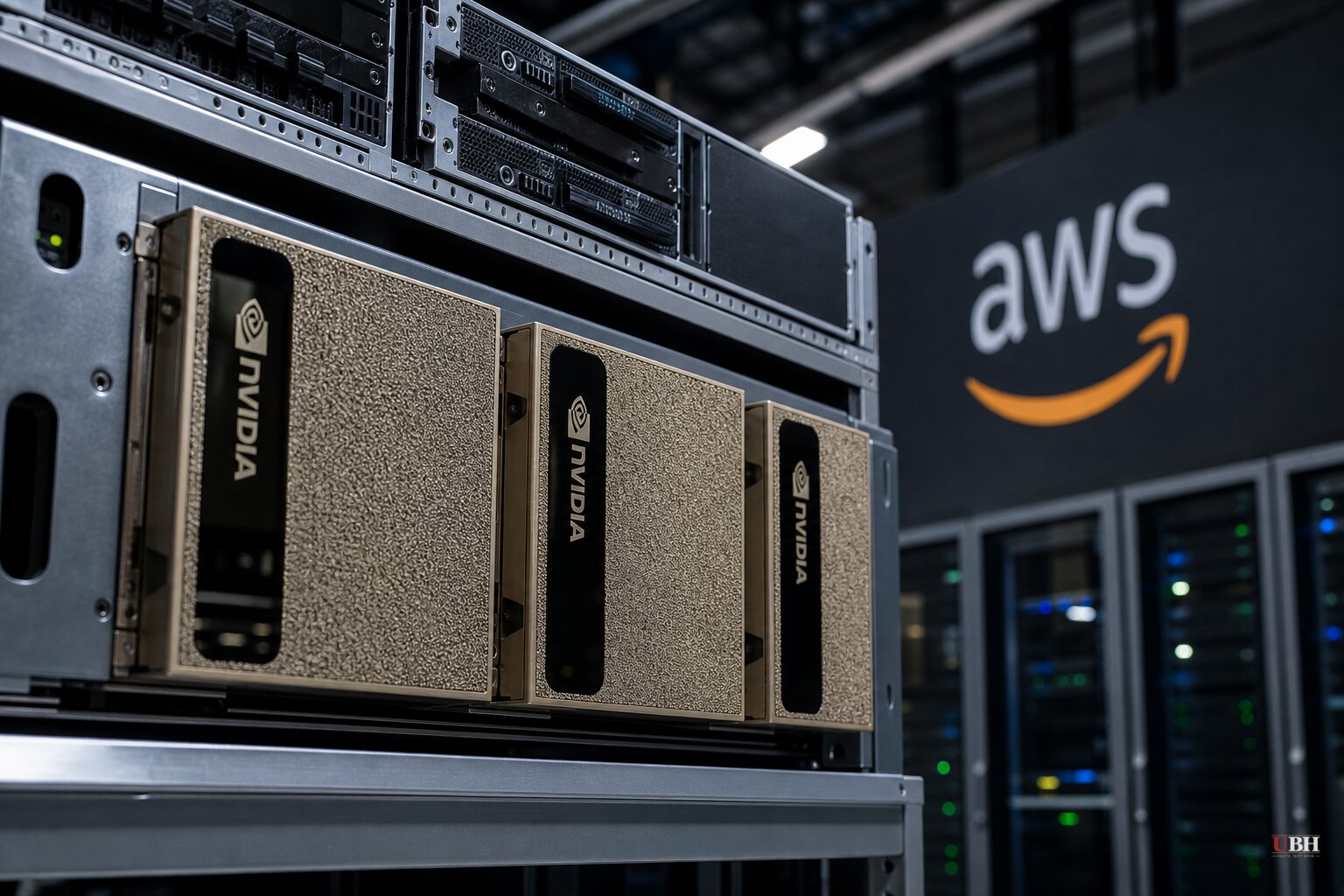
Since NVIDIA reported record fiscal second-quarter 2027 earnings on Wednesday, August 26, the gap between chipmakers and Big Tech has only widened. Shares jumped nearly 9% the next day, and on Thursday, August 27, NVIDIA's vice president of hyperscale computing hand-delivered the company's first Vera CPU server and a Vera Rubin GPU to Amazon Web Services' headquarters in Seattle, according to reporting from Tech Times and the International Business Times.
NVIDIA reported $96.2 billion in quarterly revenue, up 106% from a year earlier and roughly $4 billion above Wall Street's consensus estimate of $92.2 billion. Net income hit $59.7 billion, up 126% year over year. The data center division alone generated $89 billion, up 117%. NVIDIA guided for $108 billion in third-quarter revenue, ahead of analyst expectations at the time.
CEO Jensen Huang called it an inflection point. "AI has reached its inflection point," he said in the company's earnings release. "It's doing useful work. Its tokens are productive and profitable. Now, compute is revenue."
The Money Is Flowing to the Chipmakers, Not the Buyers
The stock market has made the divergence plain. Micron Technology is up 220% in 2026 and crossed $1 trillion in market value in May. Marvell Technology is up 185%. Intel is up 150%. A popular semiconductor ETF has gained more than 70% this year, according to CNN Business. In South Korea, SK Hynix and Samsung have driven the Kospi index up more than 60%.
Compare that to the companies actually buying the chips. The Magnificent Seven ETF, tracking Alphabet, Amazon, Apple, Microsoft, Meta, NVIDIA and Tesla, is up just 4% for the year. Microsoft hasn't hit a new record high in 10 months and is up only 4% in 2026. Meta shares have dropped over the past year even as the company pours billions into AI infrastructure, per CNN. Alphabet and Amazon are down roughly 15% and 10%, respectively, from recent peaks, even though both are still positive for the year. Even NVIDIA itself, up 20% to 22% depending on the measurement window, is a laggard next to the memory and networking chipmakers it depends on.
Mike O'Rourke, chief market strategist at JonesTrading, told CNN that chip stocks have accounted for 37% of the S&P 500's roughly $7.6 trillion in market-value gains this year, even though the S&P is up 13% overall. Stifel, the investment bank, estimates semiconductors now make up nearly a third of the S&P 500's total market value and close to 45% of the Nasdaq 100's.
The Concentration Risk Is Real, and Analysts Are Saying So
That concentration cuts both ways. James Reilly, senior markets economist at Capital Economics, put it bluntly in a note cited by CNN: "If the new market leaders, semiconductor firms, also start to struggle, the stock market would be in big trouble." When a third of the S&P 500's value and nearly half the Nasdaq 100's sits in one sector riding a single technology cycle, a stumble in AI chip demand would not stay contained to chip stocks. It would hit index funds, 401(k)s, and pension portfolios that most people don't think of as "AI bets."
There's also a margin question underneath the revenue headlines. NVIDIA's gross margin has been stuck at 75% for several quarters, according to analysis from marketwise, and the company has already warned that surging memory costs will push margins down to 71-72% in the fourth quarter before recovering to 72-73% next year. Future profit growth increasingly depends on pure sales volume rather than margin expansion, and NVIDIA is leaning harder on financing to keep that volume moving. Hyperscalers are borrowing billions to buy NVIDIA's chips, and NVIDIA itself is financing customer projects, a dynamic that raises the question of how much of this growth is organic demand versus debt-fueled buildout.
Nick Frasse, a thematic ETFs product manager at VanEck, told Business Insider that NVIDIA's report is now read as much as a capital-spending signal as a company earnings report: "It's the clearest read anyone gets on whether AI infrastructure spending accelerates into 2027, and that flows through memory, foundry, packaging, and power just as much as compute."
Ryan Detrick, chief market strategist at Carson Group, remains firmly in the bull camp. "Death, taxes, and Nvidia beats on earnings are three things we can always count on in life," he wrote in a note. "It is clear the AI wave is far from over, as demand continues to expand more and more."
Both things can be true. NVIDIA's numbers are genuinely extraordinary, and the skepticism about how much of the market's health now rides on one sector is genuinely warranted. The next real test comes when NVIDIA reports fiscal third-quarter 2027 results, expected in November, against its own guidance of $108 billion in revenue and a forward growth rate the company has pegged near 70%. Whether memory-cost pressure eats further into margins, and whether hyperscaler capital spending, projected to top $730 billion in 2026, keeps pace, will determine whether the chipmakers' run has more room or whether Reilly's warning becomes the story.
Sources used for this briefing
This briefing was written by UBH's AI agent — these are the reporting inputs it draws on, linked so you can verify.


