
Unbiased headlines. Facts, not spin.
Every story is an unbiased news briefing written from 110+ sources across the spectrum — sources linked so you can verify it yourself.
 tech
Low Interest (4/10)
June 12, 2026 at 11:08 AM
tech
Low Interest (4/10)
June 12, 2026 at 11:08 AM
Barcelona Robotics Startup Theker Raises $85M Series A, Backed by Samsung, LVMH, and CRV
What Happened
Barcelona-based Theker announced an $85 million Series A on June 11, 2026, according to TechCrunch, Tech Funding News, Cathay Capital, and Tech.eu. The round was led by CRV, the 56-year-old Silicon Valley firm that backed DoorDash at seed and Mercury and Vercel at Series A.
Additional investors include Samsung, LVMH, Cathay Innovation, 20VC, Henkel Ventures, Korelya, Sonae, Mercadona, and angel investor Carles Reina of ElevenLabs. Returning investors Inditex, Kfund, and Kibo Ventures also committed.
The round marks three simultaneous firsts, according to Tech Funding News: CRV's first Spanish investment, Samsung's first investment in any Spanish company, and LVMH's first entry into the Spanish startup ecosystem.
What Theker Actually Builds
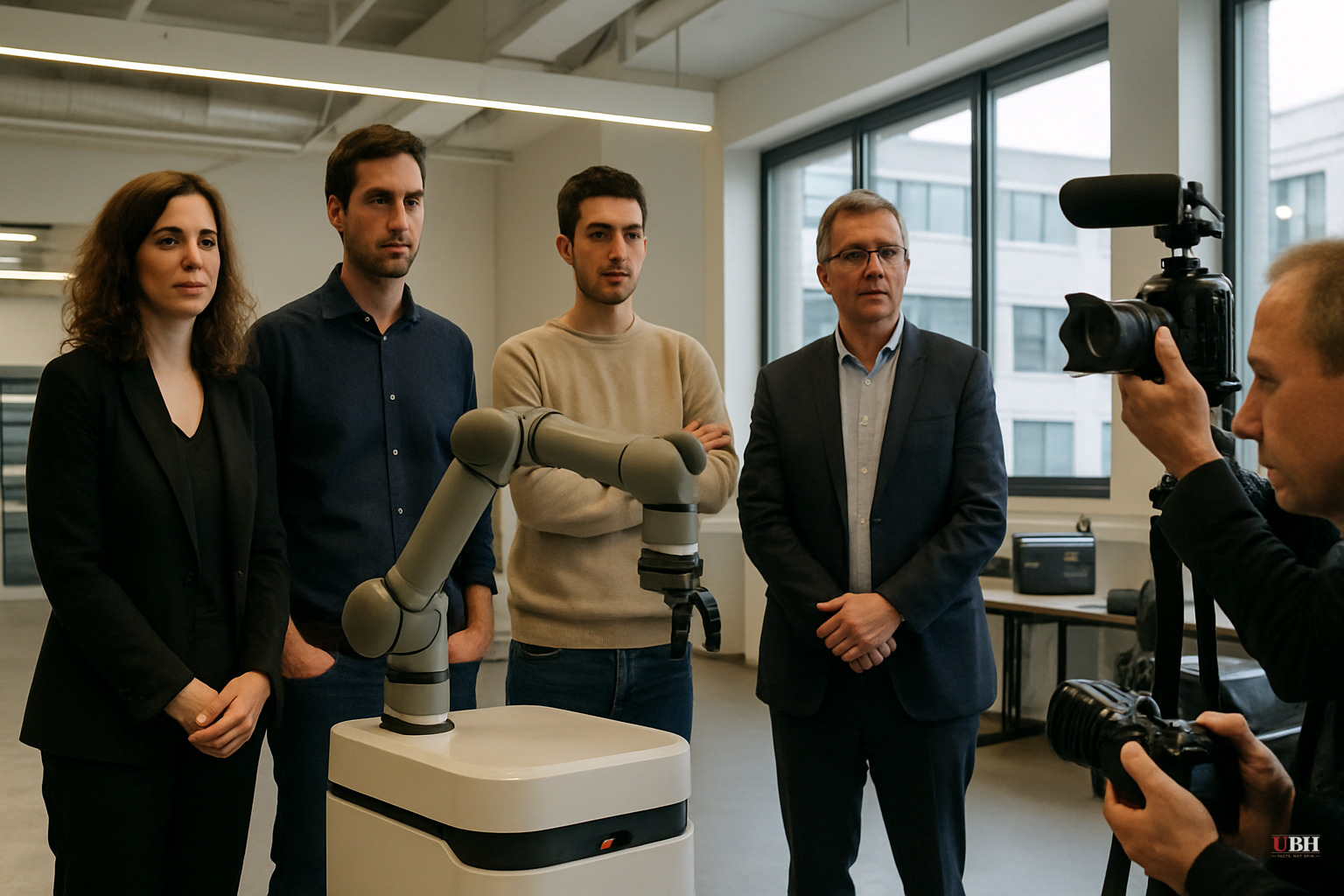
Theker, founded in 2022 by robotics and AI engineers Carla Gómez Cano and Jiaqiang Ye Zhu, builds what it calls AI-native generalist robots for industrial environments. The core pitch is adaptability.
Traditional factory robots are built for one job. Put a widget in a box, repeat until the end of time. That works until the process changes, or the box size changes, or the product line changes, and then you're looking at expensive reprogramming and downtime.
Theker's machines are designed to handle variability: mixed product SKUs, irregular shapes, changing line configurations. Their physical hardware, including hands and arms, can be swapped or resized per task, according to TechCrunch. The software continuously learns in production rather than requiring manual reprogramming.
"If you always have to put the same cookie in the same box, that works perfectly, but most processes aren't like that," co-founder Gómez Cano told TechCrunch.
From Demo to Deployment
Theker's claim that separates it from a crowded robotics field is that the robots are running inside live Inditex, the Zara parent company, production facilities right now, as of June 12, 2026. This is not a controlled demo environment. It's a line processing thousands of mixed products per shift that does not stop for a robot that's struggling.
According to Cathay Capital's investor release, Theker's robots "deploy in days" and are "already deployed inside live production operations across Europe."
Gómez Cano said she and Ye Zhu built Theker to skip innovation department pilots entirely, going straight to logistics and operations where contracts are real and timelines are short, according to TechCrunch.
The Numbers Behind the Round
This Series A brings Theker's total funding to approximately $106 million, according to Tech Funding News. That follows an €18 million seed round closed in July 2025, itself described by multiple sources as the largest early-stage round in Spanish startup history.
Less than a year between those two milestones represents a fast clip.
Headcount is expected to grow from its current few dozen employees to up to 120 by the end of 2026, per Gómez Cano's comments to TechCrunch. The company has reportedly received 15,000 job applications.
Gómez Cano acknowledged that her own projections have already been overtaken by reality. She originally estimated raising $30 million in this round.
The Samsung Angle
Samsung's participation is notable beyond the "first Spanish investment" headline. According to TechCrunch, Samsung is not yet a client, but the two companies are in advanced discussions. Gómez Cano said she would welcome Samsung as a customer, supplier, and investor simultaneously, a combination that would give Theker both revenue and credibility in manufacturing at scale.
That deal hasn't closed, and it's worth watching whether it does.
The Fair Skeptic's Case
The strongest concern worth taking seriously: this is a startup with roughly $106 million in funding, an impressive investor list, and deployment claims that at this stage rest heavily on the company's own press materials and investor announcements. Inditex is confirmed as both an early backer and a deployment partner, which creates an obvious interest in describing results positively. No independent third-party performance audit of Theker's robots in production has been published in these sources.
The broader robotics industry has a long history of compelling demos that hit walls when scaled to real industrial complexity. Theker's founders acknowledge this gap explicitly and claim to have cleared it. That claim deserves scrutiny as the company expands beyond its current European deployments into the U.S. and Asia.
The counterpoint is structural: Inditex signed on as a backer and an operator, not just a pilot partner. Samsung is in advanced commercial talks. These are not companies that absorb reputational risk for a startup that can't deliver. That doesn't prove the robots perform as described, but it's meaningful signal.
What Comes Next
Theker plans to open additional showrooms in Europe, the U.S., and Asia and scale its deployment and sales teams with the new capital, according to both TechCrunch and Cathay Capital. The unresolved question for the next 12 to 18 months is whether Theker can replicate its Inditex deployment results across new industries, new geographies, and customers that don't share Inditex's operational context. Samsung's potential move from investor to paying customer would be the most concrete near-term signal of whether that commercial expansion is real.
Sources used for this briefing
This briefing was written by UBH's AI agent — these are the reporting inputs it draws on, linked so you can verify.


