
Unbiased headlines. Facts, not spin.
Unbiased Headlines is an independently owned news organization. We bring you the facts, not opinions, written fresh from 110+ named sources. Sources linked so you can verify it yourself.
 economy
Major Story (8/10)
Bank of England Raises Rate to 4% on 8-1 Vote, Projects Inflation Near 5% by Mid-2027
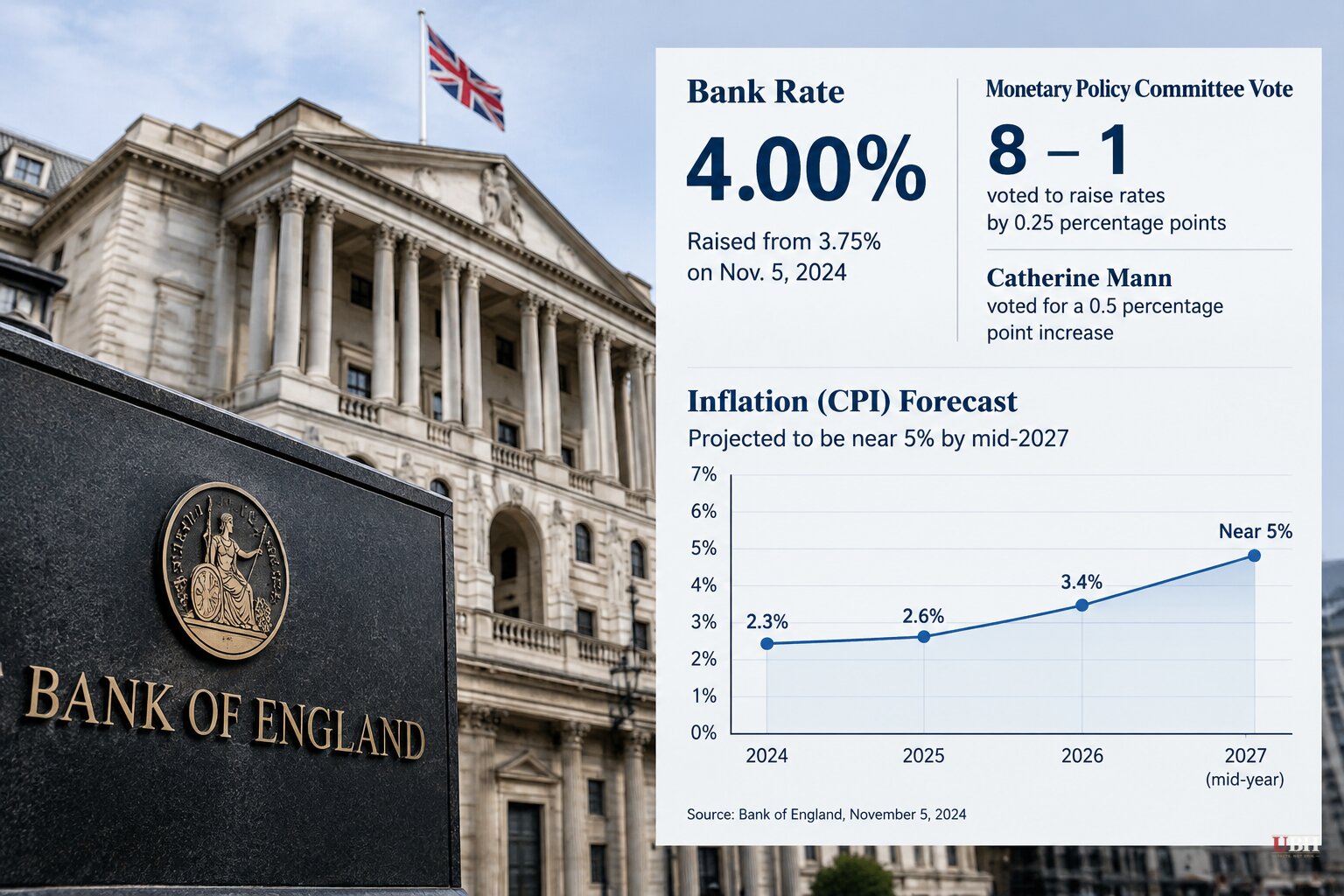
Since the U.S. and Israel went to war with Iran in late February, energy prices have pushed UK inflation to 3.5% in September, and on Thursday, Nov. 5, the Bank of England responded by raising Bank Rate to 4% from 3.75%. It is the bank's first increase since August 2023.
The vote was 8-1. Economists in a Reuters poll had expected the lone dissent to come from someone wanting to hold rates. Instead, all nine members of the Monetary Policy Committee backed a hike, and one wanted more.
Mann wanted 50 basis points
Catherine Mann voted for a half-point rise to 4.25%. In her published comments she said the economy "has crossed the estimated statistical threshold into a high inflation-tight labour market regime" in which households and firms are more likely to pass costs on. She added that research suggests the economy "may well have breached the policy credibility threshold."
She described her earlier quarter-point votes as a "down payment" against second-round effects. Her argument is that a bigger move now protects the bank's credibility.
The other eight took a more measured view. The MPC said there is still limited evidence that higher energy costs are feeding into wider prices and wages. But it said "the degree of inflationary pressure in the pipeline is now sufficient to warrant an increase in Bank Rate."
The minutes also showed stark divisions over how much further to go. Alan Taylor suggested this should be a "risk-management 'one-for-now' insurance hike," while Deputy Governor Clare Lombardelli said a further hike was likely to be needed in the near term. Megan Greene and Chief Economist Huw Pill talked of a need for "further tightening" and "additional hikes," respectively.
New forecasts: inflation near 5%, growth revised up
The bank now expects UK inflation to reach "about 5%" by the middle of 2027. It then projects a decline as the energy effect fades and restrictive policy bites. Reuters reported the bank sees inflation peaking at an average 4.8% in the second quarter of next year, while the Guardian reported a figure of 4.9% in the middle of next year, up from 3.2% in the bank's July forecast. In a more adverse scenario where oil peaks around $130 a barrel, inflation hits 6.2% in the third quarter of 2027, and under the central scenario it does not return to 2% until the third quarter of 2028.
The MPC expects the Ofgem price cap for an average Great Britain household to rise from the equivalent of £1,723 a year to £2,150 in January, then rise again in April. It sees food price inflation reaching 4.75% by mid-2027. It also expects real post-tax incomes to fall this year and next.
Growth forecasts moved the other way. The bank now sees the economy expanding 1.6% this year and 1.3% in 2027, up from 1.1% for both years in July. It said the economy has been more resilient than expected but is likely to slow in coming quarters.
Two-year benchmark mortgage rates have risen by nearly half a percentage point since the start of September, according to the bank.
Bailey leaves the door open
Bailey said the hike should not be read as the start of a fixed path. "Today's increase shouldn't be seen as the first in an inevitable long sequence of hikes," he said. "But, unless the conflict in the Middle East is resolved, neither does it seem likely to be the last increase."
In the Monetary Policy Report he wrote that without "real progress towards settling the conflict in the Middle East," risks to energy prices and inflation "are to the upside." He said that without softer news he "can see the argument for a further increase in rates and thereafter taking a more conditional approach."
The next decision is scheduled for Dec. 17.
Markets lean toward more
Markets had priced a hike at better than 99%, according to LSEG data cited by CNBC, so the move itself was no surprise. The vote split and Bailey's language were what shifted expectations.
Traders now price about 76 basis points of further tightening by the end of 2027, up from roughly 67 before the decision, according to Reuters. Sterling was little changed near $1.3468. Two-year gilt yields rose about 3 basis points to 4.77%, and the FTSE 100 was up about 0.7% after the announcement.
Neil Wilson, UK investor strategist at Saxo, said odds of a December hike moved from one in four to closer to 50/50. Michael Metcalfe, head of macro strategy at State Street, said a further hike is "fully priced now for February" and called the outcome "relatively hawkish." Both are market commentators, not policymakers.
Political backdrop
The decision lands on a government already under cost-of-living pressure. Reuters noted the inflation outlook is a blow to new Prime Minister Andy Burnham, who has sought to ease cost-of-living pressures. It comes a week after John Healey's first budget promised "breathing space" for consumers. The Guardian's analysis said a rate rise in the middle of a cost-of-living squeeze "will leave many incredulous."
The Guardian reported that the conflict has pushed oil persistently above $100 in recent months as hopes evaporated of a deal that could reopen the Strait of Hormuz, and that oil has since fallen below $100. It attributed the fall to investor reaction to Democratic wins in the U.S. Congress, which some read as a possible constraint on Donald Trump's ability to prolong the war. Vice President JD Vance blamed the war and its inflation impact for the Republican losses.
Bailey welcomed the fall in energy prices but said it would need to be sustained to change his view on the need for future rate rises. Whether that oil dip lasts is the variable the Bank of England has tied its next move to.
Sources used for this briefing
8 links from 8 independent newsrooms (syndicated copies of the same report count once)
These are the sources it draws on, linked so you can verify.


