
Unbiased headlines. Facts, not spin.
Unbiased Headlines is an independently owned news organization. We bring you the facts, not opinions, written fresh from 110+ named sources. Sources linked so you can verify it yourself.
 economy
Major Story (7/10)
Florida Voters Approve $250,000 Homestead Exemption as Wyoming and Oklahoma Reject Property Tax Cuts
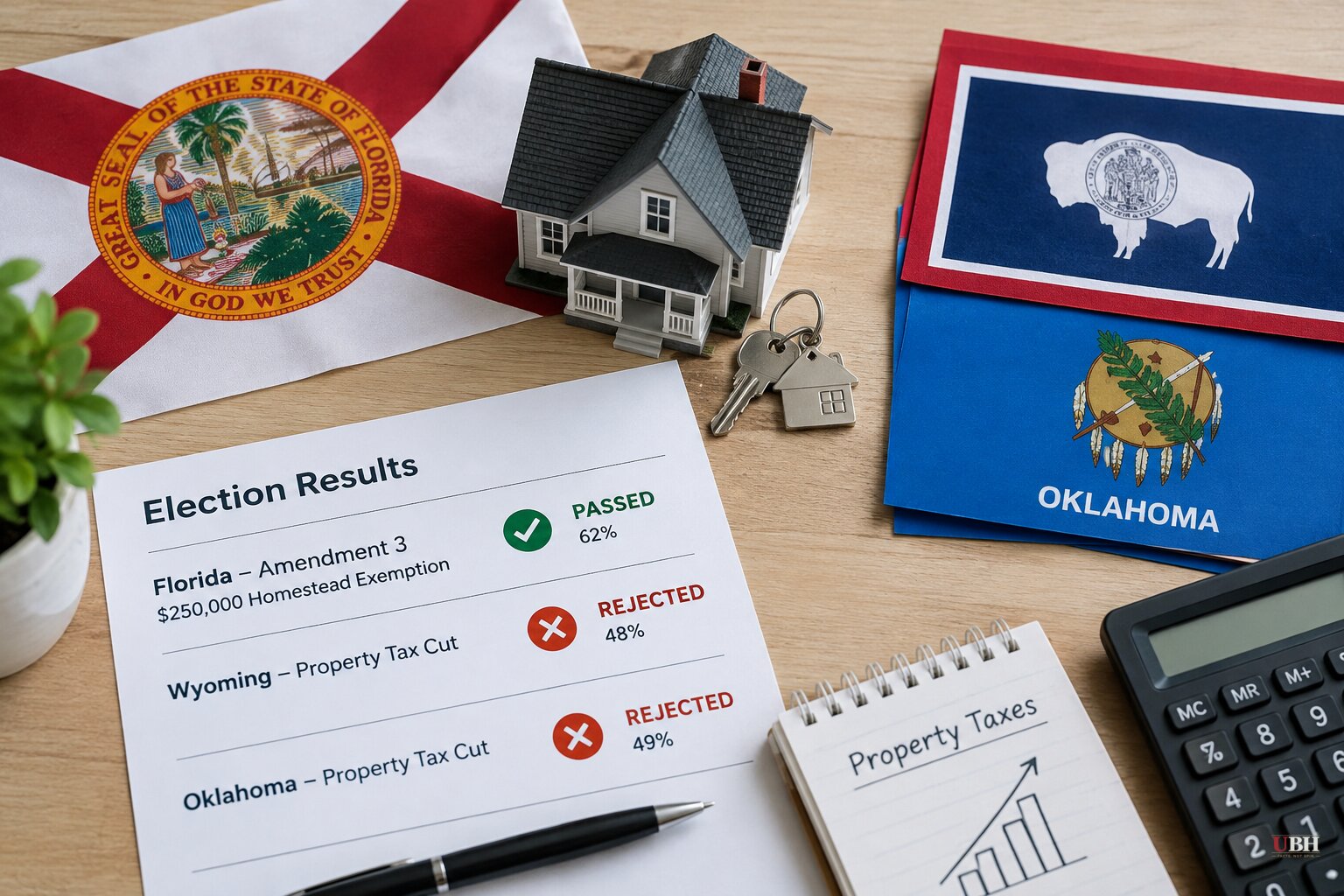
Seven states put property taxes on the ballot Tuesday, Nov. 3. Five approved some form of relief. Two did not.
The biggest result came from Florida. In Wyoming, a state generally considered the most conservative in the country and one that usually prefers lower taxes, a 50% cut lost.
Florida's $12 billion exemption
Florida's Amendment 3 passed with 62% of the vote. It needed 60%.
By 2028, the first $250,000 of a primary home's value will be exempt from nonschool property taxes. That exemption will rise with inflation afterward. The amendment also lowers the annual cap on assessed-value growth for nonprimary residences from 10% to 5%.
The Florida Legislature's Revenue Estimating Conference, a nonpartisan panel of state economists, estimates the full exemption will cut property tax revenue by $12 billion a year statewide once it is fully implemented in 2028. Measured against Reason Foundation's city and county revenue data, that equals about 10% of what Florida's counties collected in 2024 and 6% of what its cities collected. A separate analysis by the Florida legislature put the local revenue reduction at nearly $5 billion in 2027 and $8.8 billion in 2028, when the reductions are fully phased in.
School taxes are not covered. Yahoo Finance reported the change will effectively eliminate nonschool homestead property taxes entirely in some parts of the state.
"What happened last night was a really big deal," said Danielle Blake, chief of residential and advocacy at Miami Realtors, which backed the amendment. "That is the voters speaking loud and clear that they want relief."
The money for the lost revenue has to come from somewhere, and local governments now decide where. Jared Walczak of the Tax Foundation lists three options: cut spending, raise rates on the property that remains in the tax base, or raise other taxes and fees. He wrote that the amendment "leaves local governments in the lurch." He also argued that Florida's earlier relief effort, the Save Our Homes Amendment, produced high effective rates on newer homeowners, and that voters may have adopted "yet another temporary patch that will only create more problems down the road."
Christopher Berry, a professor at the University of Chicago's Harris School of Public Policy, offered a different angle. Raising rates on higher-value property is "kind of progressive," he said, because it would benefit people who own lower-valued properties.
Wyoming votes down a 50% cut
Wyoming's Initiative 1 would have exempted half of the assessed value of owner-occupied homes from property taxes. The state already exempts 25% of a primary residence's value, up to $1 million.
Homes.com reported that 55% of Wyoming voters turned down the proposed exemption on half the assessed value of a primary residence. A campaign opposing the measure spent $2.1 million, according to the Casper Star-Tribune.
Critics, including the state's governor, argued the cuts would decimate local services, according to Yahoo Finance. The potential revenue hit was estimated at $92.6 million in 2028. Hank Hoversland, executive director of the Wyoming Taxpayers Association, tied the result to an earlier property tax cut. "We've seen closures of libraries on certain days, slower service in emergency services like fire or inability to maintain their equipment," he said. He added that he does not "envy Florida in what they're going to be experiencing."
The Wyoming Taxpayers Association said on its website that the exemption would hurt rural counties' ability to pay for essentials such as police, fire and emergency services.
In Oklahoma, 54% of voters rejected State Question 847, which would have reduced the amount a home's assessed value can increase annually from 3% to 1.75%. Lowering the caps was estimated to cost local tax jurisdictions $45.8 million in the first year.
Narrower measures elsewhere
North Carolina: About 60% of voters statewide approved a constitutional amendment requiring the General Assembly to limit how much local governments can raise their total property tax collections. The amendment sets no number. Legislators are likely to take up the question in the next session in early 2027.
Ken Johnson, a finance professor at the University of Mississippi, called it "definitely a power grab from the state level," and noted that property taxes have historically been a big way for cities and counties to raise funding. Walczak, by contrast, called the levy-limit approach "much more responsible" than eviscerating the property tax.
Tennessee: Amendment 2 passed with 67%. It bars the state government from levying property taxes. Tennessee repealed its state-level property tax in 1949, so the vote writes an existing reality into the constitution. Local governments can still tax property.
Louisiana: Voters approved four narrow reforms, including added exemptions for seniors and for surviving spouses of disabled veterans, and wider eligibility for assessment freezes. They rejected two others. One would have allowed tax exemptions for rehabilitated properties. The other, defeated by 58%, would have let local governments temporarily lower rates and later restore them without voter approval.
Georgia: Amendment 1 passed, expanding preferential property tax treatment for agricultural and timberland properties.
Voters in several places also backed spending. Charlotte approved a $125 million housing bond and Raleigh a $102 million bond, each with more than 60% support. Greensboro's $5 million bond passed by a narrow margin. Rhode Island voters approved $120 million for home construction and redevelopment with 61%, with at least $25 million going toward new homeownership units.
Why the revolt keeps spreading
Property tax bills have climbed as home prices and assessed values soared while incomes largely failed to keep up. "Property tax bills are rising far faster than inflation and even home valuations," said Nicole Fox, a policy analyst at the Tax Foundation. "People are noticing."
In Florida, the median homeowner paid $3,180 in property taxes in 2025, a more than 50% jump from $2,035 in 2019, according to Census Bureau data cited by Yahoo Finance. In Oklahoma, typical taxes rose 29% to $1,781 over the same period. In Wyoming, they jumped 47% to $1,987.
Bill Healey, 2026 president of the International Association of Assessing Officers, framed the tradeoff plainly: "If you eliminate [property taxes], the money has to come from somewhere else, or the service gets eliminated." Property taxes account for 70% or more of local revenues for municipalities across the country, according to Yahoo Finance.
Before the vote, M. Nolan Gray of the Metropolitan Abundance Project argued in a Washington Post opinion piece that voters should seriously consider the consequences of the last property tax revolt before going all-in on the latest one.
What comes next
The next test is in Florida. The exemption phases in by 2028, and local governments there must absorb the lost revenue. Whether they cut spending, raise rates on remaining taxable property, or lean on other fees will be decided in local budget fights over the next two years.
In North Carolina, legislators are likely to take up the actual levy limit that voters authorized without specifying, in the session beginning in early 2027.
Sources used for this briefing
7 links from 7 independent newsrooms (syndicated copies of the same report count once)
These are the sources it draws on, linked so you can verify.


