
Unbiased headlines. Facts, not spin.
Unbiased Headlines is an independently owned news organization. We bring you the facts, not opinions, written fresh from 110+ named sources. Sources linked so you can verify it yourself.
 finance
Major Story (8/10)
Event date: November 24, 2026 ·
Bank of England Puts Hyperscaler AI Exposure Above $4 Trillion and Cuts UK Bank Capital Requirements the Same Day
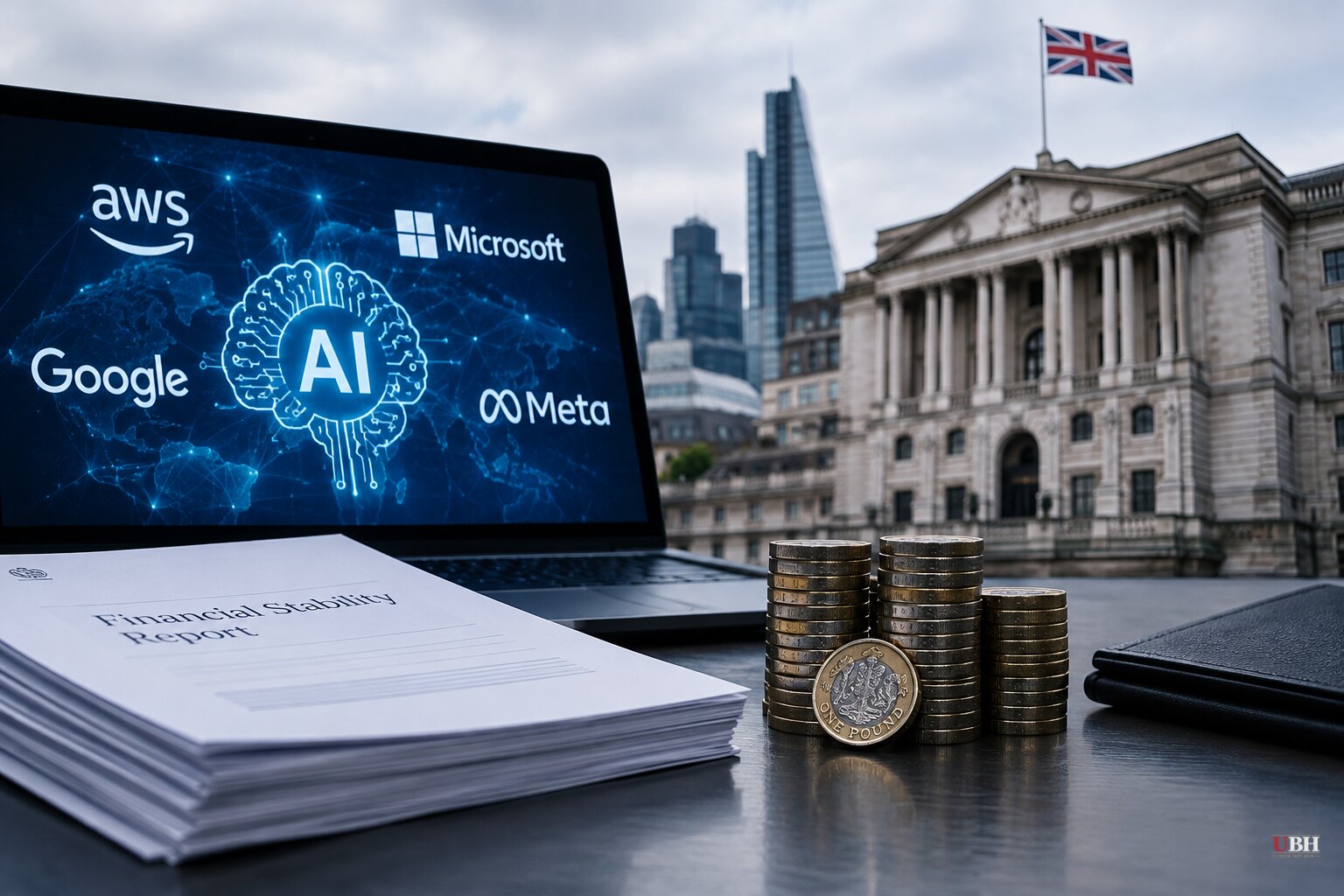
Since the Federal Reserve's October minutes flagged "complex and opaque" AI financing and Fed Governor Michael Barr laid out his own list of risks on Nov. 19, the Bank of England has added a number. In its financial stability report on Thursday, Nov. 26, the BoE said hyperscalers' financial exposure to artificial intelligence has grown to more than $4 trillion.
What the Bank of England said
The BoE said the "very rapid expansion and broadening" of AI financing, "in a form that is increasingly complex, circular and opaque," is deepening interconnections across the global financial system.
The report warned that the debt and off-balance-sheet commitments hyperscalers rely on could come "under strain in a stress or if expectations around future AI revenues were revised down."
The bank also said some private credit funds are getting pickier about which data-center and AI deals they join, because of credit-quality concerns. "Stress at individual firms can affect financing conditions for similar projects," the BoE said.
Bloomberg data shows hyperscalers have raised more than $300 billion in bond debt across nine currencies this year. Billions more have gone through off-balance-sheet deals designed to ease pressure on credit ratings. The latest is a $32 billion SpaceX debt deal last week to fund access to chips.
Nvidia's habit of backstopping other companies in the AI supply chain has also fed talk of a "Bank of Nvidia" sitting under a web of circular financing.
The bank's own escalation
The BoE has raised its tone all year. A May joint statement with the Financial Conduct Authority and HM Treasury warned that frontier AI capabilities now outpace skilled practitioners. In July the bank's stability report flagged high AI valuations while still calling the UK banking system resilient.
Governor Andrew Bailey wrote to G20 ministers in August warning that autonomous AI models could cause cyber disruption across borders. Deputy Governor Sarah Breeden described AI advances as a systemic risk to the global financial system on Oct. 15.
As of Sept. 30, the Financial Policy Committee put AI-related debt issuance at roughly $450 billion, double the 2025 level. That figure measures debt issuance. The $4 trillion figure measures financial exposure. They are different yardsticks.
The same day, a capital cut
On the same Thursday, the committee set out measures to cut capital requirements for major UK lenders by a further 30 basis points. The package would free up an additional £175 billion of lending capacity, according to the report on the measures.
It is the final stage of the committee's review of the bank capital framework. It keeps overall requirements consistent with a system-wide Tier 1 benchmark of around 13%. The committee set that benchmark in December 2025 when it lowered the previous level of around 14%.
The largest UK-focused banks get the biggest relief, about 60 basis points, double the group figure.
The lenders' argument is that overlapping rules, specifically Pillar 2A add-ons interacting with the UK's 2% neutral countercyclical capital buffer, counted the same risk several times. They say that left banks holding more capital than historical losses justified. The committee agreed that the interaction made requirements on domestic lending less proportionate than necessary. Its stress tests, it said, did not show that banks with more domestic lending were more exposed to cyclical risks.
The committee also warned that cuts beyond the proposed levels could risk instability and weaken banks' ability to absorb shocks. Major UK banks have returned about £100 billion to shareholders through buybacks and dividends over the past three years.
The Fed's version
Barr, speaking at the Milken Center in Washington, said on-balance-sheet debt at the seven largest AI firms has risen sharply in 2026 and is expected to exceed $800 billion by year-end.
He named bank runs as a major risk. AI agents, he said, could amplify a run in minutes, leaving banks and regulators little time to respond. He cited the 2023 Silicon Valley Bank collapse as the template.
He also flagged "herding," where many firms use similar AI models and make the same trades at once. When stress hits, Barr said, the Fed must be ready to provide liquidity, and he said the Fed has worked to keep its discount window available in a high-speed environment. Officials still need to understand better how different models and training techniques affect the likelihood of herding.
The Fed's October minutes say "almost all participants" commented on the risk that AI investment returns disappoint, and "most participants" observed that AI-related debt had grown quickly through opaque structures.
The bubble argument
Former SEC Chair Gary Gensler, now an MIT professor, told CNN the AI boom "is already a bubble" and will likely burst and cause a recession before the 2028 presidential election. He pointed to estimates of about $800 billion a year going into AI infrastructure and to the railroad, electricity and internet booms. "The only question is if it's a soft recession or something more dramatic," he said.
That $800 billion is annual infrastructure spending, a different number from Barr's year-end debt stock. Ray Dalio, Kenneth Rogoff and Mike Novogratz have issued similar bubble warnings, per CNN.
What is still open
Barr flagged a gap in the rulebook. Market-integrity law centers on a human with intent. "When that human has bad intent, then they're held liable for a set of consequences," he said. "It's much harder to understand what that would look like in the context of artificial intelligence in trading markets."
No regulator on either side of the Atlantic has said who answers when an AI agent triggers a run or a herd trade. The BoE has now given the exposure a $4 trillion figure while loosening bank capital rules in the same report.
Sources used for this briefing
6 links from 6 independent newsrooms (syndicated copies of the same report count once)
These are the sources it draws on, linked so you can verify.


