
Unbiased headlines. Facts, not spin.
Unbiased Headlines is an independently owned news organization. We bring you the facts, not opinions, written fresh from 110+ named sources. Sources linked so you can verify it yourself.
 finance
Notable (6/10)
Event date: November 13, 2026 ·
Greece's 10-Year Yield Falls Below Italy's and France's After KBRA Upgrade
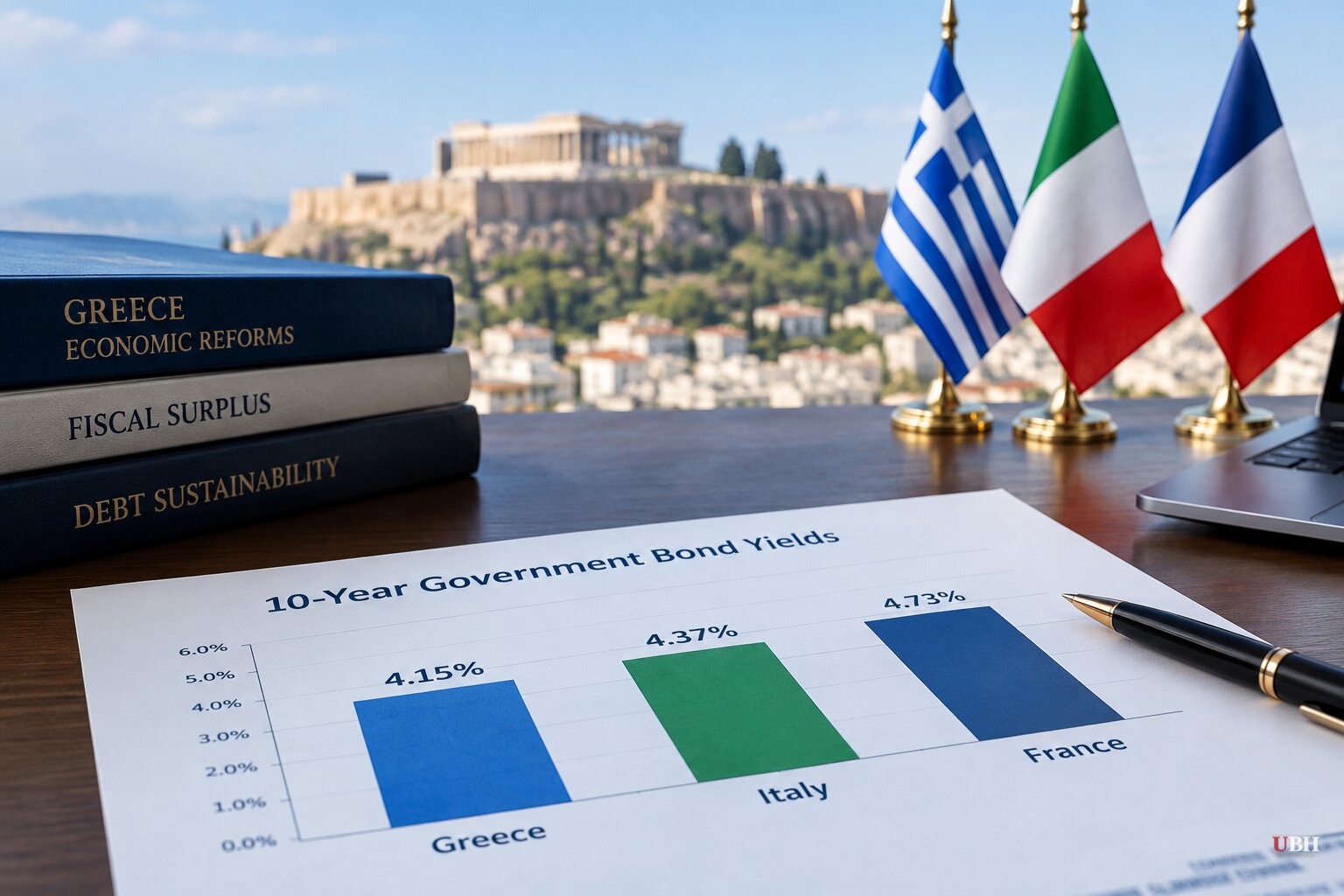
In early 2012, Greece's 10-year yield topped 35% as Athens prepared the largest sovereign debt restructuring in history. Italy, then seen as the next domino, had paid more than 7% at the peak of its own scare.
On Wednesday, Nov. 25, the order was reversed. Greece's 10-year yield was 4.15%. Italy's was 4.37%. France's was 4.73%.
That is 22 basis points under Rome and 58 under Paris.
How long the gap has held
Greek yields first dipped below Italy's in November 2019. They have stayed there without a break since April 20. They first slipped under France's in January 2025 and have held there every day since June 15.
On Nov. 20, U.S. rating agency KBRA upgraded Greece to BBB+ from BBB with a stable outlook, two notches above the lowest investment-grade rating. The upgrade came after the yield gap had already opened, so it follows the market move rather than driving it.
"Credit ratings should be forward looking, and not backward looking, and recognize when credit risks have receded," said Joan Feldbaum-Vidra, senior managing director for sovereigns at KBRA.
What Athens did
Greece ran a primary surplus of 5.1% of GDP in 2025, which KBRA calls the strongest in Europe. Revenue beat spending by that margin before interest payments.
Tax collection improved sharply. The VAT compliance gap fell from 24% in 2019 to about 9% in 2024, roughly the EU average.
Real growth averaged 4.1% a year from 2021 to 2025. Unemployment dropped to 7.6% in September from 8.8% a year earlier. The share of bad loans at Greek banks fell from 6.9% in June 2024 to 3.4% in June this year.
Eurostat puts Greek public debt at 140.8% of GDP in the second quarter of 2026, down from 152% a year earlier. Italy's rose to 139.9% from 137.6%. France's climbed to 119.1% from 115.4%.
The gap between Athens and Rome was more than 14 percentage points. It is now under one. KBRA expects Greek debt to fall to about 129% of GDP by 2027.
Structure matters too. "Its debt is largely fixed-rate, with very long maturities," said Ken Egan, KBRA's senior director and head of sovereign credit. The average maturity of Greece's central government debt is 18 years. For European Stability Mechanism loans it is 32 years.
Greece's weak spots
Greece is not in the clear. Its debt ratio remains the highest in the eurozone.
KBRA flags low household savings as the weak spot. It forecasts a current account deficit of 6.6% of GDP this year, because investment is funded largely with money from abroad.
France moves the other way
France's debt ratio is far lower, but its direction is the problem. The deficit is about 5.4% of GDP, and French spending is about 57% of GDP, the highest in the G20.
The National Assembly rejected the 2027 budget this week, according to the economics site Economics Help. It reports 458 votes against and none in favor, with the left, the National Rally and even the government's own supporters opposed. Parliament had stripped out tax increases and added spending. That site's figures show the deficit would have risen to 5.9%.
Prime Minister Sébastien Lecornu governs without a majority. He has leaned on special constitutional powers to force budgets through and has survived repeated no-confidence votes.
The government plans to borrow a record €340bn next year. Its interest bill is forecast to climb from €62.6bn to €72.9bn.
This autumn France's 10-year yield touched 5%, its highest close since 2002, according to Brussels Signal citing Reuters and De Tijd. The same account says Belgium paid more than Greece to borrow for the first time since 2008. The French-German spread hit its widest in more than a decade in October.
The opposing read is that this is not a crisis. Lombard Odier says markets are "pricing uncertainty rather than the conditions for a new sovereign debt crisis" and expects French spreads to stay wide until a credible budget passes. The European Central Bank also has tools to calm disorderly markets if needed.
Protests over living costs have added to the political strain in France. On Oct. 17, a mob stormed city hall in Limoges during demonstrations against the "high cost of living," and the building was destroyed by fire.
The refinancing wall
France's debt matures much faster than Greece's. Its average maturity is about eight and a half years, per Economics Help, so debt keeps returning to the market.
In 2027, France must refinance €196bn. Four big fixed-rate bonds maturing next year carry an average coupon of about 1.7%. French 10-year borrowing is now closer to 4.9%, according to that site, which puts the extra cost at about €4bn a year on the same amount of debt.
A study commissioned by the French finance ministry projects the deficit rising to about 7% of GDP by 2030 on current policies, as cited by Economics Help. The Bank of France has warned that the country risks being squeezed by rising rates.
Paris still has no passed 2027 budget. Investors expect little change before the 2027 presidential election.
Sources used for this briefing
7 links from 7 independent newsrooms (syndicated copies of the same report count once)
These are the sources it draws on, linked so you can verify.


