
Unbiased headlines. Facts, not spin.
Unbiased Headlines is an independently owned news organization. We bring you the facts, not opinions, written fresh from 110+ named sources. Sources linked so you can verify it yourself.
 finance
Major Story (8/10)
Bank of England: AI debt boom and Middle East war have raised risks to the financial system
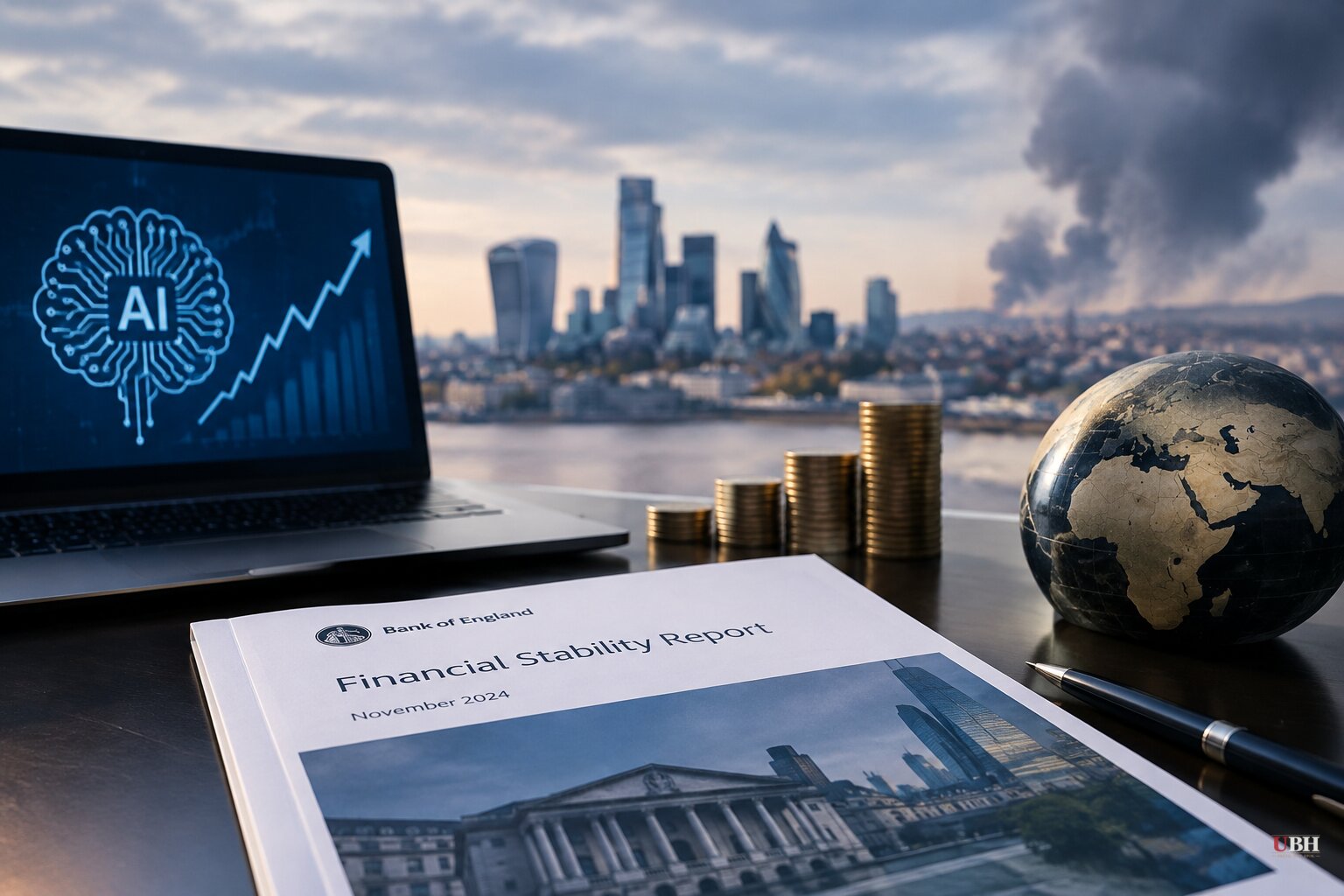
The Bank of England said Thursday, Nov. 26, that risks in the global financial system have intensified in recent months. The conflict in the Middle East has dragged on, pushing up inflation and interest rates, while AI companies and governments keep borrowing heavily.
The warning comes in the Bank's half-yearly Financial Stability Report.
AI financing under the microscope
Share prices have fallen sharply on doubts about AI companies' prospects. The Bank still called valuations "stretched" and heavily dependent on AI firms delivering the profits investors expect.
The bigger worry is how the buildout is paid for. "The very rapid expansion and broadening of its financing, in a form that is increasingly complex, circular and opaque, is making it increasingly likely for stress in one area to propagate to another," the Bank said.
The numbers are large. The Bank said the hyperscalers building AI data centres are on course to issue more than $305 billion of debt this year. Borrowing by the broader sector exceeds the annual borrowing of most governments, Britain's included.
The Bank's Financial Policy Committee had already flagged the trend. Global AI-related debt issuance reached nearly $450 billion by early September 2026, more than double the prior year, according to the Bank's own figures cited in Governor Andrew Bailey's Sept. 30 Insight article. Hyperscalers have made up 47% of sterling corporate bond issuance so far in 2026.
Deputy Governor Katharine Braddick told a press conference that keeping Britain's system resilient if investor sentiment turns against AI is "a top priority." "It's a very live part of our supervision," she said.
Bailey declined to be drawn on whether turmoil at the top of chipmaker Nvidia points to broader weakness in US corporate governance. He noted that British regulators scrutinise senior financial executives' conduct closely. "I think the UK has made good choices in that respect," he said.
Mortgage bills
The Bank's Financial Policy Committee said about 7 million borrowers will come off fixed-rate deals before December 2029. Roughly 6.5 million of them will pay more.
For about 3.4 million, the monthly increase will be under £100. For another 2.7 million it will be £100 to £500. About 430,000 will see payments jump by more than £500 a month.
Over the next year alone, about 1 million households will see payments rise by almost £200 a month.
The Bank raised its rate from 3.75% to 4% this month and signalled it may go higher to fight inflation tied to the Iran war. Financial markets are pricing three quarter-point rises by summer 2027. The energy regulator raised the household energy price cap by 26% a day earlier.
Sarah Breeden, the Bank's deputy governor for financial stability, argued households can take the hit. They "face this shock with strong balance sheets," she said, with household debt at a level last seen in the early 2000s. "While there's a distributional effect and some households would be hit more than others, in aggregate we think this is absorbable," she said.
The figures add pressure on the government's cost-of-living effort. Chancellor John Healey used his first budget to promise "breathing space" for hard-pressed consumers.
The Bank also announced plans Thursday to reduce capital requirements for more domestically focused British lenders. It said the heightened global risks were no barrier to that.
Cyber, outsourcing and quantum
Recent outages at Google and Microsoft exposed how dependent businesses are on outside technology providers. The Bank said "disruption at a single provider" could "affect many firms at once."
Bailey also singled out "open weight" AI, meaning open-source models, many developed in China. "These models can be run more cheaply. Safeguards may be disabled or removed more easily. This could make more advanced AI capabilities more readily available and useful to malicious actors," he said.
The Bank and the Financial Conduct Authority published new cyber-resilience guidance the same day. A joint survey found 88% of firms expect frontier AI capabilities to significantly change their risk profile over the next two years. Another 64% said emerging AI threats have sharpened their focus on vulnerability management and patching.
The guidance also tells firms to prepare for cryptographically relevant quantum computers, machines that could break the encryption protecting payments and financial records. None is in operation. Regulators point to "harvest now, decrypt later": an attacker steals encrypted data today and holds it until quantum hardware can read it.
The Bank called an orderly move to quantum-resistant cryptography "the immediate financial stability priority." Current guidance calls for banks to migrate high-priority systems by the end of 2031 and all remaining systems by the end of 2035. The most systemically important firms should aim to beat those dates.
The guidance tells firms to inventory their cryptographic dependencies and assess third-party supplier risk. A bank can upgrade its own systems and still be exposed through a vendor running older ones.
The China problem
Bailey, who also chairs the Financial Stability Board, wants major economies to test frontier AI models before and after release. In his September article he called for "rigorous model testing, conducted both before and after deployment," with testing coming ahead of formal regulation.
On Thursday he added that cooperation must involve China. "AI does not stop at the borders, and so we need to tackle these questions together," he said.
The Bank has not said how it would bring China into a shared testing regime. It also has not said whether its testing-first approach will move from an Insight article into formal supervisory standards.
The Bank is meanwhile guiding for another rate rise. Over the next three years, its own figures show hundreds of thousands of households facing a payment shock.
Sources used for this briefing
6 links from 6 independent newsrooms (syndicated copies of the same report count once)
These are the sources it draws on, linked so you can verify.


