
Unbiased headlines. Facts, not spin.
Unbiased Headlines is an independently owned news organization. We bring you the facts, not opinions, written fresh from 110+ named sources. Sources linked so you can verify it yourself.
 finance
Major Story (7/10)
Global Stocks Rebound as Stoxx 600 Gains 1.6% and Kospi Recovers Part of 6.2% Drop, With U.S. Markets Closed for Thanksgiving
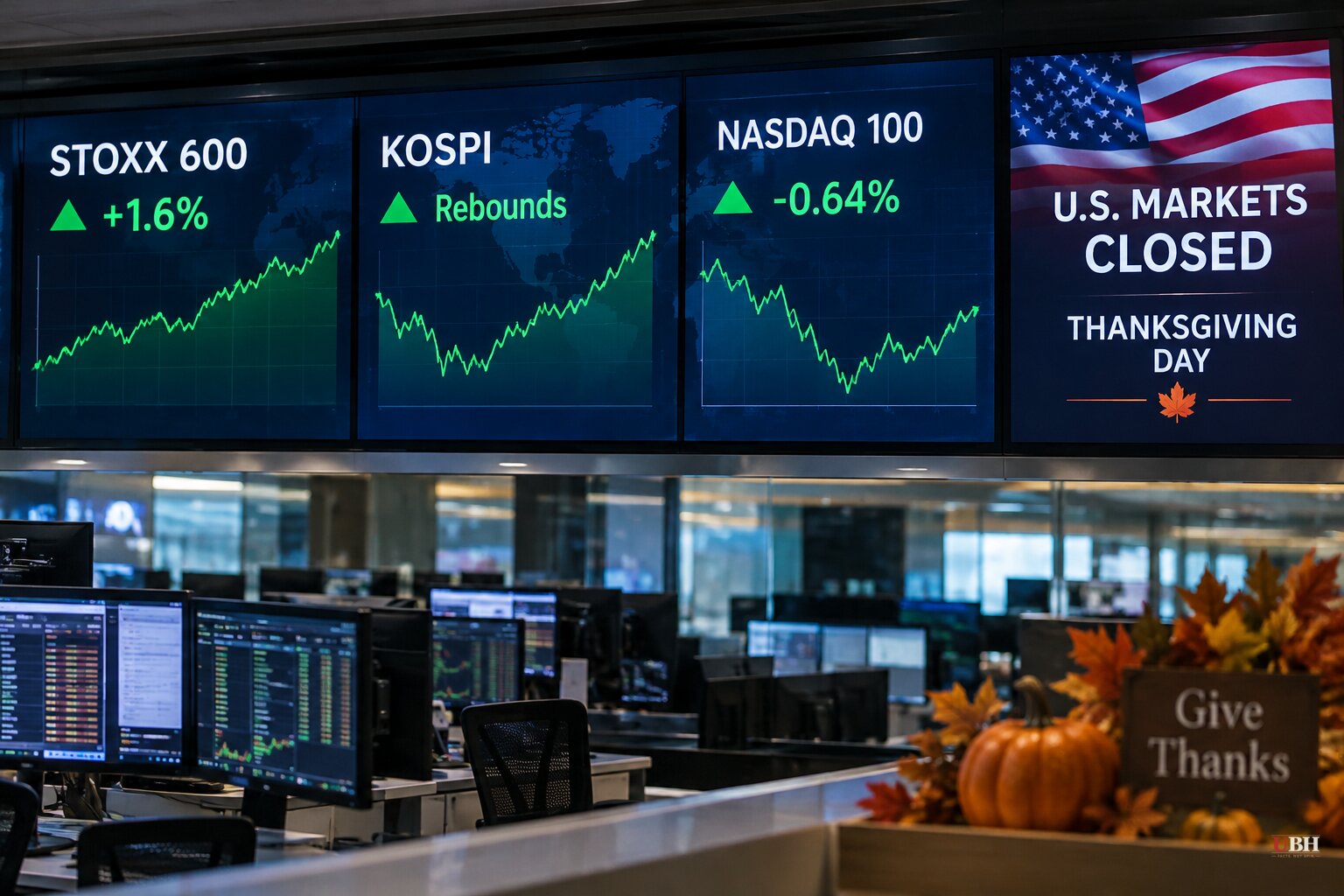
Since Wednesday's wild session, when the Nasdaq 100 fell as much as 4.7% and then clawed back to close down only 0.64%, the selling has paused overseas. European and Asian stocks are rising today, Nov. 26, with chipmakers leading.
The pan-European Stoxx 600 was up about 1.6% to 1.7% on the day, with every sector in positive territory by midday in London. Germany's DAX gained 1.9%. The Stoxx 600 Technology index jumped 2.5%, though it is still down roughly 12% for the month.
Infineon rose more than 4%, and ASML and ASMI each gained just over 3%. Banks joined in, with Deutsche Bank and BNP Paribas posting solid gains.
Asia claws back part of Wednesday's losses
South Korea's Kospi closed up 0.29% at 4,711.21. That recovers only a sliver of Wednesday's 6.2% drop. Samsung Electronics added 0.35% and SK Hynix more than 2%.
Japan's Nikkei 225 closed up 0.86% at 57,499.16, after a 2.8% fall the day before. SoftBank Group surged more than 7%. Kioxia jumped more than 12%, and Advantest gained 4.57%.
Hong Kong's Hang Seng rose about 1.5% late in the session. Australia's S&P/ASX 200 added 0.82% to 8,763.8. Mainland China's CSI 300 edged up marginally to 3,900.55.
What drove the sell-off, and what hasn't changed
Two things hit markets this week. One is doubt that the huge spending on AI infrastructure will pay off. The other is a fresh batch of tariffs from the White House, along with inflation data that came in hot.
October's PCE price index rose 3.8% from a year earlier. The core measure, which strips out food and energy, rose 3.3%, well above the Fed's 2% target. The economy also grew faster last quarter than first reported. CME FedWatch shows traders pricing a 98% chance the Fed raises rates a quarter point in December.
The 10-year Treasury yield sat little changed near 4.86%. The Bank of Korea added to the tightening mood today, raising its benchmark rate 25 basis points to 3.25%, a two-year high.
On tariffs, the U.S. Trade Representative confirmed Wednesday that the new duties would be capped at levels set in existing agreements, according to a Crypto Briefing account of the announcement. Russ Mould, investment director at AJ Bell, said the new round of Trump tariffs "aren't as bad as feared." The U.S. plans to impose higher tariffs on China, Japan and the European Union, among other partners.
Nvidia and Anthropic still under pressure
The AI trade is not fully healed. Nvidia fell 3.9% Wednesday, its second straight down day, even after its board reinstated Jensen Huang as CEO on Monday. S&P Global Ratings warned Wednesday that it could downgrade Nvidia's credit rating over concerns about the company's management and governance.
Anthropic, which began public trading last week, fell almost 10% Wednesday before ending up 1.1%. It remains below its $83 IPO price. It had closed under that level for the first time on Tuesday.
On Wednesday, Argent Capital Management portfolio manager Jed Ellerbroek said investors were "just selling tech and fleeing for safety." Harris Financial Group's Jamie Cox said that AI nerves combined with rate-hike expectations produce "violent moves."
The skeptics
Not everyone reads the dip as a buying opportunity. David Bahnsen, chief investment officer of The Bahnsen Group, said on Nov. 7, after an earlier tech rout, that the pullback reflected the risk of a "blow-off top." He said it "does not represent a buying opportunity" and warned of "complacency around risk and the disconnect from valuations and revenue models that make sense."
Mould, for his part, cautioned investors not to get complacent after today's bounce.
The Nasdaq 100 is still on track for an 8.2% decline in November and sits nearly 20% below its October peak.
Oil is also adding pressure. Brent crude is up 0.5% at $91.11 a barrel and U.S. crude is up 0.8% at $84.33, with Middle East tensions persisting. Brent traded near $72 before the war began in late February.
What comes next
U.S. markets are closed today for Thanksgiving. They reopen Friday, Nov. 27, for a shortened session, and trading volumes are expected to be thin. Thin volume can exaggerate moves in either direction.
The first real test of whether Wednesday's dip-buying holds comes when full volumes return, ahead of the Fed's December meeting.
Sources used for this briefing
7 links from 6 independent newsrooms (syndicated copies of the same report count once)
These are the sources it draws on, linked so you can verify.


