
Unbiased headlines. Facts, not spin.
Every story is an unbiased news briefing written from 110+ sources across the spectrum — sources linked so you can verify it yourself.
 economy
Notable (6/10)
June 12, 2026 at 11:55 AM
economy
Notable (6/10)
June 12, 2026 at 11:55 AM
Bank of America and UBS Now Say No Fed Rate Cuts Until 2027, Citing Inflation at 3.3 Percent and a Hawkish New Chair
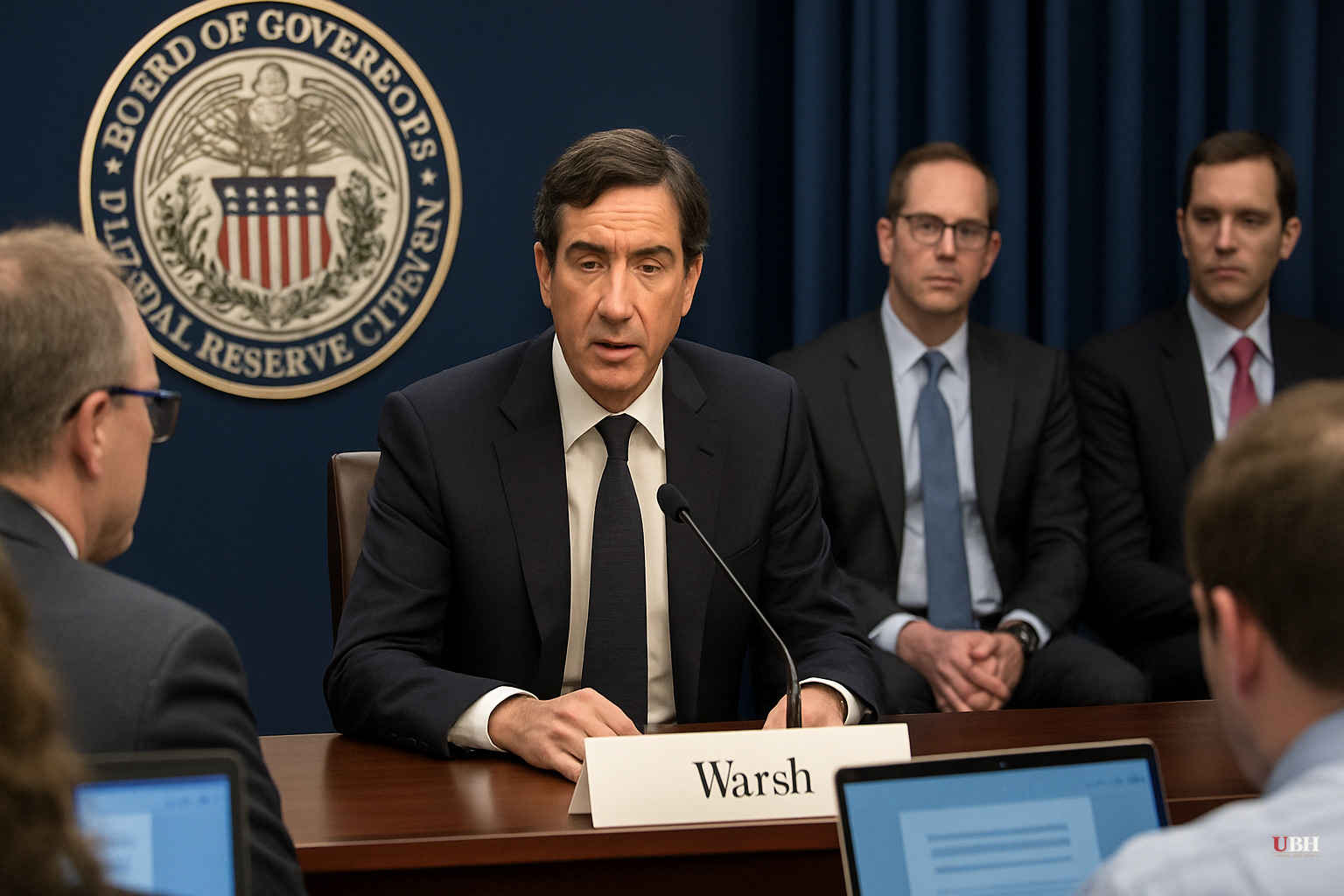
Since Kevin Warsh was sworn in as Federal Reserve Chair on May 22, 2026, Wall Street's rate-cut timeline has moved from "later this year" to "probably not until the second half of 2027."
The Forecast Revisions
Bank of America Global Research had previously expected two rate cuts in September and October of this year. As of June 12, that forecast is gone. "We no longer expect the Fed to cut rates this year," BofA economists wrote in a note to clients, according to CBS News. The bank now expects easing to begin in the second half of 2027, if at all.
UBS moved the same direction. Strategists Dominic Schnider, Giovanni Staunovo, and Wayne Gordon cut UBS's gold price forecasts by $300 to $900 per ounce this week, citing what they called a "double whammy": stronger U.S. economic data and a Fed easing timeline now pushed to 2027, according to Yahoo Finance Canada.
CME Group's FedWatch tool, which tracks market-implied probabilities, shows less than a 50% chance of any rate cuts before the second half of 2027, according to CBS News.
The last time the Fed actually cut rates was December 2025.
Why the Pivot
Three things are driving this.
First, inflation is still running at 3.3%, well above the Fed's 2% target, according to BofA Global Research. Deutsche Bank economists, in a May 8 note, said "trend inflation has not shown clear signs of dipping below 3%," pointing to ongoing tariff pressure and AI-driven increases in computer hardware and software costs. BofA added that "core inflation is too high, and moving up."
Second, the job market surprised to the upside. Employers added 115,000 jobs in April, nearly double the forecast of 65,000, according to CBS News. That kind of labor market strength undercuts the argument for stimulus.
Third, Warsh himself is an unknown quantity. BofA's original forecast for cuts this year was partly built on the assumption that Warsh would push the Fed toward easing. That assumption is now in question.
Warsh's Silence as Strategy
Markets head into Warsh's first FOMC meeting with almost no signal from the chair himself. That appears intentional.
"I think truth-seeking is more important than repetition," Warsh said at his April confirmation hearing, according to CNBC. "If one has a press conference, one wants to deliver some important news." He has not committed to holding a press conference after every meeting, as predecessor Jerome Powell did routinely.
Warsh has a documented skepticism of heavy Fed communication. After leaving his first stint as Fed governor, he led an internal review of the Bank of England's communications strategy in 2014, according to CNBC. His position: central banks telegraph too much, creating market dependency on Fed guidance that distorts prices and policy.
The immediate practical question is whether Warsh will remove the "easing bias" from the FOMC's policy statement, a technical signal that has told markets additional rate cuts remain the default direction. Three FOMC members dissented at the last meeting specifically to oppose keeping that language, according to CNBC. JP Morgan Chief Economist Michael Feroli told CNBC he doesn't expect Warsh to explicitly signal openness to rate hikes, "but I could see him saying he can't rule it out."
The Case for Caution on Caution
The strongest pushback on the hawkish consensus is worth stating plainly. Chicago Fed President Austan Goolsbee and St. Louis Fed President Alberto Musalem have both flagged concern that AI-driven productivity gains could raise the economy's speed limit, meaning the Fed could be tightening into a structural expansion rather than an overheating cycle. If productivity is genuinely accelerating, today's inflation readings may overstate the underlying price pressure, and holding rates high too long carries its own risks: a hard landing, credit stress, and housing affordability that worsens by the month. BofA acknowledged those uncertainties, noting that the Iran war, tariffs, and AI are making forecasting "harder" than usual. None of this means the hawks are wrong. It means the data is genuinely ambiguous and reasonable analysts disagree.
Where This Leaves Savers, Borrowers, and Gold
For anyone waiting on mortgage rates or auto loans to come down, 2027 is a long way off. For gold traders, UBS still sees long-term upside but warned that prices "may continue to gravitate toward the $3,850-4,000/oz range in the near term" as real yields stay elevated and safe-haven demand tied to U.S.-Iran tensions has cooled.
UBS noted central bank gold buying remains steady, with China's People's Bank adding 10 metric tons in preliminary May data and Uzbekistan's central bank buying nearly 9 metric tons in the same period.
Whether Warsh will cut rates this year is essentially settled. Nearly no one expects that now. The open question is whether his deliberate silence is a feature or a bug. If it restores Fed credibility and reduces market over-reliance on central bank guidance, it could be a genuine improvement. If it simply generates more uncertainty during a period when the economy is absorbing tariffs, an active conflict, and an AI-driven structural shift simultaneously, that silence carries its own price.
Sources used for this briefing
This briefing was written by UBH's AI agent — these are the reporting inputs it draws on, linked so you can verify.


