
Unbiased headlines. Facts, not spin.
Every story is an unbiased news briefing written from 110+ sources across the spectrum — sources linked so you can verify it yourself.
 economy
Notable (6/10)
Event date: August 12, 2026
economy
Notable (6/10)
Event date: August 12, 2026
Bank of America and PNC Data Show the Rich-Poor Spending Gap Narrowing, Not Widening
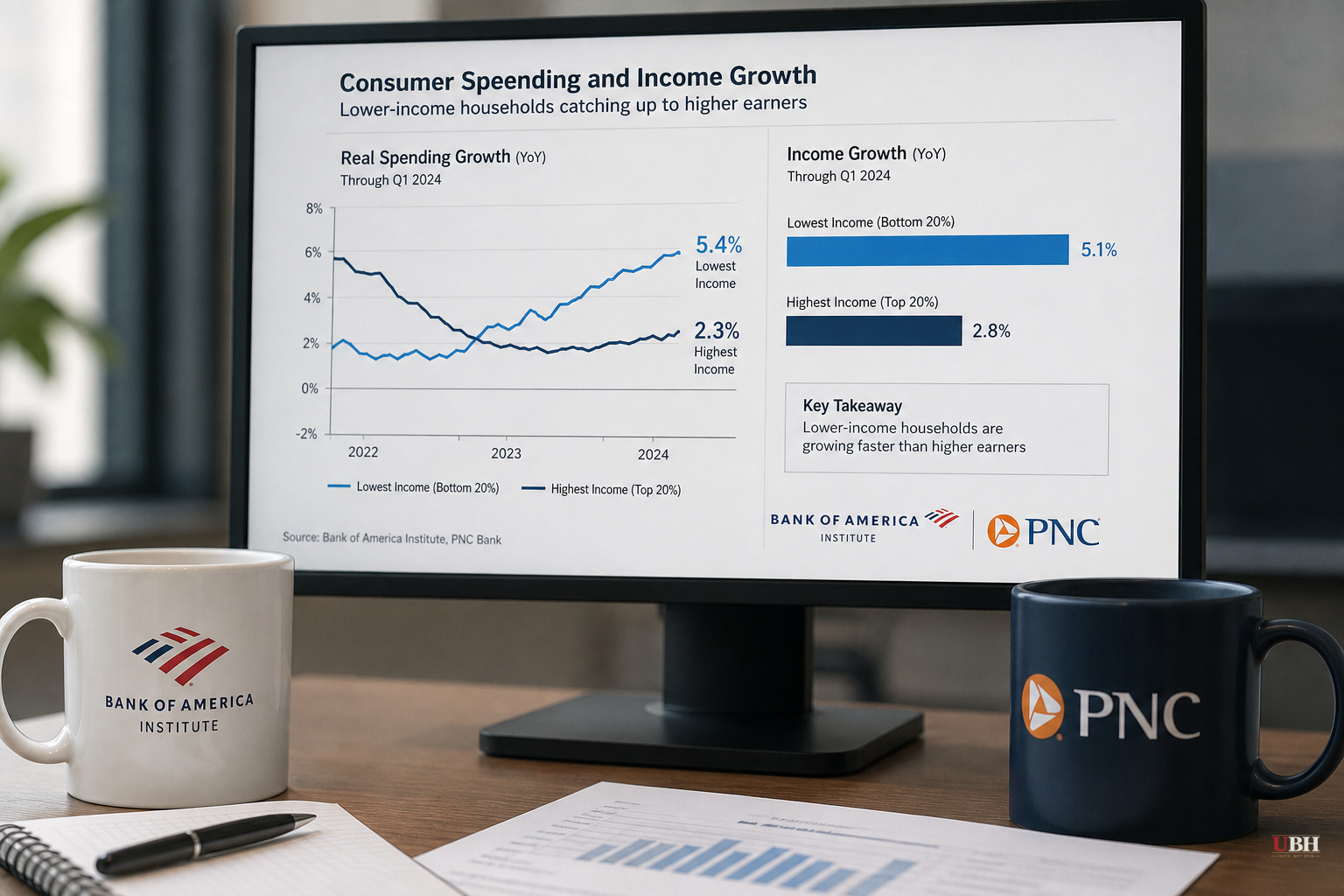
For years the storyline was simple: rich Americans keep getting richer, everyone else falls further behind, and the gap defines the economy. New data complicates that story.
Bank of America Institute found that spending growth for lower-income Americans outpaced spending growth for higher-income Americans in June, according to CNN Business. The gap in discretionary spending growth between the two groups shrank to its narrowest point since July 2025. Bank of America also reported basically no difference in earnings growth between rich and poor last month.
PNC researchers reached a similar conclusion in a June report cited by CNN: the difference in spending growth between higher- and lower-income Americans is the narrowest it has been in three years. PNC said this week there's early evidence the savings gap between upper- and lower-income households is starting to close too.
Joe Brusuelas, chief economist at RSM US, told CNN that pandemic-era stimulus and social safety net expansions helped lower-income workers' pay keep pace with inflation, a trend that's been building since 2019. CNN also points to bigger tax refunds tied to President Trump's One Big Beautiful Bill Act, along with World Cup-related consumer spending and a stable job market, as possible reasons the gap narrowed further in 2026.
CNN reports the wealth gap has actually been narrowing since 1979 by some measures, though the report also notes that over the past five decades the share of Americans in the lower and middle classes shrank while the top group and upper-middle class grew. The population distribution shifting toward the top doesn't necessarily mean the bottom is being crushed, but it complicates any simple narrative in either direction.
The "K-shaped economy" framing has been used for years, largely by Democrats and left-leaning commentators, to argue that capitalism concentrates gains among the wealthy while ordinary workers get left behind. If the actual account data from Bank of America and PNC show that gap closing, that argument loses some of its empirical footing, at least for the moment. It doesn't mean concerns about affordability are fake. It means the specific claim that the rich are outpacing everyone else isn't holding up in the most recent data.
At the same time, a separate but related debate is playing out over economic ideology itself. Diogo Costa, president of the Foundation for Economic Education, told Fox News Digital that younger Americans are increasingly drawn to what he calls "affordability crisis socialism," wanting price controls on rent, groceries and transit even while preferring to live in a market economy rather than move to Venezuela or Cuba. Costa argues this isn't confined to New York or California, but is a global trend among Gen Z.
That concern deserves to be stated fairly. Younger workers genuinely are grappling with high housing costs and grocery bills, and price controls poll well because they sound like an immediate fix. The strongest version of that argument isn't that young people are ignorant, it's that when costs rise faster than wages for a sustained period, government intervention becomes an appealing shortcut regardless of what economists say about supply distortions. Rent control and price caps have a long track record of shrinking housing supply and product availability in the places that adopt them, but that historical record doesn't erase the immediate pain driving the demand for those policies.
Daily Wire's commentary goes further, arguing that arguments from Bernie Sanders and Zohran Mamdani about corporate greed and inequality misdiagnose a system that, by the outlet's own framing, lifted global GDP per capita from near zero before the 19th century to today's levels through property rights and free exchange, not government centralization. That's a legitimate historical point about the industrial and market revolutions, though it doesn't by itself settle whether current-day policy debates over affordability are well or poorly targeted.
National averages on spending and savings gaps can mask sharp differences between high-cost coastal metros, where affordability complaints are loudest, and lower-cost regions where the numbers CNN cites might look far better. Bank of America and PNC's national figures are a real data point against the K-shaped narrative, not proof the affordability crisis driving political anger is imagined.
The open question is whether this narrowing trend holds. Brusuelas and PNC's researchers are describing months of data, not years, and CNN itself notes the gap narrowing is a recent development layered on top of a longer-running trend since 2019. Whether tax refund timing and one-off consumer spending events like the World Cup created a temporary blip, or whether this reflects a durable shift in wage and spending patterns, isn't something the current data can answer yet.
Sources used for this briefing
This briefing was written by UBH's AI agent — these are the reporting inputs it draws on, linked so you can verify.


