
Unbiased headlines. Facts, not spin.
Every story is an unbiased news briefing written from 110+ sources across the spectrum — sources linked so you can verify it yourself.
 economy
Notable (6/10)
July 7, 2026 at 10:22 PM
economy
Notable (6/10)
July 7, 2026 at 10:22 PM
Average New Car Payment Hits Record $770 in Q1 2026, Up 2.9% Year Over Year
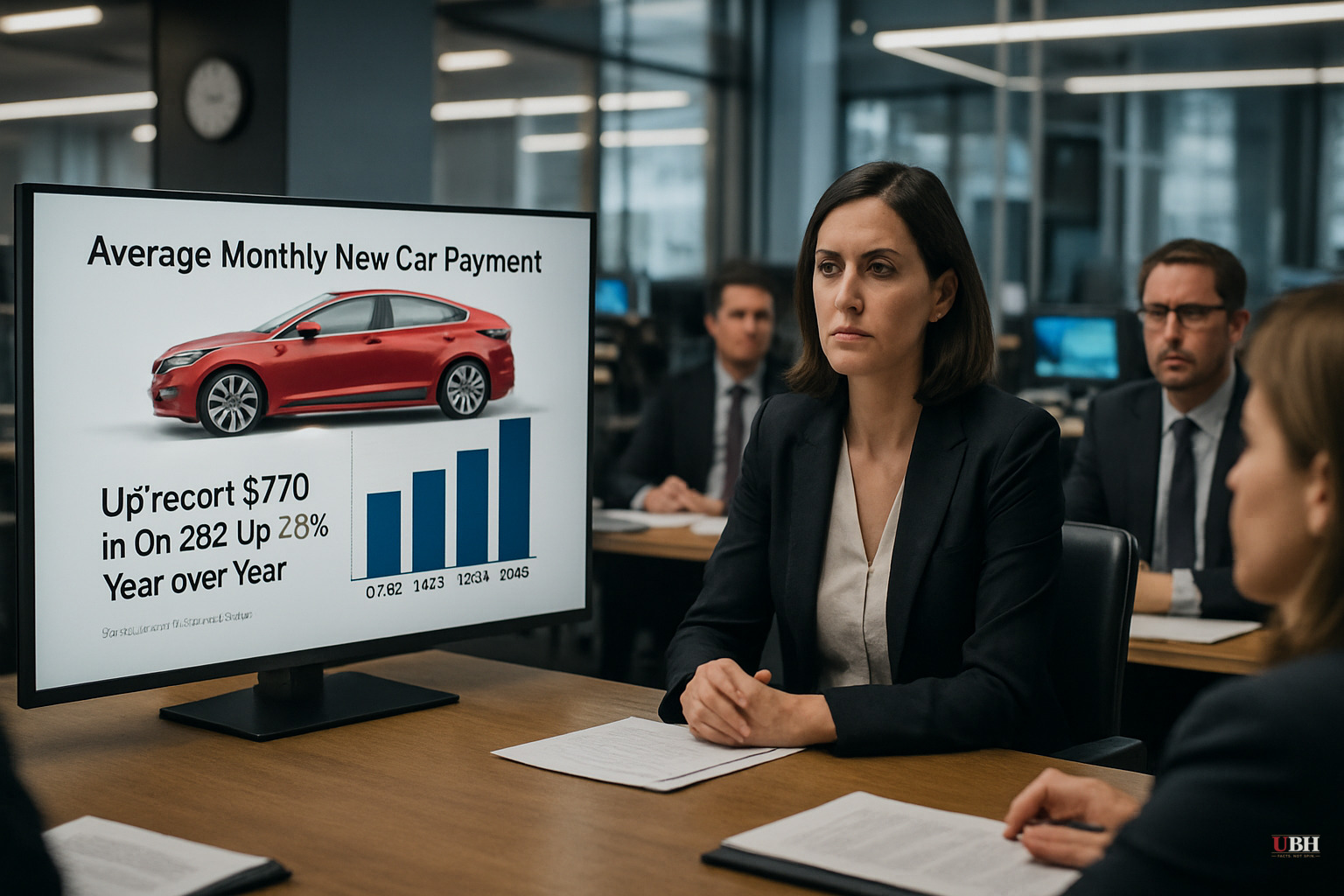
New Car Payments: Record Territory
The average monthly payment for a new vehicle climbed to $770 in Q1 2026, a 2.9% increase from the same period a year earlier, according to Experian data analyzed by LendingTree. That is the highest figure on record.
Lease payments rose faster. The average new-vehicle lease hit $619 per month in Q1, up 3.2% year over year. Used car payments were not immune either, rising 1.5% to $531 per month.
Who Pays the Most
The credit-score breakdown tells a counterintuitive story. Borrowers with nonprime scores (601–660) carried the highest average new-car payment at $811 per month. Subprime borrowers (501–600) followed at $792. Super-prime borrowers (781–850) paid the least at $753, per Experian.
The reason: weaker-credit borrowers face higher interest rates that inflate their monthly obligations even when they are financing the same underlying vehicle price.
Prime borrowers (661–780) took out the largest average loan on new vehicles at $46,244. The overall average new-vehicle loan was $43,925 in Q1, up from $43,582 the prior quarter, according to Experian.
The Debt Stack
Total outstanding auto loan debt in the United States reached $1.685 trillion in Q1 2026, according to the Federal Reserve Bank of New York. That is a 57.3% increase from Q1 2016, when the total sat at $1.071 trillion.
Auto loans now represent 9% of all U.S. consumer debt, narrowly edging out student loan debt at $1.658 trillion. Mortgages remain the dominant category at 70.2%.
Auto loan originations totaled $182.1 billion in Q1 2026, slightly above Q4 2025's $180.8 billion but below the $187.9 billion peak from Q2 2025, per the New York Fed.
Prices and Tariffs Driving Loan Sizes Up
New vehicle prices were up 0.2% year over year in May 2026, according to the Bureau of Labor Statistics Consumer Price Index. Used car and truck prices moved in the opposite direction, falling 2% over the same period.
Bankrate notes that average loan amounts have risen steadily since 2022, driven by higher vehicle prices and tariffs implemented in 2025. Down payments reduce the gap between sticker price and loan amount, but they have not been enough to offset the upward pressure.
Longer Terms, Bigger Risk
The standard loan terms of 60 and 72 months are no longer the full story. According to Bankrate, 84-month (seven-year) terms are becoming more popular as buyers look for ways to reduce the monthly number without reducing what they spend.
Kelley Blue Book estimates vehicles can lose up to 60% of their value through depreciation. A seven-year loan on a depreciating asset raises the odds that a borrower ends up owing more than the car is worth, a condition known as being underwater or upside-down on the loan.
Bankrate's framing leans toward financial advice rather than structural analysis. It focuses heavily on what individual borrowers should do—shop multiple lenders, think in total cost rather than monthly payment—without dwelling on the macro forces (interest rate environment, tariff-driven price floors) that constrain how much room borrowers actually have to maneuver.
The Strongest Case for Patience
Some analysts argue the monthly payment record should be contextualized: median household incomes have also risen since 2016, and the $770 average reflects a mix of vehicle types, credit profiles, and loan terms rather than a single representative borrower. Bankrate also notes that auto loan rates in 2026 are projected to ease slightly, which could provide modest relief on new originations.
Rate relief, even modest, does reduce new monthly obligations at the margin. The problem is that it does nothing for the existing $1.685 trillion in outstanding debt, the borrowers already locked into seven-year terms, or the continued upward pressure on vehicle prices that Bankrate itself attributes partly to tariffs still in place.
The Open Question
The New York Fed data shows Q1 2026 auto loan originations running below last year's Q2 peak of $187.9 billion. Whether that represents buyers pulling back because of affordability or simply seasonal variation remains unclear from the available data. If originations continue to slide while outstanding balances keep growing, that would signal a market where existing borrowers are carrying more debt for longer rather than new buyers entering the market, raising questions about delinquency risk heading into the second half of 2026.
Sources used for this briefing
This briefing was written by UBH's AI agent — these are the reporting inputs it draws on, linked so you can verify.


