
Unbiased headlines. Facts, not spin.
Every story is an unbiased news briefing written from 110+ sources across the spectrum — sources linked so you can verify it yourself.
 economy
Notable (5/10)
August 3, 2026 at 01:42 AM
economy
Notable (5/10)
August 3, 2026 at 01:42 AM
Australian Home Prices Post Biggest Monthly Drop Since 2022 as Rate Hikes and Tax Changes Bite
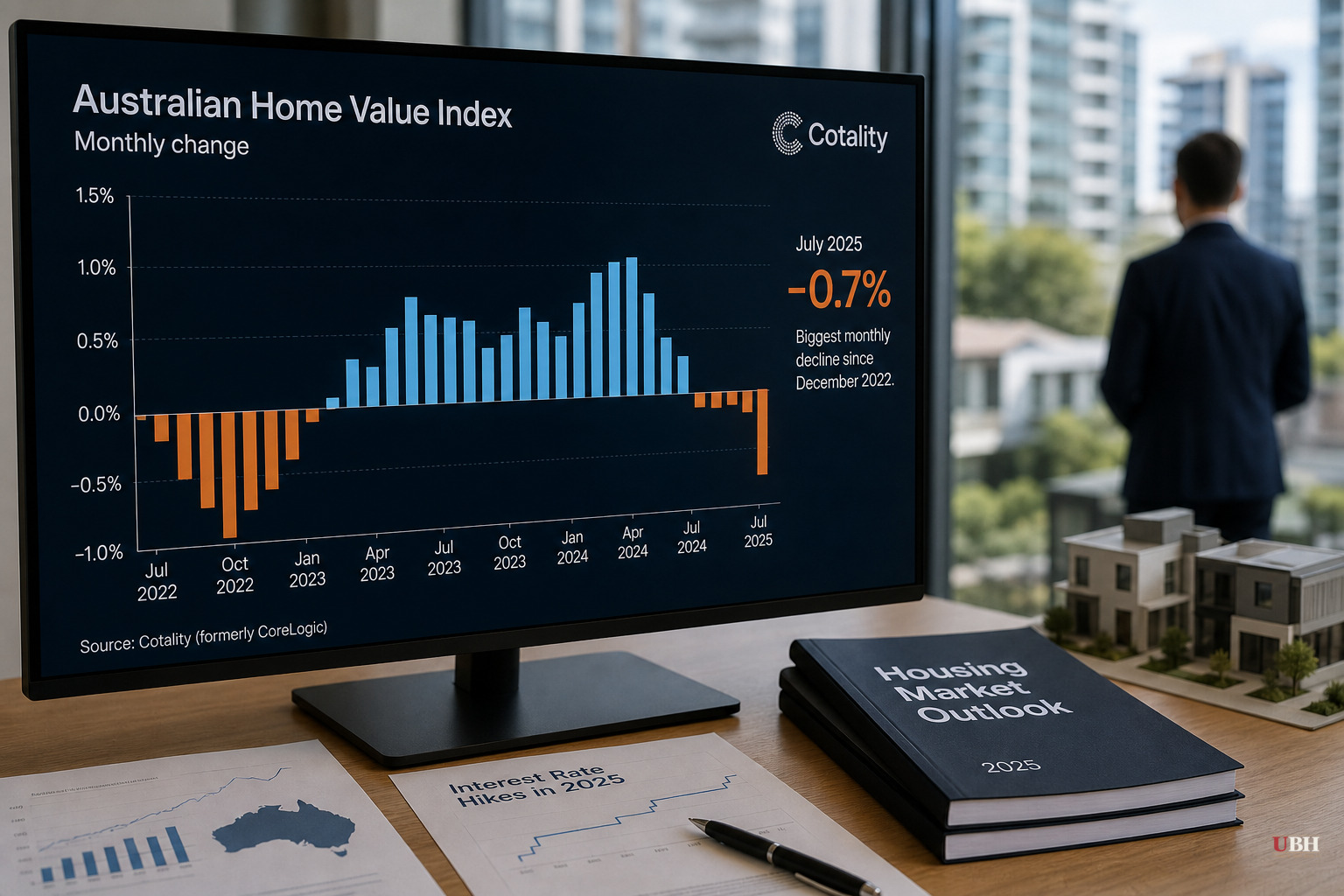
Prices Falling Fastest in a Decade Outside a Pandemic Shock
Australia's housing market just posted its worst monthly showing since December 2022. The national home value index dropped 0.7% in July from June, according to property research firm Cotality. Prices are now down 5.3% from a year ago.
This isn't a Sydney and Melbourne problem anymore. Cotality's data shows the downturn has spread into mid-sized capital cities that had been holding up until recently. Sydney values fell 1.4% in July, Melbourne dropped 1.2%. Melbourne peaked back in November, Sydney in January. Both have been sliding since.
Higher-value homes are getting hit hardest. Upper-quartile home values fell 3.2% nationally over the three months to July, according to Cotality, while the lower price tier actually gained 0.3% over the same stretch. The pain is concentrated at the top of the market.
Why This Is Happening
Three things are converging here, and none of them are a mystery.
First, the Reserve Bank of Australia has raised interest rates three times this year, between February and May, specifically to fight inflation that's still running above target. RBA Governor Michele Bullock said plainly on July 28 that housing is "a bit of litmus test" for whether financial conditions are tight enough, according to the Business Times. Her exact words: if inflation doesn't come down, "the board have some difficult decisions to make." She also acknowledged the housing market has slowed "more than we were expecting."
Second, the federal government wound back tax breaks for property investors in May, curbing negative gearing on established homes and killing a generous capital gains tax discount, according to the Business Times. The government's stated reasoning: housing affordability had fallen sharply and something had to give.
Third, there's a confidence problem tied to the conflict in Iran, which both Cotality and the Business Times flag as a drag on consumer sentiment and a driver of the inflation the RBA is fighting. Higher fuel costs from the conflict are squeezing household budgets on top of higher mortgage payments.
Cotality's head of research, Gerard Burg, put it this way: the combination of three rate hikes, higher fuel costs, and "deeply pessimistic levels of consumer confidence" from the Iran conflict and the federal budget changes "have pulled in the same direction." He also noted sellers have been slow to adjust their price expectations, but that's starting to change.
The Real-Economy Fallout
This is where it stops being an abstract numbers story. The Business Times reports mortgage inquiry levels, tracked by credit analytics firm Equifax, dropped 14% in June compared to a year earlier. That's a sharp reversal from January, when inquiries were up nearly 11%. People are simply stepping back from the market, both buyers and sellers.
Jason Zhang, who owns a kitchen renovation business in Sydney, told the Business Times his clients are shelving renovation projects and he's worried about work drying up next year. "Unless interest rates come down, there won't be much change," he said. "Everyone is bracing for a long haul." That's one small business owner, but it's the kind of ripple effect that shows up across real estate agents, removalists, and tradespeople when a housing market this large slows down.
State governments are also taking a direct hit. New South Wales cut its stamp-duty revenue forecasts by A$5.3 billion (roughly US$3.7 billion) over the next four years in its June budget, according to the Business Times. That's real money state governments budgeted for and now won't collect.
There's also the wealth-effect risk. About two-thirds of Australian households own their homes, and rising property values have underpinned consumer confidence and spending for years. When that reverses, spending can follow it down.
Context Matters Here
This correction is coming off an extraordinary run-up. The total value of Australia's 11.5 million homes surged 87% this decade to A$12.8 trillion, according to the Business Times. A 5.3% annual pullback, painful as it is for recent buyers, still leaves prices far above where they sat just a few years ago.
Cotality's national listings data backs up the sense that the market is normalizing rather than collapsing. Total home listings sat just 1.1% below the five-year average over the four weeks ending July 26, up sharply from being 25.9% below average back in mid-January. Advertised supply in the combined capital cities is now running 5.7% above average. More homes are coming onto the market as sellers who held out are starting to adjust.
The open question is whether the RBA sees enough disinflation from this housing slowdown to hold off on further rate hikes, or whether Bullock's "difficult decisions" comment signals more tightening ahead. That decision, and its effect on mortgage holders already stretched thin, is the next thing to watch out of Canberra.
Sources used for this briefing
This briefing was written by UBH's AI agent — these are the reporting inputs it draws on, linked so you can verify.


