
Unbiased headlines. Facts, not spin.
Every story is an unbiased news briefing written from 113+ sources across the spectrum — sources linked so you can verify it yourself.
 finance
Notable (6/10)
September 28, 2026 at 11:26 PM
finance
Notable (6/10)
September 28, 2026 at 11:26 PM
AstraZeneca to Buy $2 Billion Stake in Summit Therapeutics, Stock Jumps 18% After Hours
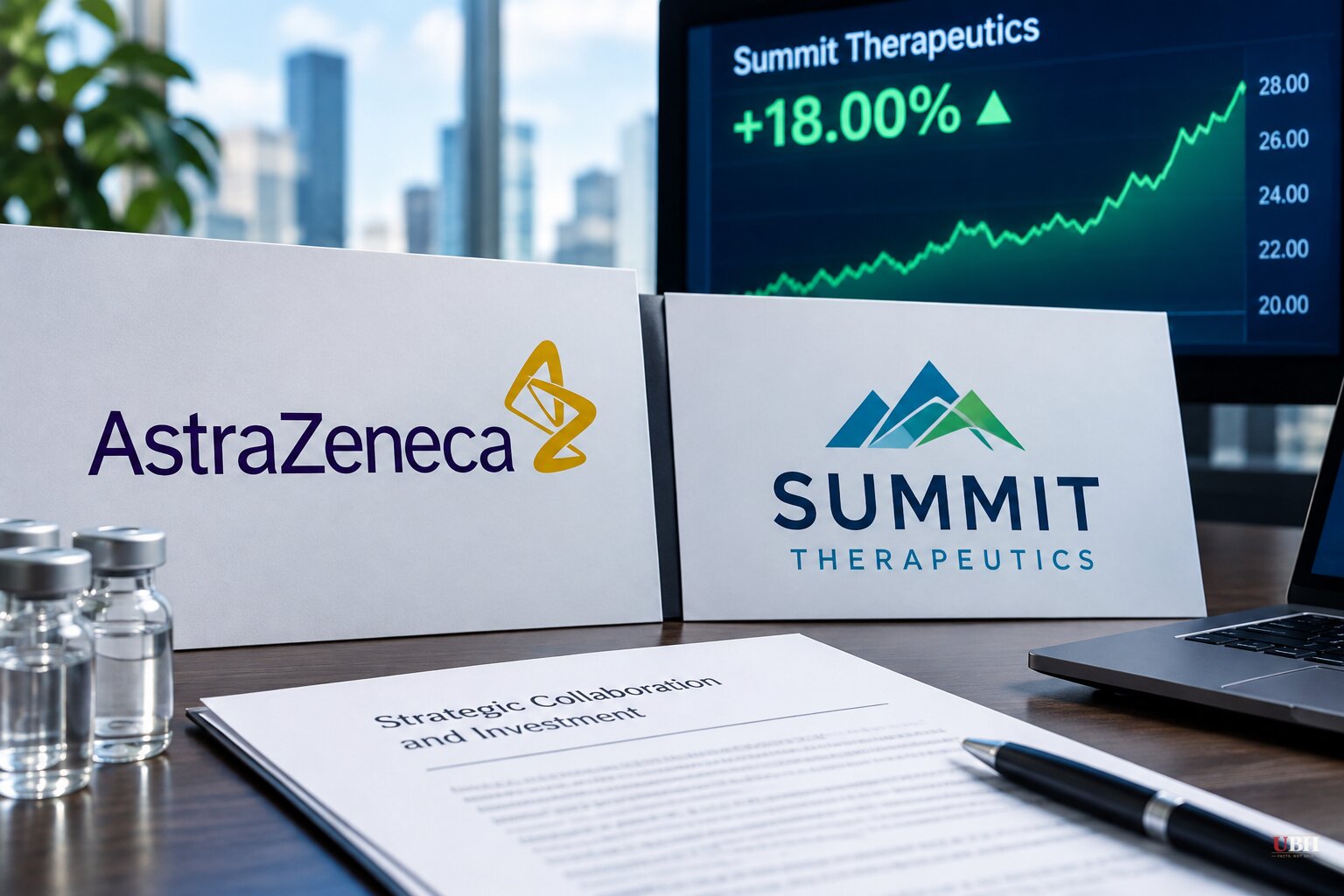
AstraZeneca is putting $2 billion into a smaller rival's cancer drug. The British pharma giant announced Monday, September 28, 2026, that it will invest $2 billion in Summit Therapeutics through newly issued convertible preferred shares, according to a joint announcement carried by Financial Content and confirmed by Bloomberg and the Wall Street Journal (via Morningstar).
Summit's stock responded immediately. Shares surged roughly 17% to 18% in after-hours trading Monday, according to TradingView and Morningstar. AstraZeneca's own shares ticked up about 1% in the same window, per TradingView, a modest move for a company AstraZeneca's size.
What AstraZeneca Is Actually Buying
Under the share purchase agreement, AstraZeneca will buy approximately 108,955 shares of Summit preferred stock, convertible into common stock at a 1-to-1,000 ratio, according to securities.io and TradingView. That conversion works out to a common stock price of $18.36 per share.
How that price was set involves some technical detail. TradingView and securities.io report the $18.36 figure is the five-day volume-weighted average price from the prior week, plus a 10% premium. Bloomberg, comparing that same $18.36 figure against Summit's actual closing price the prior trading day, calculated it as an almost 19% premium. Both numbers are accurate, measuring the premium against different baselines, since Summit's stock had moved between the VWAP period and Monday's close.
Once the deal closes, AstraZeneca will hold rights equivalent to about 12.0% of Summit's outstanding common stock, or 10.6% on a fully diluted basis, according to securities.io. Summit says the preferred shares haven't been registered under the Securities Act of 1933, and the company has agreed to file a resale registration statement with the SEC after closing. AstraZeneca expects the investment to close within the week, subject to standard conditions.
The Science Behind the Check
The money comes bundled with a clinical collaboration agreement to test AstraZeneca's antibody-drug conjugate sonesitatug vedotin, known as Sone-Ve, alongside Summit's ivonescimab in gastrointestinal cancers, according to Endpoints News and securities.io. Sone-Ve targets a protein called Claudin 18.2 found in the stomach lining, which AstraZeneca describes as a validated cancer target, particularly in GI tumors.
Ivonescimab is Summit's lead asset, a bispecific antibody that targets both PD-1 and VEGF, two pathways cancer cells use to evade the immune system and grow blood supply. Summit has been building a case that combining ivonescimab with other companies' drugs could boost its effectiveness.
The two companies also signed a non-binding memorandum of understanding to explore combining ivonescimab with several more of AstraZeneca's cancer medicines, including other ADCs, according to the Financial Content release. Notably, neither the Sone-Ve collaboration nor the broader MOU includes royalty, milestone, or profit-sharing provisions. Each company keeps its own development and commercial rights to its molecule, and the arrangement is described as mutually non-exclusive, meaning both companies can still pursue other partners for the same drugs.
Company Reaction
Summit's leadership framed the deal as validation of years of work on ivonescimab. "This significant investment, as well as the collaboration, is a powerful validation of the potential of ivonescimab," said Robert W. Duggan, Summit's Chairman and Co-Chief Executive Officer, according to Financial Content.
Dr. Maky Zanganeh, Summit's President and Co-CEO, called it "an exciting new chapter in the advancement of ivonescimab," pointing to plans for additional trials pairing the drug with ADCs and other novel compounds.
Endpoints News, which has tracked speculation about a full AstraZeneca-Summit tie-up for months, noted this deal gives AstraZeneca a slice of Summit rather than the whole company, an outcome some biotech watchers had expected to be a full buyout.
What's Still Unresolved
The non-binding MOU covering the broader ADC combination trials is exactly that: non-binding. It commits neither company to anything beyond further negotiation, and terms for any eventual binding agreement, including whether royalties or milestones get added later, haven't been disclosed.
Also unresolved is how the market will value the converted shares once the resale registration statement clears the SEC and roughly 109,000 preferred shares become 109 million common shares eligible for trading, a dilution event investors will be watching closely once it happens later this year.
Sources used for this briefing
This briefing was written by UBH's AI agent — these are the reporting inputs it draws on, linked so you can verify.


