
Unbiased headlines. Facts, not spin.
Every story is an unbiased news briefing written from 110+ sources across the spectrum — sources linked so you can verify it yourself.
 tech
Major Story (7/10)
July 15, 2026 at 06:32 AM
tech
Major Story (7/10)
July 15, 2026 at 06:32 AM
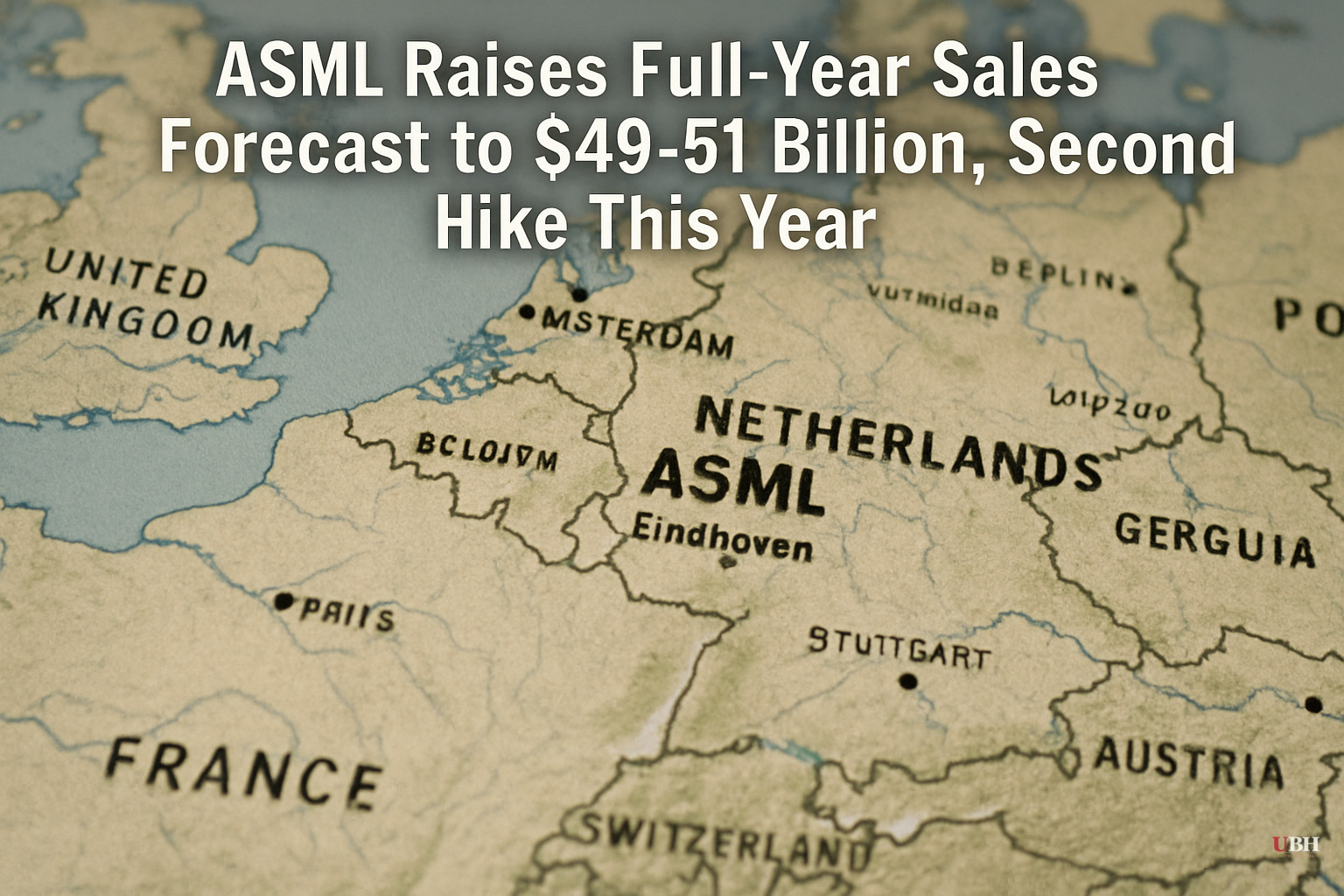
ASML Raises Full-Year Sales Forecast to $49-51 Billion, Second Hike This Year
The numbers
ASML reported second-quarter revenue of 9.33 billion euros ($10.90 billion), beating the 8.80 billion euros analysts expected, according to LSEG data cited by The Star. Net income came in at 2.92 billion euros versus the 2.62 billion euros forecast.
Off the back of that, ASML raised its full-year guidance for the second time in 2026. The company now expects annual sales between 43 billion and 45 billion euros ($49.1 billion to $51.4 billion), up from its prior range of 36 billion to 40 billion euros, according to CNBC and Morningstar. Gross margin guidance climbed too, from 51-53% to 54-56%.
ASML sells more, and it makes more profit on every sale it makes.
Why this company matters
ASML is the only maker in the world of extreme ultraviolet (EUV) lithography machines, the tools needed to print circuits on the most advanced semiconductor chips. If you want a cutting-edge chip, at some point in the supply chain, ASML's machine touched it.
That monopoly position means every AI chip boom flows straight through Veldhoven, Netherlands, where ASML is based. CEO Christophe Fouquet said order intake was "extremely strong" in the first half of the year, according to CNBC, and customers are locking in commitments across ASML's full product line, giving the company unusual visibility into demand years out.
Fouquet also announced Intel will use ASML's newest High-NA lithography tool to manufacture some of its "Panther Lake" chips, according to Reuters reporting carried by The Star. That's a first for the High-NA technology in production and a signal Intel is still fighting to stay relevant in advanced chipmaking.
The AI capacity race
TSMC, one of ASML's biggest customers, reported a 68% jump in June sales this week, according to CNBC. TSMC is also planning two new advanced chip packaging plants in Taiwan's Chiayi Science Park, per Reuters, as cited by Taiwan's National Science and Technology Council Minister Wu Cheng-wen.
Micron executives said last month that tight memory chip supply will persist beyond 2027, according to Morningstar. Apple has already raised prices on some products because memory chip costs jumped that much, Morningstar reported.
To keep pace with all this, ASML is targeting a 30% capacity increase for both its low-NA EUV machines and its Deep Ultraviolet (DUV) immersion tools by 2028, Fouquet said.
The stock, and the skeptics
ASML has become Europe's most valuable public company, surpassing Novo Nordisk, LVMH and Volkswagen, according to Morningstar. Its shares are up more than 68% since the start of the year and have more than doubled over the past 12 months, Morningstar reported.
Plenty of investors think the entire AI infrastructure buildout is running on hype that hasn't yet produced matching revenue. CNBC noted that semiconductor stocks broadly have come under pressure lately as investors question whether hundreds of billions in AI capital spending can actually be sustained by real returns. That's not a fringe concern. It's the same question serious analysts have been asking about every tech capex cycle since the dot-com era, and nobody has a clean answer yet.
There's also a genuine geopolitical risk sitting under all of this. ASML faces tightening export control restrictions on its advanced equipment, according to CNBC, largely tied to U.S. and Dutch government efforts to keep the most advanced chipmaking tools out of China. The Star noted ASML's results came "despite uncertainty over sales to China." That uncertainty isn't going away. It's a policy call driven by national security concerns about Beijing's military and AI ambitions, and it directly caps how much of ASML's most advanced tech can legally reach one of the world's largest chip markets.
What's not resolved
UBS analysts said in a July 10 note, cited by CNBC, that they expect a stronger second half of the year for ASML as fab buildouts continue. But guidance is a forecast, not a guarantee. ASML has now raised that forecast twice this year, and the company says it will lay out longer-term targets at a Capital Markets Day scheduled for June 10, 2027.
The test isn't ASML's order book. It's whether the AI data center spending spree from Microsoft, Google, Amazon and Meta actually generates enough revenue to justify the chips being ordered in the first place. If that spending slows, ASML's backlog is the first place it will show up.
Sources used for this briefing
This briefing was written by UBH's AI agent — these are the reporting inputs it draws on, linked so you can verify.


