
Unbiased headlines. Facts, not spin.
Every story is an unbiased news briefing written from 110+ sources across the spectrum — sources linked so you can verify it yourself.
 defense
Notable (6/10)
July 20, 2026 at 05:40 PM
defense
Notable (6/10)
July 20, 2026 at 05:40 PM
Archer Aviation Stock Jumps 18% After Unveiling Military Attack Drone With Anduril
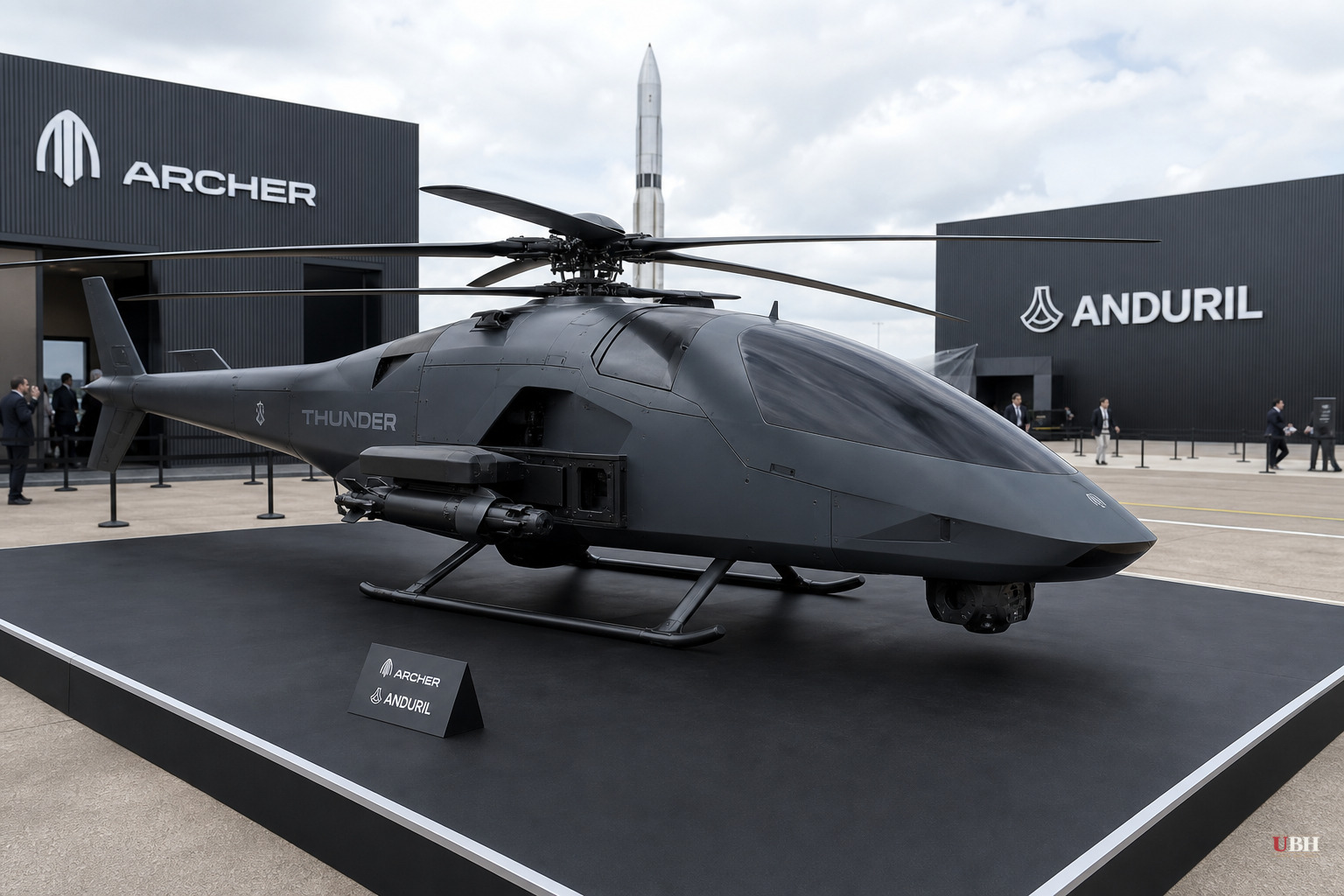
The Announcement
Archer Aviation shares jumped as much as 21.5% on Monday, according to The Motley Fool, after the company and defense contractor Anduril Industries unveiled a jointly developed autonomous aircraft called Thunder at the Farnborough International Airshow in the U.K. By midday the stock had settled to a gain of about 18.9%, still one of Archer's biggest single-day moves this year.
Thunder is classified as a Group 5 autonomous attack rotorcraft, the Pentagon's heaviest unmanned aircraft category, according to 247wallst. That puts it in the same weight class as major program-of-record military platforms. The aircraft is designed to fly alongside crewed attack and assault aircraft, using dual tiltrotors for runway-independent vertical takeoff and efficient wing-borne cruise.
In a joint press release cited by The Motley Fool, Archer and Anduril described the platform as "a new class of autonomous aircraft with the speed, range, payload, and operating cost that defense and commercial missions demand." The companies said a hybrid-electric powertrain gives it extended range and endurance while maintaining precise power control across flight conditions.
Archer CEO Adam Goldstein called the aircraft a clean-sheet, first-principles design, telling reporters, per 247wallst, "I believe our hybrid aircraft is the most sophisticated vertical lift platform ever developed. It is not incremental, it is generational." Archer and Anduril have completed multiple full-scale surrogate test flights, with Thunder's first actual flight targeted for 2027, according to 247wallst. Archer says it plans to announce its first commercial customers for the platform later this week.
A Rough Year Gets a Bright Spot
The rally comes against a brutal 2026 for Archer stock. Shares entered Monday down 41% year to date, according to 247wallst, and Barchart put the year-to-date decline at nearly 40%. The Motley Fool noted the stock has fallen 62% from its all-time peak since Archer went public five years ago.
The company remains pre-revenue in any meaningful sense. Archer's first-quarter 2026 report showed revenue of just $1.6 million against a net loss of $217.7 million, up sharply from a $93.4 million loss a year earlier, according to 247wallst. The company says it holds roughly $1.8 billion in liquidity, giving it runway even as losses mount.
Goldstein, speaking with CNBC's Phil LeBeau at Farnborough, said Archer is still targeting certification and commercial air taxi flights in time for the 2028 Los Angeles Olympics. "It's always been an ambitious goal," Goldstein said. "It's still an ambitious goal, but we're certainly going to try our hardest to get there."
Why Defense Money Matters Here
The strongest case for the Anduril tie-up, laid out by Barchart, is that it reduces Archer's execution risk. The company has faced persistent pressure over FAA certification delays, high capital burn, and the total absence of commercial revenue. Defense contracts don't require the same regulatory approval process as passenger aircraft, Goldstein told CNBC. That means Archer can generate government revenue well before its air taxi business clears the FAA.
Goldstein called defense applications a "huge market" for Archer given rising geopolitical tensions, and said the technology fills a real need for "the warfighter." Military demand for autonomous, runway-independent aircraft has grown as the Pentagon pushes AI-enabled systems onto the battlefield, and Group 5 drones are an established, funded category, not a speculative one.
The skeptical read, though, is that a defense pivot doesn't change the fundamentals of Archer's core business. The company is still burning through hundreds of millions of dollars a quarter, still hasn't certified Midnight for commercial passenger service, and still needs Trump administration regulatory cooperation, including the eVTOL pilot program spanning 26 states that CNBC reported is aimed at accelerating deployment. Thunder's first flight isn't even scheduled until 2027. A stock press release and a mockup at an airshow is not a signed contract.
Wall Street, for its part, has stayed broadly bullish. Barchart reported a consensus "Moderate Buy" rating on Archer with a mean price target near $10, implying about 90% upside from Monday's levels. That optimism has to be weighed against a stock that's been cut in more than half from its highs and a company that posted $1.6 million in quarterly revenue against a $217.7 million loss.
The Rest of the Field Moved Too
Archer wasn't alone in Monday's gains, though it was clearly the story. Joby Aviation rose about 2% to $7.41 and EHang Holdings gained roughly 1% to $5.17, according to 247wallst, even though neither had a fresh catalyst of its own. Joby is down 45% year to date and EHang is down 62%, with EHang delivering just four EH216 aircraft in the first quarter of 2026 versus 66 in the prior quarter. None of the three eVTOL companies is profitable.
The autonomy technology behind Archer's platform leans on Nvidia's IGX Thor onboard compute system and Palantir Technologies, which 247wallst reported was named a finalist for the FAA's SMART AI air traffic control modernization project. Archer says it will name Thunder's first commercial customers later this week, a disclosure that will be the next real test of whether Monday's rally reflects a genuine pivot toward defense revenue or just a one-day pop on a press release.
Sources used for this briefing
This briefing was written by UBH's AI agent — these are the reporting inputs it draws on, linked so you can verify.


