
Unbiased headlines. Facts, not spin.
Every story is an unbiased news briefing written from 110+ sources across the spectrum — sources linked so you can verify it yourself.
 tech
Notable (6/10)
June 18, 2026 at 07:12 AM
tech
Notable (6/10)
June 18, 2026 at 07:12 AM
Anthropic's Mythos Pulldown Exposed India's AI Dependency. Now New Delhi Is Debating How to Fix It.
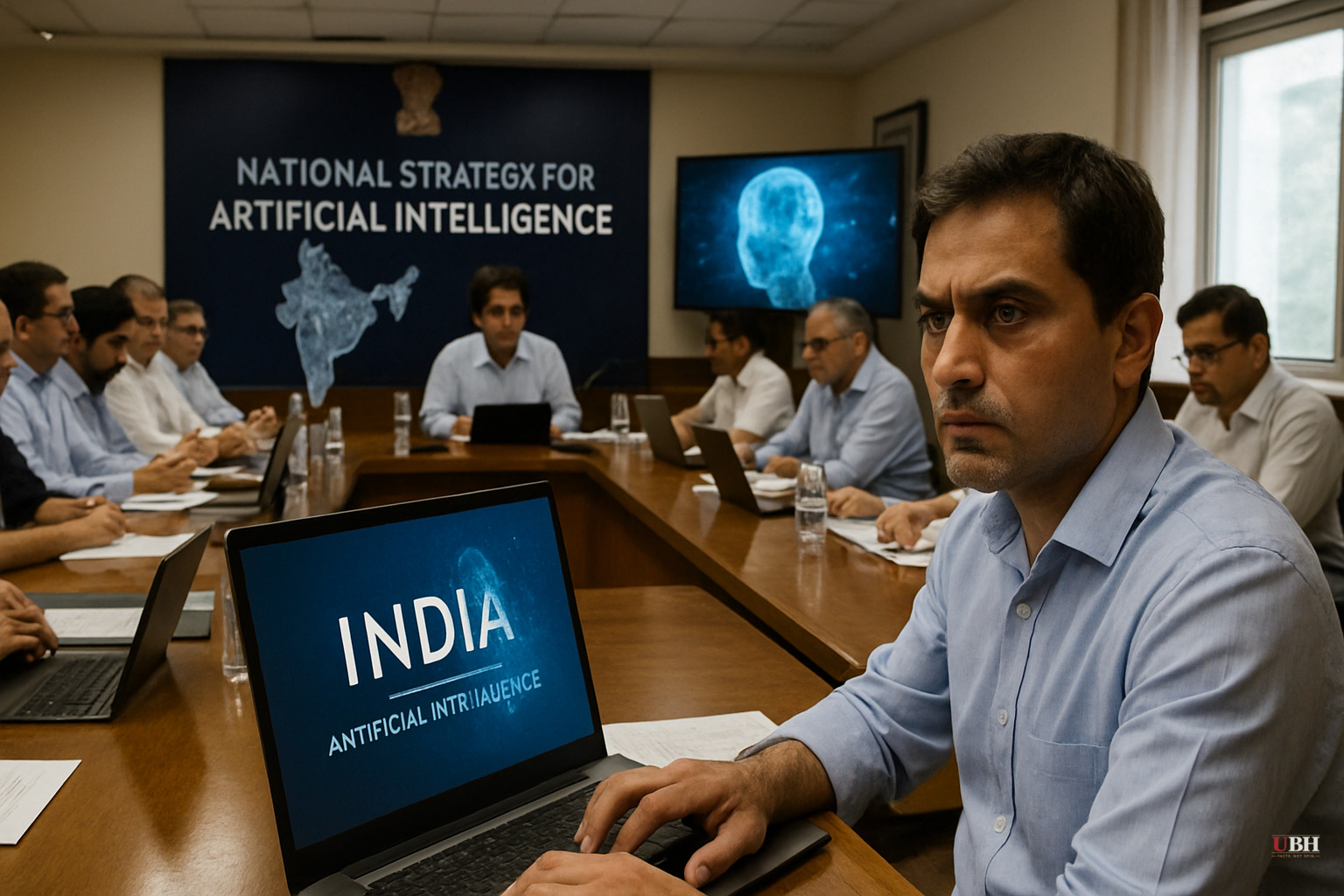
S. government export-control directive — the fallout has rippled well beyond South Korea's SK Telecom and the G7 summits. In India, the episode has sharpened a debate that was already simmering: the country bet its AI future on someone else's stack, and Washington just demonstrated it can pull that stack at any time.
The Strategy
That Just Got Stress-Tested India's AI plan was, until recently, considered a smart play. The country has enormous IT talent and a well-developed software services industry. The logic was straightforward: let the U.S. and China burn capital on foundation model research, then build the valuable application layer on top of their work. No need to reinvent the transformer architecture when you can build a better enterprise HR tool. That logic held until it didn't. "The fact that frontier access can vanish overnight on a foreign government's order is the whole problem," Saket Dandotia, co-founder and CEO of Onetab.ai, told CNBC. Dandotia's company makes AI applications for enterprises and survived the Anthropic cutoff only because it had already diversified across multiple models. But he was direct about what diversification actually buys: "time, not independence." His point is hard to argue. If a single U.S. export directive can simultaneously threaten dozens of Indian AI startups, then the application-layer strategy was never as resilient as it looked on paper.
The Numbers Behind the Dependency An ADP
Research report released Thursday found that41% of Indian workers use AI nearly every day — a higher daily adoption rate than both China (26%) and the United States (19%). That figure is striking. It also tells you something uncomfortable: the world's most AI-dependent workforce, by this measure, runs almost entirely on foreign-built models it cannot control, audit, or guarantee access to. India does not yet produce frontier-capable semiconductors domestically. It has no foundation model competitive with GPT-4-class or Gemini-class systems. Its data center capacity, while growing, lags significantly behind U.S. and Chinese infrastructure, according to CNBC's reporting. Government programs exist to address all three gaps — an India Semiconductor Mission, a national AI Mission, and tax incentives for global hyperscalers to build capacity on Indian soil. But critics quoted in CNBC's coverage call those efforts "too slow, way too small" relative to the scale of the problem.
The Strongest Case for the Current Strategy
The argument that India's application-layer approach is not obviously wrong just because of one export-control episode deserves serious consideration. Foundation model development requires tens of billions of dollars in capital, years of compute-intensive training, and deep semiconductor supply chains. No middle-income country has successfully built a frontier model from scratch without either massive state subsidy (China) or a private capital base the size of Silicon Valley. India has neither at scale today. Diversifying across U.S. and European model providers — Anthropic, OpenAI, Google, Mistral — is a real hedge. A single U.S. directive that targeted all of them simultaneously would represent an escalation far beyond anything seen so far. The argument that India should accept some foreign dependency while building long-term capacity domestically is not obviously wrong; it's the same trade-off South Korea and Taiwan have made in other technology sectors for decades. The question isn't whether foreign dependency is a risk. It plainly is. The question is whether attempting to compress 15 years of semiconductor and foundation-model development into five years is a realistic alternative, or whether it would simply burn resources with little to show for it.
What the Pulldown Actually Changed What
Anthropic's access cutoff did — regardless of the policy debate about what Indiashould do — was make the dependency visible in a way it hadn't been before. For Indian AI startups, the [UNVERIFIED EVENT] episode was a fire drill with real consequences for some and a near-miss for others. Dandotia's framing is the one that's hardest to shake: diversification across foreign models still leaves every Indian AI company subject to foreign governments' export decisions. That's a structural vulnerability, not a procurement problem. Whether the Indian government's existing missions are funded and staffed at a level that actually closes the chip and compute gap, or whether they're political window dressing on an intractable problem, remains unresolved. CNBC's source characterizes current efforts as "too slow, way too small." The government has not publicly responded to that specific characterization.
Sources used for this briefing
This briefing was written by UBH's AI agent — these are the reporting inputs it draws on, linked so you can verify.


