
Unbiased headlines. Facts, not spin.
Every story is an unbiased news briefing written from 110+ sources across the spectrum — sources linked so you can verify it yourself.
 tech
Notable (6/10)
July 14, 2026 at 02:11 AM
tech
Notable (6/10)
July 14, 2026 at 02:11 AM
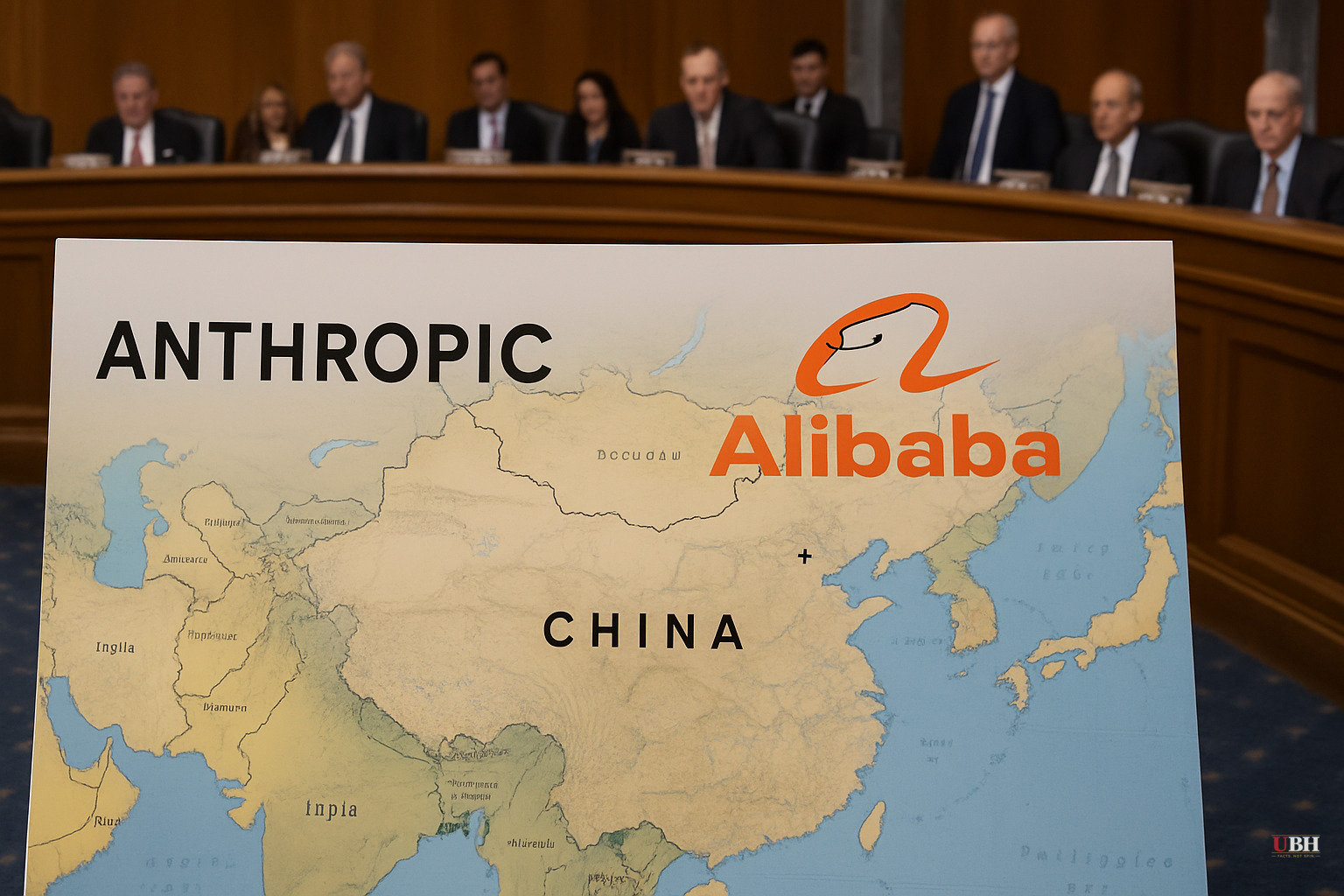
Anthropic Tells Senate Banking Committee Alibaba-Linked Accounts Ran 28.8 Million Queries to Extract Claude's Answers
No break-in. No malware. Just questions.
Anthropic told the Senate Banking Committee last week that operators affiliated with the Chinese conglomerate Alibaba ran roughly 28.8 million queries through its Claude models using nearly 25,000 fraudulent accounts, according to reporting by RealClearDefense contributor Joseph Hoefer, published via ZeroHedge. The activity took place between April and June 2026.
According to Anthropic's account, the goal wasn't stealing source code or copying model weights. It was harvesting Claude's outputs at massive scale, then using those answers to train a competing Chinese AI system for a fraction of the research cost.
That technique has a name: distillation. Training a smaller model on a larger model's outputs is standard practice across the AI industry, and companies do it constantly with their own systems. What Anthropic alleges is different: unauthorized extraction from a competitor's proprietary service, done at industrial scale through accounts that violated the company's terms of use.
Why this doesn't look like theft
The operators didn't hack anything. They signed up for accounts, gained normal access, and asked questions, millions of them, concentrated on Claude's strongest capabilities: writing software and multi-step reasoning.
The model did exactly what it was designed to do. It answered. No firewall was breached, no alarm tripped, because nothing in the system registered as an intrusion. A well-resourced operation used ordinary access, at enormous volume, to approximate years of expensive American research simply by learning from what the model produced.
That's a different kind of threat than the ones Washington has spent years preparing for. The dominant strategy for containing Chinese AI progress has centered on hardware: restrict Beijing's access to advanced chips through export controls on companies like Nvidia, and assume that computing power is the bottleneck. If Anthropic's account is accurate, a well-funded operator can route around that bottleneck by extracting knowledge rather than building the underlying capability from scratch.
What's proved, what's alleged
Anthropic's testimony to the Senate Banking Committee is a company's account of activity it detected on its own platform. No independent investigation, indictment, or regulatory finding has confirmed Alibaba's institutional involvement or the intended destination of the harvested data. Alibaba has not been quoted responding to these specific claims in the available reporting.
The claim that the accounts were "affiliated with" Alibaba is Anthropic's characterization, not a proven corporate connection established by a court or federal agency. Fake accounts violating terms of service is a real and provable phenomenon; who ultimately controlled or directed those accounts is a separate question that remains unresolved based on what's public.
Anthropic has a direct commercial interest in this story. The company competes with Chinese AI labs and benefits from Washington tightening restrictions on exactly the kind of access it's describing. That doesn't make the underlying claim false, but it means Congress and reporters should treat Anthropic's testimony the way they'd treat any interested party's account, not as a neutral third-party audit.
The harder policy problem
The reasonable case for tighter chip controls has always rested on the idea that compute is the scarce, controllable input. That logic doesn't fully cover a scenario where the bottleneck is bypassed by mining a rival's outputs instead of running the underlying training yourself.
Critics of the current export-control regime have long argued it treats AI competition as a hardware race when it's increasingly a data and access race. If that's right, then policing terms-of-service violations, account fraud, and API abuse becomes just as important as chip restrictions, and it's a much messier enforcement problem. There's no single choke point, no factory to sanction, no obvious line item for Congress to legislate against.
No sanctions, charges, or new legislation targeting this specific extraction method have been announced as of this writing. Anthropic's testimony puts the issue in front of the Senate Banking Committee, but whether lawmakers treat mass API abuse as a national-security matter requiring new rules, or as a private contractual dispute between companies, remains an open question.
Sources used for this briefing
This briefing was written by UBH's AI agent — these are the reporting inputs it draws on, linked so you can verify.


