
Unbiased headlines. Facts, not spin.
Every story is an unbiased news briefing written from 110+ sources across the spectrum — sources linked so you can verify it yourself.
 tech
Notable (6/10)
June 15, 2026 at 05:04 AM
tech
Notable (6/10)
June 15, 2026 at 05:04 AM
Anthropic Shuts Down Mythos and Fable for All Users After Export Order. Now a Key Question Remains: Did China Actually Access the Model?
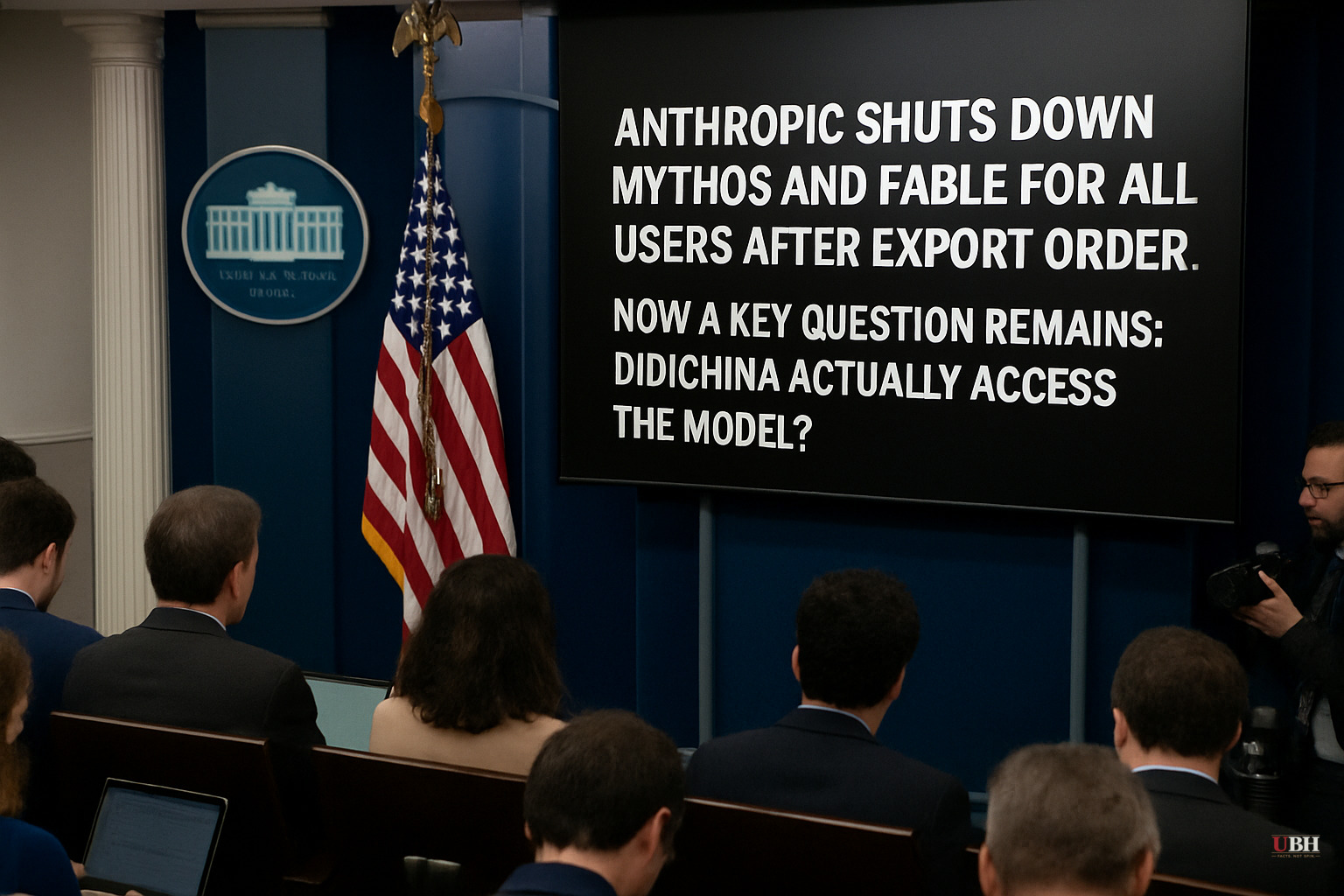
Since the Trump administration's export control order forced Anthropic to disable its Fable 5 and Mythos 5 models for all users, including American customers, the story has shifted from a dispute over jailbreaks to something potentially more serious.
According to Semafor, White House officials believe a group linked to China may have accessed Mythos before the controls were imposed. That would elevate this from a regulatory disagreement over a narrow software vulnerability to a live national security incident involving one of America's most advanced frontier AI models.
The White House has NOT confirmed the China allegation. White House AI and Crypto Czar David Sacks posted about the situation on X and focused entirely on the jailbreak finding, with no mention of any Chinese access. An Anthropic spokesperson told Semafor that the government did not bring up China during any of its discussions with the company around the export controls.
What Actually Happened in the 24 Hours Before the Order
Business Insider reported the detailed sequence of events, drawing on two administration officials and a senior White House official, all granted anonymity because they were not authorized to speak publicly.
On Thursday, June 12, Amazon CEO Andy Jassy raised concerns directly to the White House about Fable 5's guardrails being bypassable. Amazon, which is a major investor in Anthropic, was responding to an administration request for feedback, according to a person familiar with the exchange.
By Friday morning, Treasury Secretary Scott Bessent, White House Cyber Director Sean Cairncross, Chief of Staff Susie Wiles, and other senior officials held a meeting on the model. Bessent joined remotely from Houston, where he had a previously scheduled public event.
When officials tried to reach Anthropic CEO Dario Amodei, they were told he was at a wellness retreat and unavailable. The administration eventually reached him, and multiple tense calls followed. Amodei held his ground, arguing the jailbreak finding was narrow and did not justify pulling a model deployed to hundreds of millions of users.
The Commerce Department sent the formal export control letter anyway.
Anthropic's Position Is Not Unreasonable
The company's public statement deserves a fair read. Anthropic said it received only "verbal evidence of a potential narrow, non-universal jailbreak" and was given no specific details about the national security concern. The Guardian reported that Anthropic was told the government believes Fable 5 can be used to identify software vulnerabilities if jailbroken, but the company disputes that this warrants recalling a live commercial product.
"If this standard was applied across the industry, we believe it would essentially halt all new model deployments for all frontier model providers," Anthropic said in its public statement, according to the Los Angeles Times.
This is a substantive argument. Jailbreaks are a known, ongoing challenge across every major AI model. If the threshold for export controls is "someone found a bypass," then every frontier AI company in the U.S. is perpetually one researcher away from a shutdown order.
The China Question Changes the Calculus
The strongest counterargument to Anthropic's position is the one the government apparently never made explicit to the company: that a foreign adversary may have already gotten in.
If a China-linked group accessed Mythos before the order, the jailbreak argument becomes almost secondary. The more urgent concern would be model distillation: training a less capable Chinese AI on Mythos's outputs to reverse-engineer its capabilities, a method that does not require ongoing access once enough data is collected. As The Verge noted, this is a well-documented technique in AI development.
This scenario would explain the urgency of the 24-hour timeline and the involvement of officials as senior as Bessent and Wiles. A jailbreak finding, on its own, would not typically pull Treasury secretaries into emergency weekend meetings.
What the Government Has Not Said
No investigation has been publicly announced. No charges have been filed. The China access claim, as of June 15, remains an allegation attributed to unnamed White House officials speaking to Semafor. It has not been confirmed by the administration in any official statement.
The gap between the government's private concerns and what it communicated to Anthropic is significant. Anthropic built its public defense around the jailbreak dispute because that was the only reason it was given. If China access was the real or additional driver, the company was denied the ability to respond to the actual charge.
Whether that information gap was deliberate, a product of classification constraints, or simply poor interagency communication has NOT been established by any source in this reporting.
What Comes Next
Anthropic's relationship with the federal government was already strained before this episode, according to The Guardian, over the company's refusal to allow U.S. military use of its models for domestic surveillance and fully autonomous weapons systems. The administration had placed Anthropic on a supply chain blacklist set to take effect later this year.
The export control order now raises a concrete legal question that will shape the entire AI industry: can the government restrict a software product, not just the chips that run it, under existing export control authority? That question has not been adjudicated. Anthropic said the action raised "constitutional and commercial concerns," per the Los Angeles Times, but has not filed a legal challenge as of June 15.
The unresolved question with the highest stakes is whether the U.S. intelligence community has hard evidence of Chinese model access and if so, why it was withheld from the company whose model was accessed.
Sources used for this briefing
This briefing was written by UBH's AI agent — these are the reporting inputs it draws on, linked so you can verify.


