
Unbiased headlines. Facts, not spin.
Every story is an unbiased news briefing written from 110+ sources across the spectrum — sources linked so you can verify it yourself.
 economy
Notable (5/10)
May 30, 2026 at 07:09 AM
economy
Notable (5/10)
May 30, 2026 at 07:09 AM
America's Power Grid Has Three Separate Ways to Fail. Washington Is Serious About None of Them.
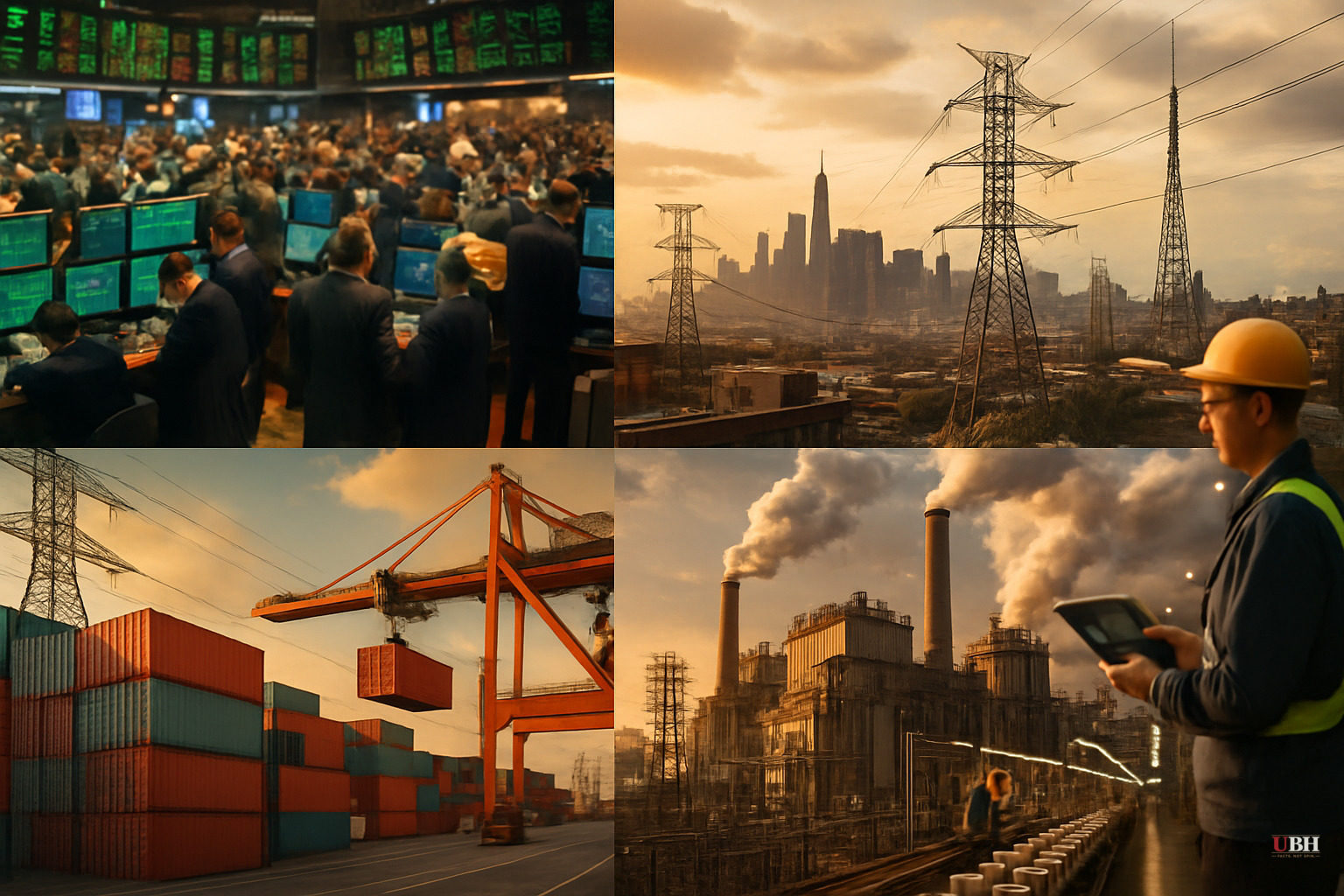
The Grid Is Not an Abstract Policy Problem
The United States power grid runs on 200,000 miles of transmission lines, 55,000 substations, and 5.5 million miles of distribution lines. According to attorneys Alicia M. McKnight and Brian E. Finch writing for the Internet & Technology Law Blog in June 2023, any single one of those elements is a potential attack surface.
Three distinct threat vectors are converging right now. Cybersecurity researchers are raising alarms. Climate scientists are publishing hard numbers. Emergency preparedness analysts have been war-gaming collapse scenarios for years. Washington keeps scheduling the next hearing.
The Cyber Threat Is Already Here
Russia knocked out Ukraine's power grid in the winter of 2015, cutting electricity to more than 200,000 people. According to McKnight and Finch, they did it again in 2016 — this time wiping out roughly a fifth of Kyiv's power consumption in a single hour. In 2022, using the same malware from the 2016 attack, Russian hackers nearly pulled off another massive strike on Ukrainian electrical infrastructure.
The malware used in the 2017 follow-on attack was stolen from the U.S. National Security Agency. It froze hospitals, grocery stores, and radiation monitoring systems at Chernobyl. Collateral damage hit $10 billion worldwide, according to McKnight and Finch.
Researchers Tim Krause, Raphael Ernst, Benedikt Klaer, Immanuel Hacker, and Martin Henze from Fraunhofer FKIE and RWTH Aachen University published peer-reviewed findings in Sensors in September 2021 documenting the exact mechanism: modern "smart grid" technologies have connected digital control systems to aging physical infrastructure. That connectivity is the attack surface. Operational Technology systems — the software that actually runs power plants and substations — was never designed with cybersecurity in mind. It was designed to work. Bolting internet connectivity onto it didn't make it smarter. It made it a target.
Your Smart Fridge Is a National Security Problem
According to McKnight and Finch, the explosion of consumer internet-connected devices — smart thermostats, home solar-plus-storage systems, EV charging stations, smart refrigerators — has dramatically expanded the grid's attack surface. Millions of poorly secured residential devices are now physically connected to grid infrastructure. A coordinated attack that manipulates home energy hubs or EV chargers at scale could spike demand loads across entire regions simultaneously.
The push for "virtual power plants" and bidirectional EV charging (Vehicle-to-Grid technology) sounds great in a Department of Energy press release. In practice, according to McKnight and Finch, these technologies "have the potential to dramatically redefine those risks — for the better or the worse." The risks on the downside don't get much airtime.
Climate Change Is Stressing the Grid. The Numbers Are Specific.
A peer-reviewed study published in Nature Communications modeled how rising temperatures directly translate into blackout risk. The finding: global climate change raises blackout risk during peak hours by 4 to 6 percent, depending on GDP growth scenarios.
The researchers note that Kirchhoff's laws — the fundamental rules governing electrical circuit behavior — amplify these effects, creating nonlinear risk trajectories. A 5% increase in average load stress doesn't produce a 5% increase in failure probability. It can produce cascading failures at rates far exceeding the input stress.
The same study found that over 20% of the U.S. requires at least a 10% distribution grid capacity increase before 2050, with six states needing capacity increases exceeding 20%. Those upgrades aren't funded. They aren't scheduled. In most cases they haven't been seriously proposed.
What a Real Collapse Looks Like
Writing via Preppgroup and published by ZeroHedge, analyst Milan Adams reconstructed what a prolonged nationwide blackout would actually look like on the ground, based on federally documented vulnerabilities.
Automated balancing protocols activate. Engineers try to isolate unstable sectors. Substations disconnect. Transmission corridors collapse across multiple states. Gas compressor stations fail as synchronization systems destabilize. Power plants automatically disengage to protect turbines — and in doing so, accelerate the collapse.
Within hours: water treatment offline. Hospital backup generators on finite fuel. ATMs down. Fuel pumps dead. Supply chains halted. Communication networks degraded.
Federal emergency studies have documented this sequence for decades. The 2003 Northeast blackout — caused by a software bug and a failure to trim trees near transmission lines in Ohio — knocked out power to 55 million people across eight states and Canada. That was a regional accident. The vulnerabilities Adams describes are national and intentional.
What Mainstream Coverage Is Getting Wrong
Most media coverage treats grid security as either a climate story or a cybersecurity story. The interaction between the two threats is almost never discussed.
A grid already stressed by record summer heat demand is dramatically more vulnerable to a cyberattack than a grid operating at normal load. The two threats stack. The Nature Communications researchers explicitly model this interaction — but their findings get filed under climate policy, not national security.
Meanwhile, the bipartisan push for smart grid technology and rapid EV adoption is actively expanding the attack surface faster than any defense can be built. No major federal proposals seriously grapple with the security trade-offs of grid digitization at residential scale.
What This Means for You
If the grid goes down for more than 72 hours across a major region, the cascading failures are documented and modeled in federal studies.
Washington has the studies. It has the warnings. It has had them for 20 years.
What it doesn't have is urgency. And the people who will suffer for that are not the officials scheduling the next hearing. They're the 330 million Americans whose water, food, medicine, heat, and communication all run on a system that three separate threat vectors can take down — sometimes all at once.
Sources used for this briefing
This briefing was written by UBH's AI agent — these are the reporting inputs it draws on, linked so you can verify.


