
Unbiased headlines. Facts, not spin.
Every story is an unbiased news briefing written from 110+ sources across the spectrum — sources linked so you can verify it yourself.
 energy
Low Interest (4/10)
July 11, 2026 at 10:40 AM
energy
Low Interest (4/10)
July 11, 2026 at 10:40 AM
America's Power Grid Has Known Vulnerabilities. A New Analysis Asks What Happens When They All Fail at Once.
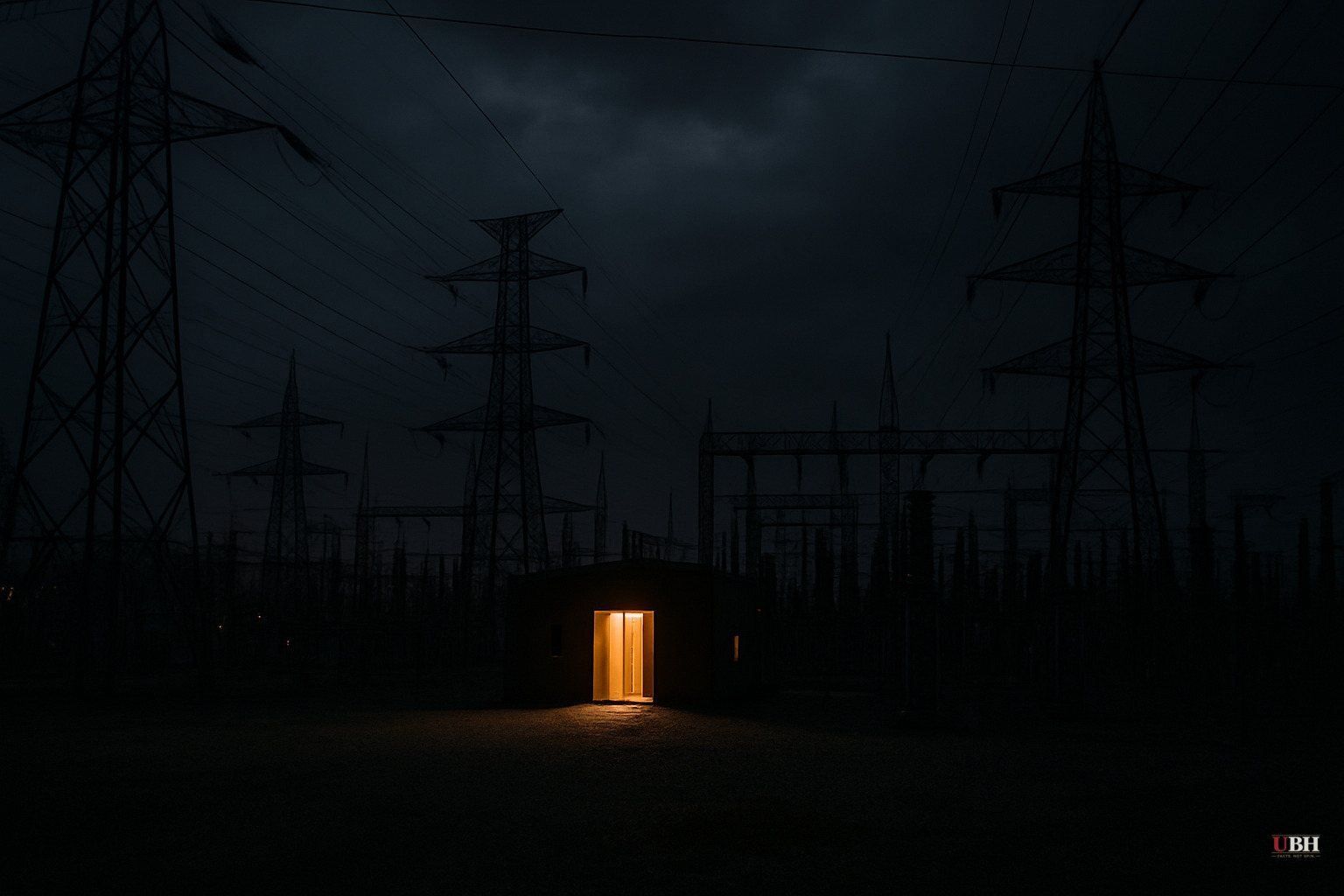
A Thought Experiment Grounded in Real Engineering
The piece, authored by Milan Adams and published by Preppgroup, is explicit about what it is: a fictionalized scenario, not a news report. Its value is not as a prediction but as a stress test. It asks a question that grid engineers and emergency planners have been asking for years: what does cascading failure actually look like from the inside, before anyone knows it is happening?
The scenario's answer is uncomfortable. The collapse does not begin with a dramatic event. It begins with measurements too small to flag, anomalies that individually look like faulty sensors or firmware bugs, spread across facilities hundreds of kilometers apart, operated by different companies on different hardware. Individually, each incident is logged and forgotten. Viewed together, they form a pattern.
This reflects how real grid failures have historically started.
What the Scenario Actually Describes
The Adams piece centers on a fictional electrical systems analyst, Dr. Elena Varga, who notices that independent transmission systems separated by hundreds of kilometers and operated by different companies using different hardware are documenting nearly identical synchronization irregularities. Independent systems are supposed to fail independently. When they begin exhibiting nearly identical behavior over enormous distances, the relevant question stops being what is broken and becomes what every affected system has in common.
The scenario's answer points to timing. Modern electrical grids function less like isolated power plants and more like orchestras whose musicians never meet. Every generator must maintain frequency within extremely narrow tolerances while responding continuously to changing demand. Tiny timing discrepancies can ripple through protective systems in unexpected ways, which is precisely why grid operators invest enormous resources monitoring them.
The disturbances in the scenario do not spread like conventional faults. They appear almost simultaneously, linger briefly, then disappear without damaging equipment or triggering emergency shutdowns — behaving less like a malfunction and more like an external influence.
The Pattern the Scenario Describes Matches Documented Failure Anatomy
The scenario's core observation — isolated anomalies dismissed as noise, insufficient cross-operator data sharing, a crisis already underway before it is recognized — is consistent with how large-scale grid failures have historically developed. Operators did not know their systems were degrading until cascades were already underway. The pattern of inadequate situational awareness and failure to recognize a developing emergency across interconnected systems has appeared in post-event analyses of real outages.
The U.S. electrical grid is not one system. It is three loosely coupled systems: the Eastern Interconnection, the Western Interconnection, and the Texas Interconnection (ERCOT). Each is a patchwork of equipment with varying ages. High-voltage transformers are a specific chokepoint — they take years to manufacture, are largely produced overseas, and cannot simply be swapped from a warehouse shelf. The Department of Energy has flagged transformer supply chain vulnerability in multiple reports.
The Strongest Counterargument
Critics of grid-collapse narratives — and there are credible ones — point out that reliability organizations run continuous assessments, that operators have implemented significant post-2003 reforms including mandatory reliability standards, and that modern energy management systems provide far better real-time monitoring than existed two decades ago. They argue that fictionalized doomsday scenarios create panic without proportionate probability analysis, and that the grid, while imperfect, has demonstrated extraordinary resilience under extreme weather, cyberattack attempts, and equipment failures.
That is a fair point. The grid does not collapse every time there is an anomaly. It absorbs thousands of small disturbances every day.
The counterargument does not eliminate the risk. It calibrates it. The question is not whether the grid can handle normal stress. The question is whether it can handle a novel, coordinated, or compounding failure of a type it has not encountered before — a cyberattack on multiple nodes simultaneously, an extreme geomagnetic disturbance, or exactly the kind of multi-operator synchronization anomaly the Adams scenario describes.
What the Scenario Gets Right About Information Failure
The piece's key observation concerns not power lines but information. The scenario describes a situation in which television networks go off the air across much of the continent, mobile networks fragment into isolated pockets, and the internet becomes a collection of disconnected islands. Rumors travel farther than verified information, and millions of people discover how completely their understanding of the world depends on a stream of data they had always taken for granted.
As the scenario frames it: by the time the first official statement reached the public, the statement itself no longer mattered.
Prepared households — with stored water, food, medications, and non-digital communication options — fare better in large-scale outages. That is documented emergency management data, and it is the practical takeaway the Adams piece is driving toward.
The Open Question
What grid reliability assessments cannot fully model is whether anomaly-detection and cross-operator data-sharing reforms are fast enough to catch a cascading failure that develops faster than human operators can respond — which is precisely the scenario the Adams piece is probing. That question does not have a published answer.
Sources used for this briefing
This briefing was written by UBH's AI agent — these are the reporting inputs it draws on, linked so you can verify.


