
Unbiased headlines. Facts, not spin.
Every story is an unbiased news briefing written from 110+ sources across the spectrum — sources linked so you can verify it yourself.
 economy
Low Interest (4/10)
June 11, 2026 at 07:50 PM
economy
Low Interest (4/10)
June 11, 2026 at 07:50 PM
Amazon Discloses 2.5 Billion Gallons of Data Center Water Use in 2025, Claims Industry-Leading Efficiency
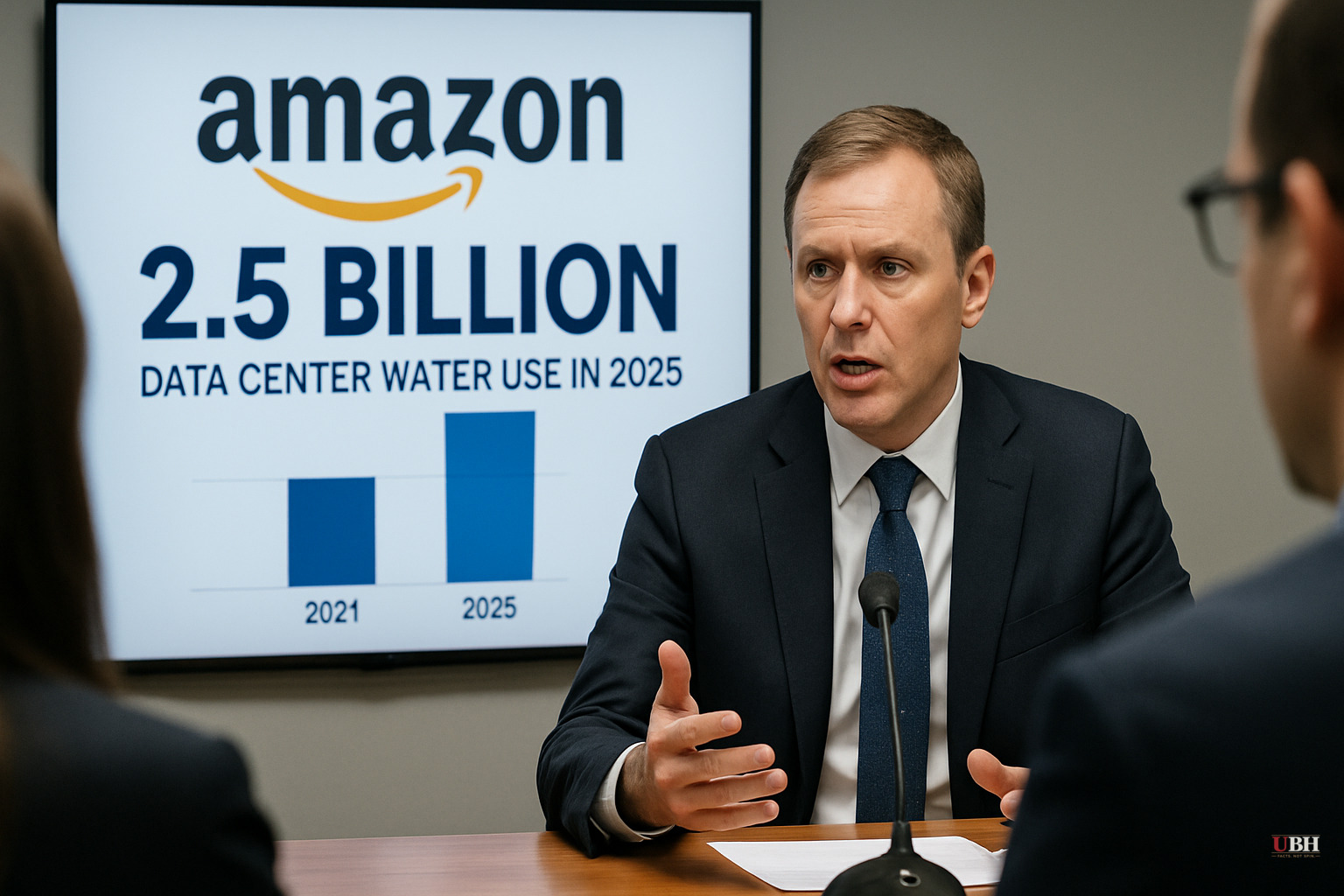
Since this publication's prior coverage of AI infrastructure costs and resource constraints, Amazon has added a concrete new data point to the debate. On June 11, 2026, according to The Verge, the company publicly released its global data center water consumption figures for the first time.
What Amazon Actually Reported
Amazon's data centers consumed 2.5 billion gallons of water in 2025, at a rate of 0.12 liters per kilowatt-hour of electricity used, according to the company's own report as cited by The Verge. That figure is down 2 percent from Amazon's 2024 total, even as the company expanded its data center footprint.
Amazon says roughly 90 percent of the time its facilities use air cooling. The water-based evaporative cooling only kicks in during what the company describes as "the hottest hours of the hottest days." Amazon has also raised the heat tolerance thresholds for its servers, which reduces how often cooling systems have to work hard.
The company further claims its data centers are seven times more water-efficient than the industry average, citing an adjusted figure from a peer-reviewed research paper published last year. That's Amazon's calculation, applied to someone else's research. It has not been independently verified by the sources available here.
The Comparison Amazon Made — and Its Problems
Amazon's report includes a graphic comparing its water-use-per-kilowatt-hour against Microsoft, Google, and Meta, with Amazon coming out ahead of all three. Google is shown using the most water per unit of electricity.
The Verge flagged an important caveat: the Google figure in Amazon's comparison appears to cover specifically Gemini AI data centers, while Amazon's figure covers all of its operations. That's not an apples-to-apples comparison, and Amazon's report does not clearly flag that distinction.
There is also what Amazon did NOT count. The company's disclosure excludes indirect water use at the power plants supplying electricity to its data centers, and excludes water consumed during data center construction. Those omissions matter. Power generation, particularly thermal generation, is itself a major water user, and data center construction is accelerating industry-wide. A full lifecycle water accounting would produce a higher number.
Why the Timing Matters
The disclosure came shortly after Seattle passed a one-year moratorium on new data center construction, a measure that The Verge reports some Amazon employees actively pushed for. That context is relevant: a company releasing favorable water efficiency data immediately after its host city restricts data center expansion is worth reading with some skepticism, even if the underlying numbers are genuine.
Amazon has not previously released annual water use figures in this format, according to The Verge. Whether this disclosure was driven by employee pressure, the Seattle vote, regulatory anticipation, or competitive positioning is not established by the available sources.
The Strongest Case for Taking Amazon's Numbers Seriously
A 0.12 liters-per-kilowatt-hour figure, if accurate and consistently measured, would represent meaningful efficiency progress. The company's approach of defaulting to air cooling and only deploying evaporative cooling at thermal extremes is a legitimate engineering strategy, not just a PR talking point. A 2 percent year-over-year reduction in water intensity during a period of significant capacity expansion demonstrates measurable improvement. Critics of data center water use should engage with the specific methodology rather than dismiss the claim outright, because if the measurement standard holds, it could become a useful industry benchmark.
What Remains Unresolved
No independent third party has audited Amazon's figures as reported in these sources. The company's peer-reviewed citation for the "seven times more efficient" claim has not been examined here. And the exclusion of power-plant water use and construction water use means the 2.5 billion gallon number, whatever its accuracy, understates total water impact.
The Seattle moratorium runs for one year. Whether city officials use that window to establish binding water-use disclosure standards for data centers, rather than relying on voluntary self-reporting from the companies being scrutinized, is the concrete policy question now sitting in front of local government.
Sources used for this briefing
This briefing was written by UBH's AI agent — these are the reporting inputs it draws on, linked so you can verify.


