
Unbiased headlines. Facts, not spin.
Every story is an unbiased news briefing written from 110+ sources across the spectrum — sources linked so you can verify it yourself.
 tech
Major Story (7/10)
June 22, 2026 at 08:47 PM
tech
Major Story (7/10)
June 22, 2026 at 08:47 PM
Alphabet Shares Fell 7% Monday as Talent Exits and Nadella's Commoditization Warning Hit Investor Confidence
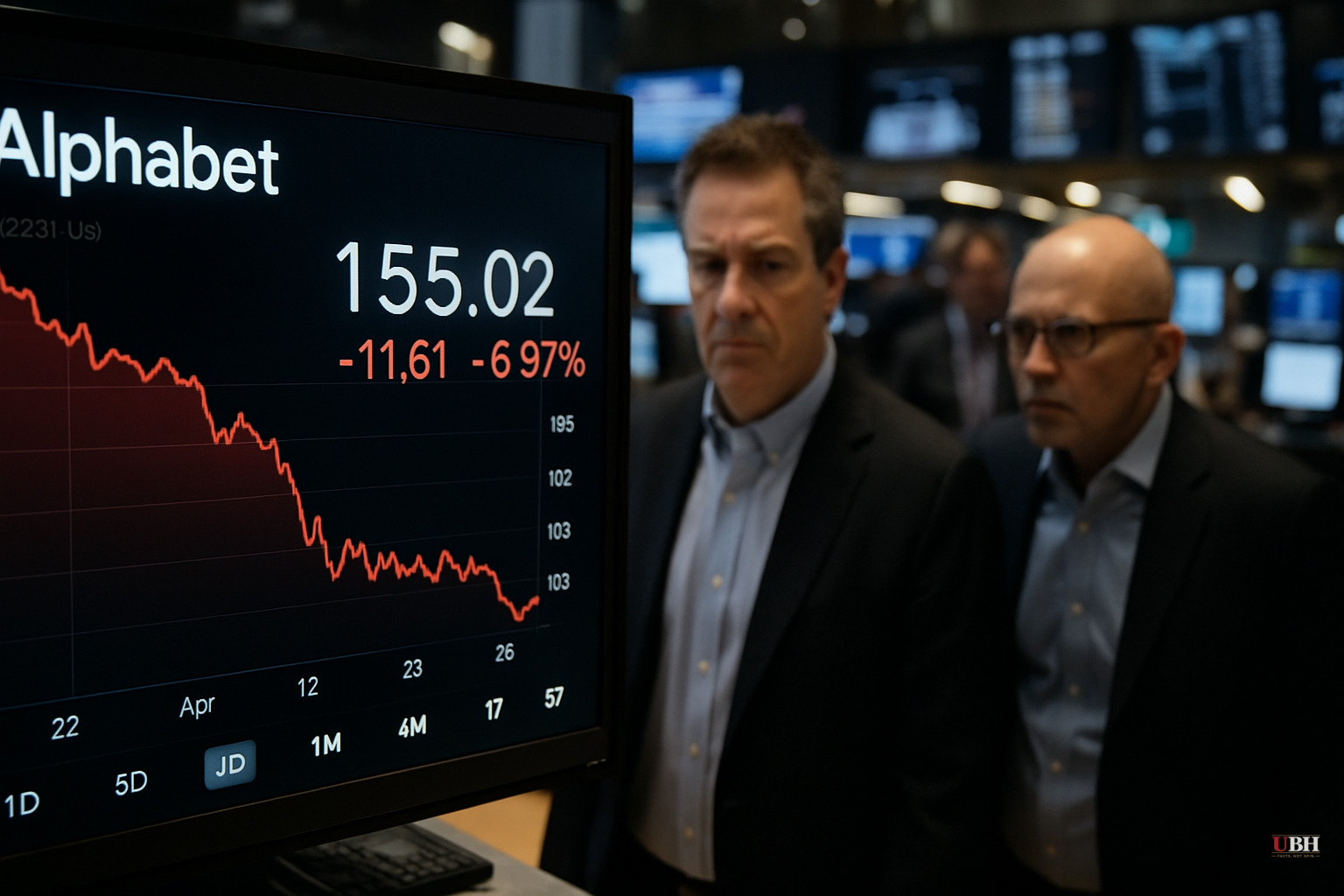
Monday's trading session saw Alphabet shares down roughly 7%, according to CNBC, underperforming both the Nasdaq composite and its megacap peers. That's the stock's worst single-day decline in approximately a year.
Two Exits in One Week
The damage began last week when Noam Shazeer, Google's vice president of engineering and a co-lead of its Gemini AI models, announced Wednesday that he was leaving for OpenAI. The timing is notable: Shazeer had only returned to Google in August 2024, less than two years earlier, as part of a licensing and partnership arrangement with Character.AI. He and Daniel De Freitas had originally left Google in 2021 to found Character.AI, which remained an independent company under that deal.
Another exit came on Friday, when John Jumper, DeepMind vice president and engineering fellow, announced he was leaving after nine years for Anthropic. Jumper is a different kind of loss. A nine-year Google veteran and DeepMind VP, he co-created AlphaFold, the AI system that has predicted more than 200 million protein structures and compressed years of biological and medical research into months. He won the 2024 Nobel Prize alongside DeepMind CEO Demis Hassabis.
The Nadella Factor
The exits didn't hit in a vacuum. On Sunday, Microsoft CEO Satya Nadella gave an interview to The Wall Street Journal in which he argued that the AI market is becoming commoditized and that companies should reduce dependence on what he called "AI Giants." CNBC reported the interview directly contributed to Monday's sell-off.
Nadella's argument carries weight, regardless of the competitive motive behind saying it publicly. If foundation models become cheaper and more interchangeable, then the question for Alphabet becomes pointed: what exactly does $141 billion in AI debt and equity spending since October buy you?
The Bull Case Deserves a Fair Hearing
The strongest argument for Google's position is vertical integration. Alphabet controls the chips (TPUs), the cloud infrastructure (Google Cloud), the distribution (Search, YouTube, Android, Chrome), and the research (DeepMind). No other company has that full stack under one roof. The argument goes that commoditized models actually help Google, because Google's moat is distribution and infrastructure, not any single model. If models become utilities, Google becomes the utility provider.
That's a coherent thesis. It's also what Google has been telling investors for two years.
The problem is that thesis requires the talent running the models to stay put long enough to execute it. Losing Shazeer and Jumper inside the same week doesn't disprove the vertical integration story, but it does raise a legitimate question about whether the culture and compensation structure at DeepMind can hold the people needed to keep that stack state-of-the-art.
Outages Made a Bad Day Worse
Google users also reported widespread outages on Gmail and YouTube on Monday, according to CNBC. The timing was terrible. Outages happen at every major tech company. These weren't reported as catastrophic or prolonged, but on a day when the market was already weighing Google's AI execution risk, service disruptions on two of its most-used consumer products reinforced a narrative the company did not need reinforced.
What Comes Next
Google unveiled new AI products at its annual I/O developer conference just weeks ago, including the Gemini 3.5 Flash model and Gemini Spark AI agent. The product roadmap hasn't changed. But the people who co-led Gemini are now at a competitor.
The unresolved question heading into Alphabet's next earnings report is whether the company can demonstrate, in hard numbers, that its AI capital expenditure is generating revenue growth at a pace that justifies the spending, or whether Monday's sell-off is the market beginning to price in the possibility that it cannot.
Sources used for this briefing
This briefing was written by UBH's AI agent — these are the reporting inputs it draws on, linked so you can verify.


