
Unbiased headlines. Facts, not spin.
Every story is an unbiased news briefing written from 110+ sources across the spectrum — sources linked so you can verify it yourself.
 economy
Major Story (7/10)
June 22, 2026 at 05:24 PM
economy
Major Story (7/10)
June 22, 2026 at 05:24 PM
Alan Greenspan, Federal Reserve Chairman for Nearly 19 Years, Dies at 100
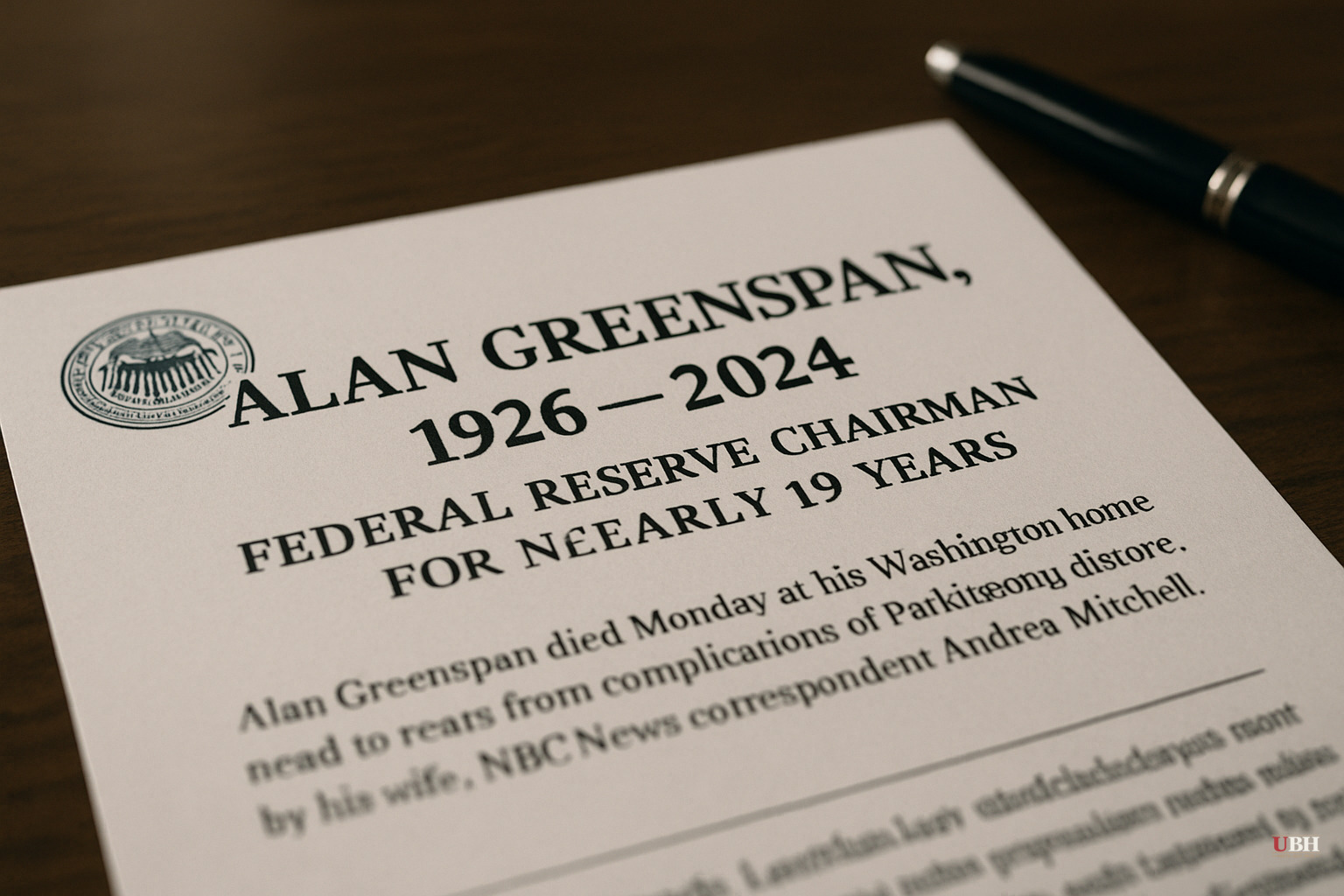
Alan Greenspan, the 13th chairman of the Federal Reserve and one of the most consequential economic policymakers of the 20th century, died Monday at age 100. The cause was complications from Parkinson's disease, according to his wife of 29 years, Andrea Mitchell.
"He was a giant of a man who helped shape the U.S. economy for decades under presidents of both parties, but was always honest in acknowledging his mistakes," Mitchell said in a statement reported by CNBC, NPR, and the Daily Wire, among others.
The Record
Reagan appointed Greenspan Fed chairman in August 1987, and he held the post until January 2006, nearly 19 years. According to CNBC, his tenure was the second longest in the institution's history, four months short of William McChesney Martin, who ran the Fed from 1951 to 1970.
He served under Ronald Reagan, George H.W. Bush, Bill Clinton, and George W. Bush. His tenure covered Black Monday in October 1987 (the Dow fell 22% in a single session, per the Daily Wire), the dot-com bubble and its collapse, and the September 11 attacks. Through most of it, the U.S. economy expanded, unemployment stayed low, and Greenspan's reputation grew to near-mythic status. The press called him "the Maestro" and "the Oracle."
The Federal Reserve, in a statement Monday morning reported by CNBC, said it noted his passing "with deep sadness" and that his "contributions to monetary policy and economic thought left a lasting mark on this institution, on the broader field of economics, and on the country."
Ben Bernanke, Greenspan's successor and the man who managed the Fed during the 2008 crisis, called him "a great central banker who helped lead his country through almost two decades of prosperity," according to CNBC.
The Legacy Problem
Greenspan's reputation was complicated well before his death. The central critique, argued seriously and not just partisan, is that his hands-off approach to mortgage markets and financial derivatives helped inflate the housing bubble that burst catastrophically in 2007–2008.
Critics have genuine evidence behind this argument. The Financial Crisis Inquiry Commission's final report, quoted by ZeroHedge, stated that "more than 30 years of deregulation and reliance on self-regulation by financial institutions, championed by former Federal Reserve Chairman Alan Greenspan and others" contributed to the crisis. Greenspan himself acknowledged the gap in his thinking. Testifying to lawmakers in 2008, he said: "Those of us who have looked to the self-interest of lending institutions to protect shareholders' equity, myself included, are in a state of shocked disbelief." He also told Congress: "I was right 70% of the time, but I was wrong 30% of the time."
Breitbart's writeup noted plainly that the housing collapse "ignited a global financial crisis that nearly toppled the U.S. banking system and plunged the economy into the worst recession since the 1930s" two years after Greenspan left office.
The Defense
The strongest case for Greenspan is grounded in facts. He navigated the Fed through the 1987 crash, the 1997–98 Asian financial contagion, the Russian default, the near-collapse of Long-Term Capital Management, and the dot-com bust without a depression-level outcome. His argument that accommodative monetary policy during periods of rapid technological change supports productivity gains shaped how central banks think. Treasury Secretary Scott Bessent explicitly invoked that argument earlier this year, telling reporters that Greenspan "resisted premature rate hikes during the technology boom of the 1990s — and history proved" the wisdom of that call, according to the Daily Wire.
His successor as Fed chair, Kevin Warsh, referenced him directly upon taking the role, saying: "Like Alan, I intend to fill the role of chairman with energy and purpose, just the way Chairman Greenspan did."
That framing matters now because Warsh is navigating an AI-driven productivity debate that mirrors the 1990s tech boom. Whether Greenspan's permissive playbook gets replicated or whether the 2008 lesson overrides it will have real consequences.
The Man Behind the Fedspeak
Greenspan was not simply a suit behind a microphone. Before economics, he studied clarinet and saxophone at Juilliard and played in a swing band alongside a teenage Stan Getz, according to NPR. He later dismissed nearly everything after the big-band era as "on the edge of noise" — his memoir's words.
He was a core member of Ayn Rand's intellectual circle, called "the Collective," meeting regularly at her Manhattan apartment from the early 1950s until her death in 1982. NPR reported that Rand nicknamed him "the undertaker" for his dark suits and sober bearing. He contributed an essay on the gold standard to her 1966 publication The Objectivist, later reprinted in her book Capitalism: The Unknown Ideal. Rand stood beside him at his 1974 swearing-in as chairman of the Council of Economic Advisers under President Ford.
In his own 2007 memoir, The Age of Turbulence, Greenspan wrote: "Ayn Rand became a stabilizing force in my life."
He received the Presidential Medal of Freedom from President George W. Bush after leaving the Fed.
Mitchell noted her husband had what she called "irrational exuberance" — borrowing his own famous phrase — for baseball, the Washington Commanders, tennis, golf, and jazz.
What Comes Next
The unresolved question Greenspan leaves behind is not merely biographical. Warsh's Fed is now weighing how aggressively to respond to an AI productivity surge with the same basic tools Greenspan used in the 1990s. If Warsh holds rates higher than the market wants, the volatility that CNBC and AP have flagged in recent coverage of Warsh's approach could intensify. If he loosens prematurely and another asset bubble forms, the Greenspan parallel will be invoked in a less flattering way. Greenspan's record, both the long boom and the 2008 aftermath, is the reference point both sides will cite.
Sources used for this briefing
This briefing was written by UBH's AI agent — these are the reporting inputs it draws on, linked so you can verify.


