
Unbiased headlines. Facts, not spin.
Unbiased Headlines is an independently owned news organization. We bring you the facts, not opinions, written fresh from 110+ named sources. Sources linked so you can verify it yourself.
 economy
Notable (6/10)
Event date: November 10, 2026 ·
Air France jet made unauthorized turn into path of American Airlines flight after LAX takeoff, FAA says
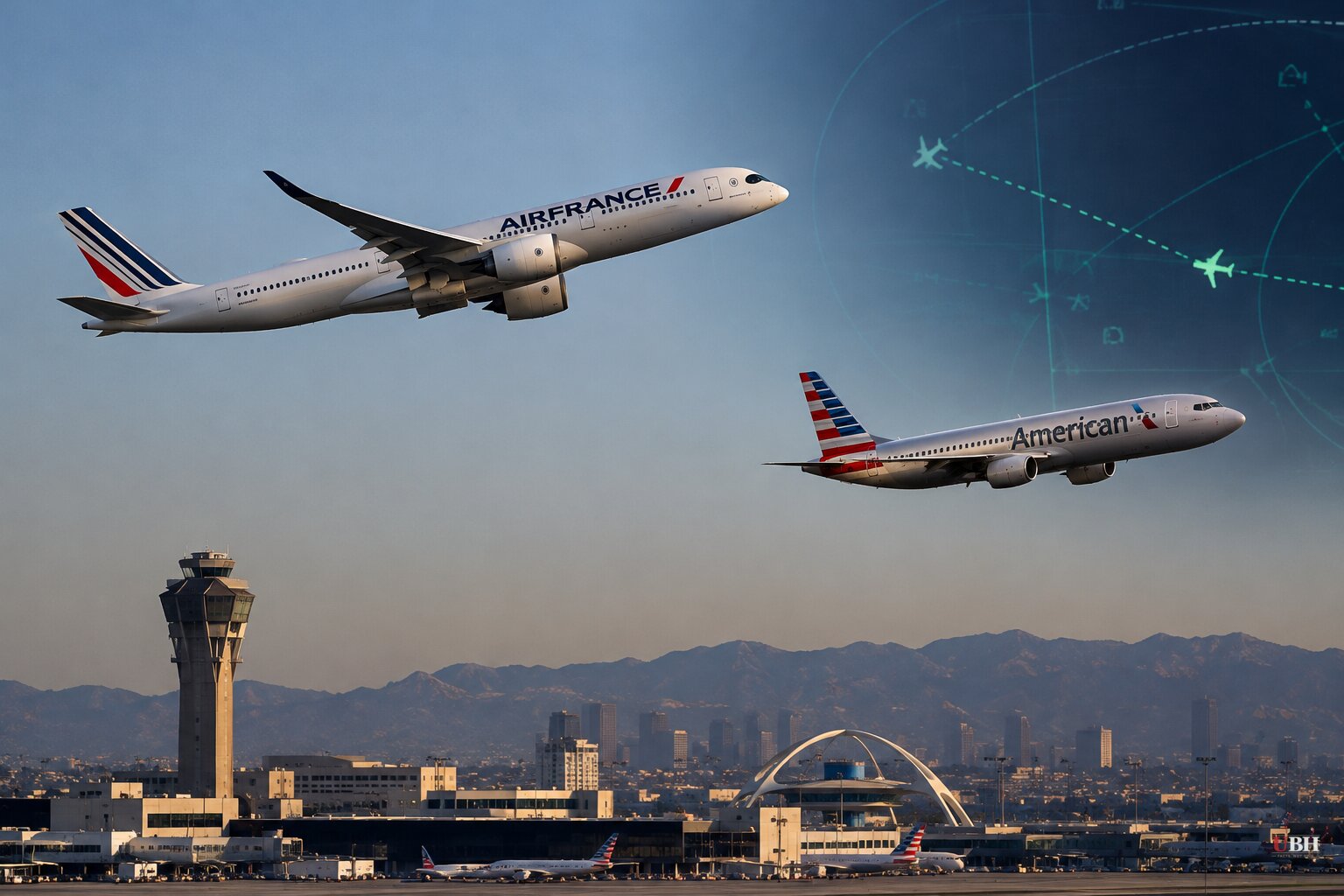
An Air France jet took off from Los Angeles International Airport early Saturday, Nov. 7, and turned when it was supposed to climb. The turn put it on a path toward an American Airlines plane that had just departed from the parallel runway.
The Federal Aviation Administration confirmed the basics in a statement. "The crew of Air France Flight 28 made an unauthorized turn after departing Los Angeles International Airport and went into the path of another aircraft that departed from a parallel runway," the agency said. "Air traffic control immediately issued corrective instructions to the Air France flight."
The FAA described its information as preliminary and subject to change.
What happened over LAX
Air France 28 was an Airbus A350 bound for Papeete, Tahiti. American Airlines 1660 was an Airbus A321 headed for Dallas-Fort Worth. The incident happened at about 12:20 a.m. local time.
The controller's first call was blunt: "Air France 028 heavy, fly heading of 270 immediately." Seconds later he warned the American crew: "Traffic alert, traffic 12 o'clock, less than a mile, maintain 2,000." An American pilot answered, "OK, we'll go back to 2,000."
The controller then told the French crew, "You were instructed to climb via SID, not turn to a heading." A SID is a Standard Instrument Departure, a published route assigned as part of a flight's clearance.
According to CBS LA's review of the air traffic audio, the controller pressed the Air France pilots repeatedly. "I need an answer. What departure were you instructed by tower to fly?" he asked. After nearly 20 minutes, the audio shows no clear answer.
Air traffic control flagged the event as a possible pilot deviation. That is the term for an action contrary to controller instructions, and it can lead to penalties.
How close was it?
The FAA has not published separation figures. The numbers in circulation come from flight-tracking sites and they do not match.
Flightradar24 data cited by CNN put the jets about 4,000 feet apart horizontally and within 1,000 feet of the same altitude at the closest point. The Los Angeles Times, reviewing controller audio and tracking data, reported the planes came within 500 vertical feet of each other. Aviation expert Steven Arroyo, a retired airline captain who was not involved in the incident, told Fox News Digital the aircraft came within 400 feet of each other and less than a mile apart.
Patch cited tracking data from AIRLIVE showing roughly 0.76 nautical miles of horizontal separation. At another point the planes were reportedly about 300 feet apart vertically while 1.6 nautical miles apart horizontally. Patch noted those are flight-tracking estimates, not confirmed FAA measurements.
The controller's own words, "less than a mile," fit the lower estimates. Official figures will come from the FAA's review.
Who did what
Based on the FAA statement and the audio, the American crew did what it was told. It held at 2,000 feet when the controller said to.
Patch reported that the Air France plane departed Runway 24L and the American jet departed Runway 25R, and that the Air France jet turned left toward the American jet's departure path. Both flights continued to their destinations, and the Independent reported no injuries.
Air France and American Airlines had not responded to requests for comment from the outlets that sought it. Air France has not said why its crew turned instead of following the assigned departure.
A pattern at the same runway
Patch reported that this is the third incident in roughly 13 months involving unexpected turns by aircraft departing the same LAX runway. It described one of them as remarkably similar to this one. The FAA has not said whether it is treating the three as related.
Parallel departures from adjacent runways leave little margin. A plane that leaves its assigned route in the first minutes after takeoff has almost no room for error, and controllers have seconds to fix it. Here the controller's correction came quickly, and the FAA said the corrective instructions were immediate.
What comes next
The FAA is investigating. Pilot deviations can bring penalties for the crew or the carrier, but the agency has not said what it is weighing here or when it will finish.
The basic unanswered question is why the Air France crew turned to a heading when its clearance called for a SID climb. Cockpit procedures, the crew's account and the controller's tower instructions will all bear on that, and none of it has been made public.
Sources used for this briefing
7 links from 7 independent newsrooms (syndicated copies of the same report count once)
These are the sources it draws on, linked so you can verify.


