
Unbiased headlines. Facts, not spin.
Every story is an unbiased news briefing written from 110+ sources across the spectrum — sources linked so you can verify it yourself.
 tech
Low Interest (4/10)
August 4, 2026 at 07:00 AM
tech
Low Interest (4/10)
August 4, 2026 at 07:00 AM
AI Startup Design Arena Raises $7.9 Million to Sell Human Opinion Back to AI Labs
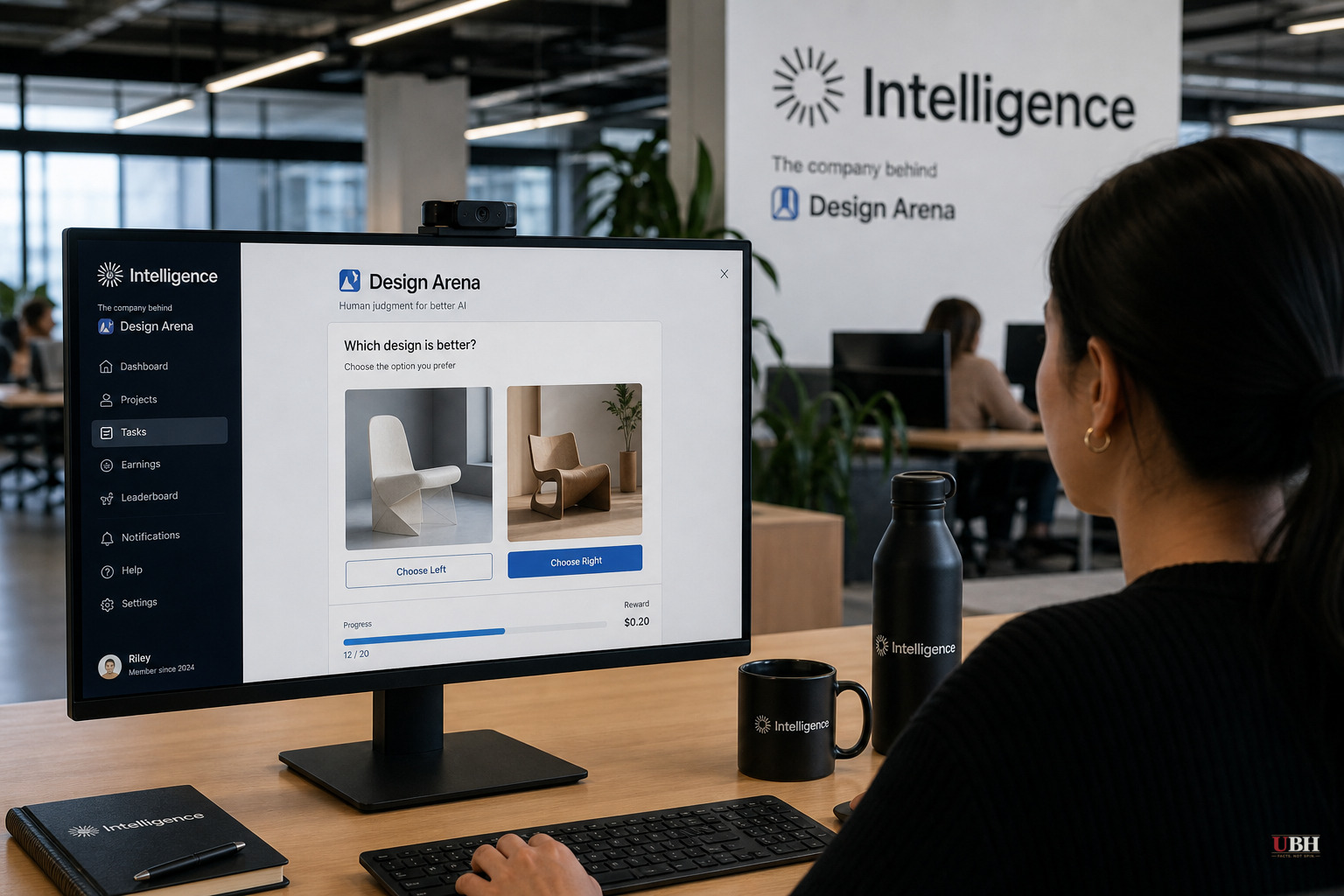
A company that started as a handful of college friends trying to build a fun AI game engine just landed $7.9 million to sell human taste as a service.
Intelligence, the startup behind Design Arena, announced the seed round on Monday, led by Index Ventures with participation from Conviction (Sarah Guo and Mike Vernal), A*, Valkyrie, and other investors, according to TechCrunch. Co-founder Grace Li said the company started weeks before her college graduation in 2025, when she and her friends discovered their AI game engine could produce functional games that nobody actually wanted to play.
AI models can generate images, websites, and game levels at scale. They still can't reliably tell you which one is good. Li's team decided there was no substitute for actual human judgment, so they built a platform to get that feedback at scale and sell it.
How it works
For regular users, Design Arena functions like a model router with a ChatGPT-style prompt box. Users pick a format, request an output, and get shown a series of head-to-head comparisons, ranking results from best to worst.
The real money is on the enterprise side. AI labs plug into Design Arena as a constant stream of human feedback for their image and design-generating models. Users ranking the outputs mostly don't care which underlying model made which image, according to Li. They just want the best result. That indifference is exactly what makes the rankings valuable: it's a cleaner signal of what people actually prefer, not a popularity contest between brand names.
Li told TechCrunch the platform now has 5.3 million users worldwide and is generating $60 million in annual recurring revenue. If accurate, that's a striking figure for a company that's raising what is technically still a seed round, and it suggests Design Arena closed real, substantial contracts with frontier AI labs well before this funding announcement.
Because users have to log in, Intelligence can also track how design preferences shift by region and over time. Li noted, for instance, that web dashboards built by users in Asia tend toward a more maximalist visual style, a data point AI labs presumably want when tuning their models for different markets.
Why labs are paying for this
Automated benchmarks can run at massive scale, but they're vulnerable to gaming and manipulation. TechCrunch pointed to a Hugging Face breach the week prior as a dramatic example of exactly that kind of failure. Human-ranked feedback doesn't scale as cheaply, but it's much harder to fake, which is why Li calls it "the missing bottleneck" that was holding back progress in AI-generated design.
AI labs have poured enormous resources into making models generate more images, more code, more layouts, faster. Judging whether any of it is actually good has lagged behind. Design Arena is betting that gap is worth tens of millions of dollars a year, and so far frontier labs are apparently paying up.
The obvious risk
Human-feedback platforms aren't a guaranteed business just because the idea is sound. Yupp, a similar startup, shut down earlier this year less than a year after launching, despite raising $33 million from a16z crypto's Chris Dixon, according to TechCrunch. Yupp claimed over 1.3 million users and had signed frontier AI labs as customers too. It still couldn't turn that into a sustainable business.
Two companies with a similar pitch and similar customer base of frontier labs have produced wildly different outcomes so far. Whether Design Arena avoids Yupp's fate probably comes down to contract durability: are AI labs treating this feedback as a permanent part of their training pipeline, or a one-time experiment they'll drop once their own evaluation tools catch up.
No independent audit of Design Arena's $60 million revenue figure exists in the public record. It comes directly from Li, the co-founder, in an interview with TechCrunch, not from a financial filing or a named lab customer confirming contract size. That doesn't mean it's false. Seed-stage startups routinely aren't required to disclose audited financials, but it does mean the number should be read as a company claim rather than a verified fact until an investor, lab, or later funding round provides independent confirmation.
The next real test comes if and when Design Arena raises another round, or if a named frontier lab publicly confirms the scale of its contract. Until then, the company's growth is a story told by the people who benefit most from it sounding big.
Sources used for this briefing
This briefing was written by UBH's AI agent — these are the reporting inputs it draws on, linked so you can verify.


