
Unbiased headlines. Facts, not spin.
Unbiased Headlines is an independently owned news organization. We bring you the facts, not opinions, written fresh from 110+ named sources. Sources linked so you can verify it yourself.
 health
Notable (6/10)
AI model flags cancer patients' 90-day death risk from a single face photo, Mass General Brigham study finds
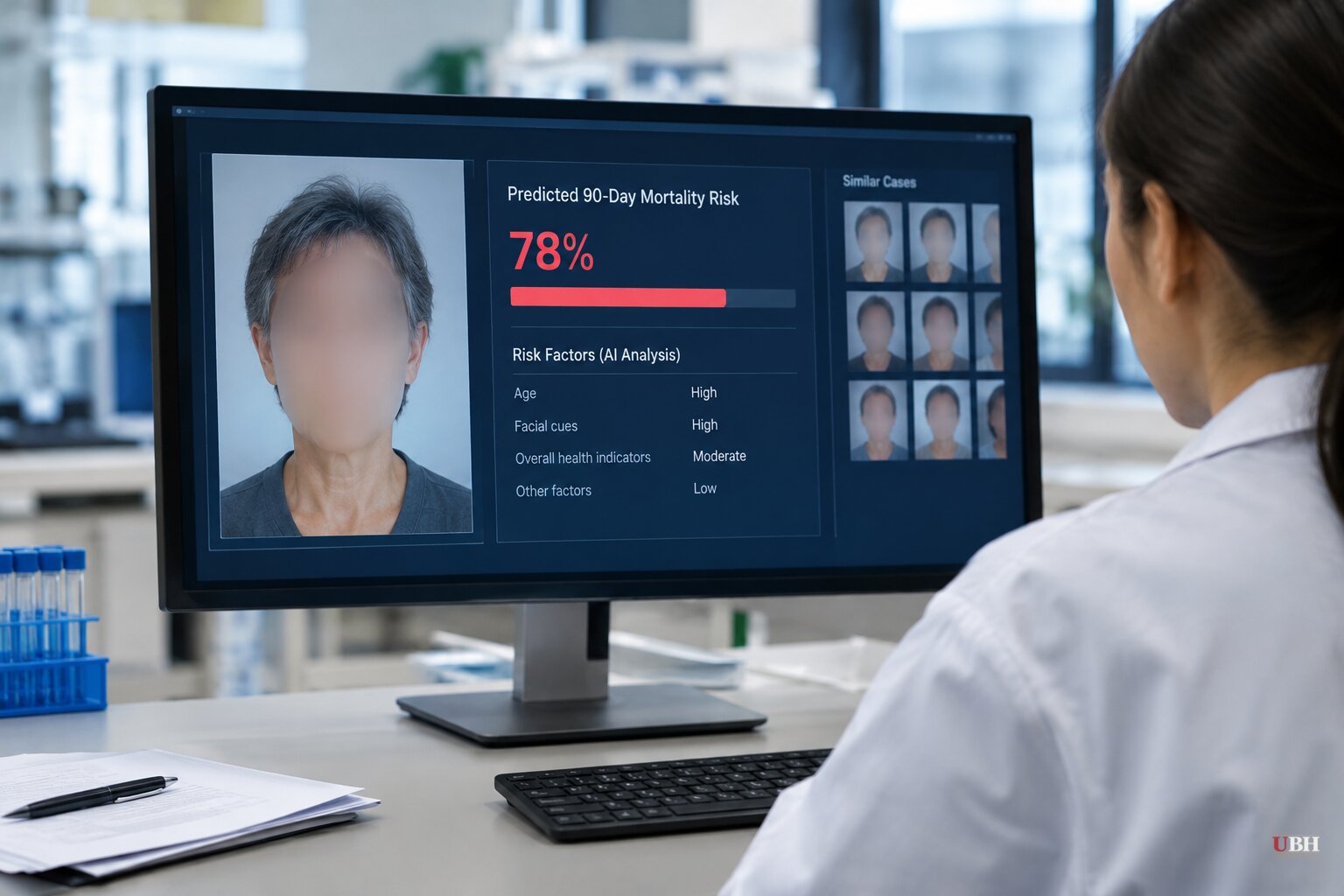
A face photo can carry real information about whether a cancer patient is likely to die soon. That is the claim of a study published today, Oct. 19, in The Lancet Digital Health by researchers at Mass General Brigham, the Massachusetts academic health system.
The team built an AI system called FAHR-Face. It was first trained on more than 40 million face images with no specific task. The researchers then adapted it into two tools.
What the tools do
FAHR-FaceAge estimates biological age, meaning how old a face looks rather than how many birthdays the person has had. FAHR-FaceSurvival skips the age step and predicts survival directly from the photo. Both were derived from the same model, but the researchers say they capture different information about a patient's health.
They also look at different parts of the face. FaceAge leans on the creases running from the nose to the corners of the mouth, the forehead above the eye sockets, and the temples. FaceSurvival focuses on the area below the eyes and around the bridge of the nose.
The survival tool was trained on photos of more than 30,000 cancer patients, many of whom had already died.
The numbers
The survival tool gave each patient in a separate test group of 3,820 a risk score between zero and one. Of the 122 patients with the highest scores, 64 died within 90 days. In the lowest-risk group, 20 of 975 patients died in the same window, about 2%.
The highest-risk quarter of patients was more than three times as likely to die as the lowest-risk quarter. That figure holds after adjusting for age, sex and cancer type. The findings were also tested on nearly 4,900 cancer patients in the Netherlands.
The age tool produced a similar signal. Among U.S. cancer patients treated with radiotherapy, those whose faces looked five or more years older than their actual age had a 21% higher risk of dying over an average four-year follow-up. Those who looked five or more years younger had a 17% lower risk. In a separate group of more than 38,000 patients, looking older than one's age also tracked with higher risk of death.
The age estimates are not precise. The model's margin of error on age is about five years.
Lifestyle and photo variation
Heavy drinking, drug use and smoking were associated with looking biologically older. Smoking showed the strongest pattern.
Mak said the team was surprised by how consistent the results were "across common real-world photo variations, including pose, lighting, facial expression and makeup." The model also worked across ages, races, genders and cancer types.
Why researchers want it
Doctors already size up patients by sight. Ray Mak, a radiation oncologist at the Mass General Brigham Cancer Institute and a lead researcher, says that impression helps drive choices among surgery, chemotherapy and radiation. "That's really a subjective assessment," he said. In an interview, he added that doctors are "in general not very good at estimating end-of-life expectancy."
Dr. Grace Lee, a colon and rectal surgeon and study co-author, called the tool a way "to standardise and quantify this intuitive practice." Hugo Aerts, a Harvard professor, director of the AI in medicine program at Mass General Brigham and co-senior author, said: "To our knowledge, this is the first demonstration that an AI model can directly predict cancer survival from a simple photograph."
The team says the goal is support, not substitution. "Our goal is to make face photograph-based health assessment more quantitative, consistent and scalable so it can support personalised treatment decisions rather than replace physician judgment," Mak said. One suggested use is deciding which patients, especially elderly ones, can tolerate aggressive treatment and which might be better served by a gentler approach.
The caution from outside
Miroslaw Bober, professor of video processing and machine learning at the University of Surrey, was not involved in the research. He says the tool is not ready for clinical use.
"Predicting an outcome is not the same as explaining it," Bober said. "It has not shown that these predictions add clinically useful information beyond doctors' assessments of a patient's general health and fitness, which were not measured in the study."
That is a specific gap. The study compares the AI's scores with actual outcomes. According to Bober, it did not compare them with what a clinician would have predicted from seeing the same patient. Bober also says the tool needs testing across different hospitals and patient groups.
What comes next
The 64-of-122 result is notable, but it describes a small slice of one test group. The study leaves open whether the score adds anything a physician's eyeball test does not already capture. Bober's call for head-to-head testing against doctors' own judgment, in more hospitals and with more varied patients, is the next hurdle before the tool could inform real treatment decisions.
Sources used for this briefing
7 links from 7 independent newsrooms (syndicated copies of the same report count once)
These are the sources it draws on, linked so you can verify.


