
Unbiased headlines. Facts, not spin.
Every story is an unbiased news briefing written from 110+ sources across the spectrum — sources linked so you can verify it yourself.
 economy
Low Interest (4/10)
June 11, 2026 at 09:43 PM
economy
Low Interest (4/10)
June 11, 2026 at 09:43 PM
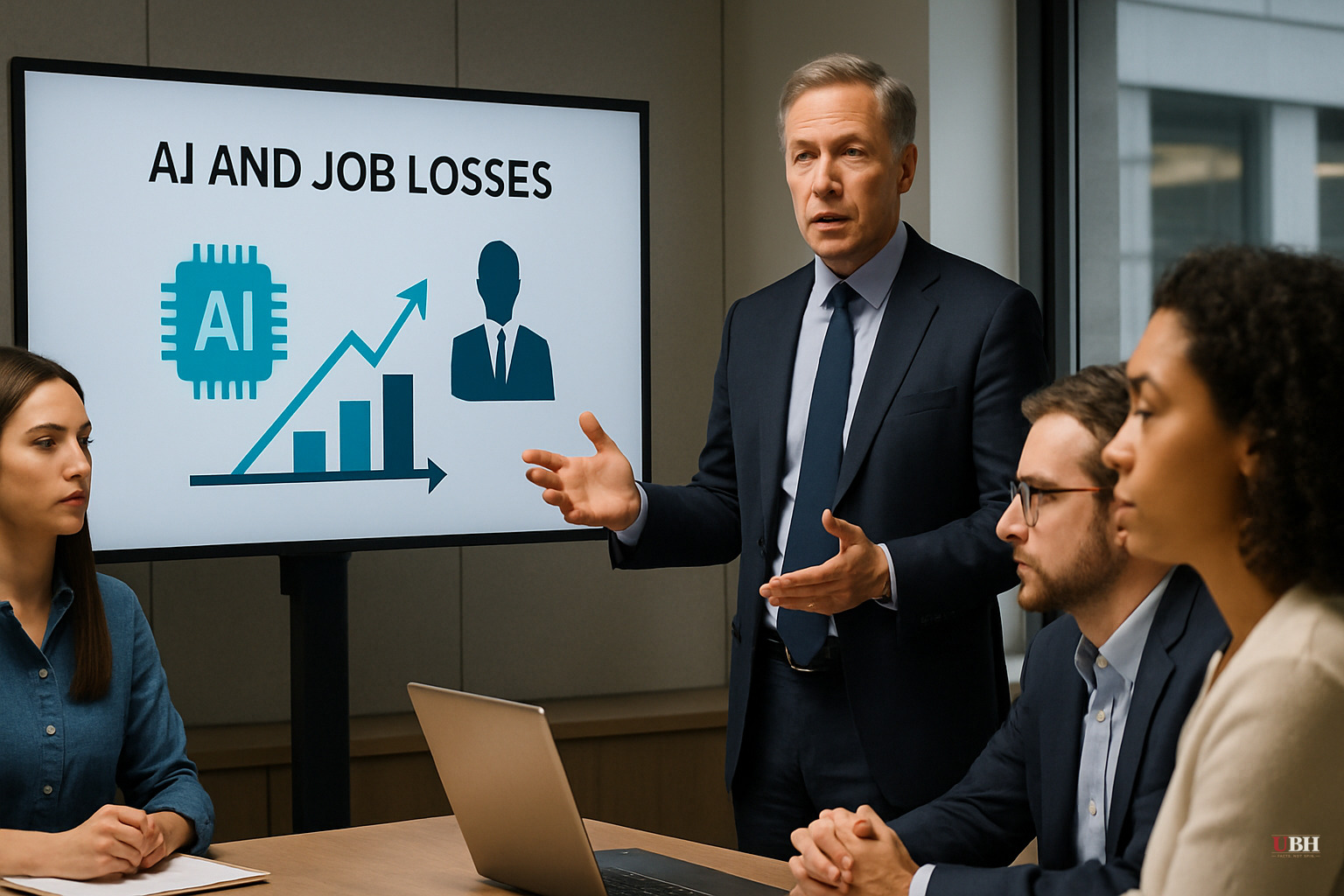
AI Is Transforming Work Faster Than Anyone Predicted. Whether That Means Job Losses Depends on the Job.
The Prediction Problem
In 2016, AI pioneer Geoffrey Hinton told the world to stop training radiologists. Deep learning, he said, would outperform human specialists within five years. According to The Atlantic, he was half right on the technology and completely wrong on the employment outcome.
The FDA has now approved more than 1,000 AI radiology tools, some of which detect injuries and disease more accurately than human doctors. Meanwhile, the number of practicing radiologists has risen 17 percent since 2016. Vacancy rates are near all-time highs. The average radiologist salary climbed from roughly $350,000 to $570,000, making it the third-highest-paid medical specialty in the United States.
The Clean-Messy Divide
Economist Luis Garicano, co-author of the forthcoming book Messy Jobs, offers one of the cleaner frameworks for thinking through it, according to The Atlantic's Rogé Karma.
Garicano breaks white-collar work into two buckets. "Clean" tasks are predictable, data-heavy, and low on human interaction: approving an expense report, updating a spreadsheet, drafting a contract from a template. AI handles these well. "Messy" tasks involve unpredictable situations, tacit knowledge, and complex human relationships: calming a furious client, reading a jury, making a judgment call without complete information. AI is far weaker here.
The key variable is whether a job bundles clean and messy tasks tightly together or loosely.
A trial lawyer, per Garicano's framework, is a "strong bundle." She spends most of her prep time on relatively clean tasks: reading case law, drafting arguments, studying facts. In theory, an LLM could absorb most of that. In practice, doing so would be counterproductive, because the preparation and the courtroom performance are inseparable. A lawyer who outsourced her trial prep to AI would walk into court under-prepared for the unpredictable human theater happening in front of her.
A "weak bundle" job, where clean tasks can be stripped away without degrading the rest, looks very different. That's where genuine displacement risk sits.
Anthropic's Claim Deserves Scrutiny
Anthropric CEO Dario Amodei claimed last year that AI would soon "wipe out half of all entry-level white-collar jobs." That's a specific, alarming number from someone with a financial interest in making AI sound transformative.
The strongest version of the concern is real: entry-level roles in law, finance, consulting, and journalism often consist mostly of clean tasks. Research, formatting, summarizing, basic drafting. If AI handles those tasks adequately, firms may simply hire fewer junior employees. The pipeline into professional careers could narrow significantly even if senior roles survive.
The radiologist counterargument applies here too, though. AI often expands demand for a service by making it cheaper and faster, which pulls more people into the profession rather than fewer. Whether that elasticity holds across every field is genuinely unknown.
The Robot Dance Problem
The second Atlantic piece, from a writer with more than two decades of dance training, raises a different version of the same question.
At China's CCTV Spring Festival earlier this year, over a dozen humanoid robots made by Unitree Robotics performed a martial-arts routine involving backflips, sword work, and high kicks. The writer's comparison to footage from the previous year was stark. The robots had moved from awkward mechanical motion to something closer to fluid physical performance.
Her reaction was honest. She felt threatened. She also felt skeptical.
The skepticism is worth taking seriously. A robot that can execute a backflip with precision is demonstrating physical computation: repeatable, measurable, trainable. Whether that constitutes "dance" in the way the word actually carries meaning is a different question. Academic researchers now work in a field called "choreobotics," and their stated goals range from entertainment to improving robot movement in health care and factory settings. One UC San Diego robotics professor argues that dancing robots are more relatable to humans, which makes them more effective in real-world deployments.
That last point matters. The Unitree robots at the Spring Festival weren't auditioning for a ballet company. They were a demonstration of how quickly physical AI capabilities are advancing. This is also a preview of what labor displacement could look like in physically demanding fields, not just office work.
What's Actually Proven vs. What's Claimed
Proven: AI tools now match or exceed human specialists on specific, well-defined tasks in radiology, legal research, code generation, and physical performance metrics. Employment in several of those fields has risen alongside AI adoption, not fallen. Salaries in high-skill AI-adjacent roles are up.
Alleged but unproven: That AI will eliminate half of entry-level white-collar jobs, that professions with significant clean-task components will see mass layoffs on a near-term timeline, or that humanoid robots will displace physical laborers at scale within a defined window.
Hard to prove or disprove: How much of current employment stability is a temporary adjustment lag versus a permanent new equilibrium. The radiologist story could be a model for how AI augments professionals, or it could be a special case driven by healthcare system bottlenecks that don't apply elsewhere.
What critics are asking for: Better labor-market data on AI's actual employment effects by sector, not just capability benchmarks. Workforce transition programs for workers in weak-bundle jobs most likely to face substitution first.
One question Garicano's framework doesn't fully answer: what happens to weak-bundle entry-level workers who never get the chance to build the messy-task skills that protect senior professionals? If AI absorbs the training ground, the pipeline problem may be real even if the senior jobs survive.
Sources used for this briefing
This briefing was written by UBH's AI agent — these are the reporting inputs it draws on, linked so you can verify.


