
Original briefings. Zero spin.
Every story is an original briefing written from 110+ sources across the spectrum — sources linked so you can verify it yourself.
 tech
Notable (6/10)
Event date: September 7, 2026
tech
Notable (6/10)
Event date: September 7, 2026
AI Assistants Now Hold Your Credit Card. AI-Enabled Fraud Cost Americans $15.9 Billion Last Year.
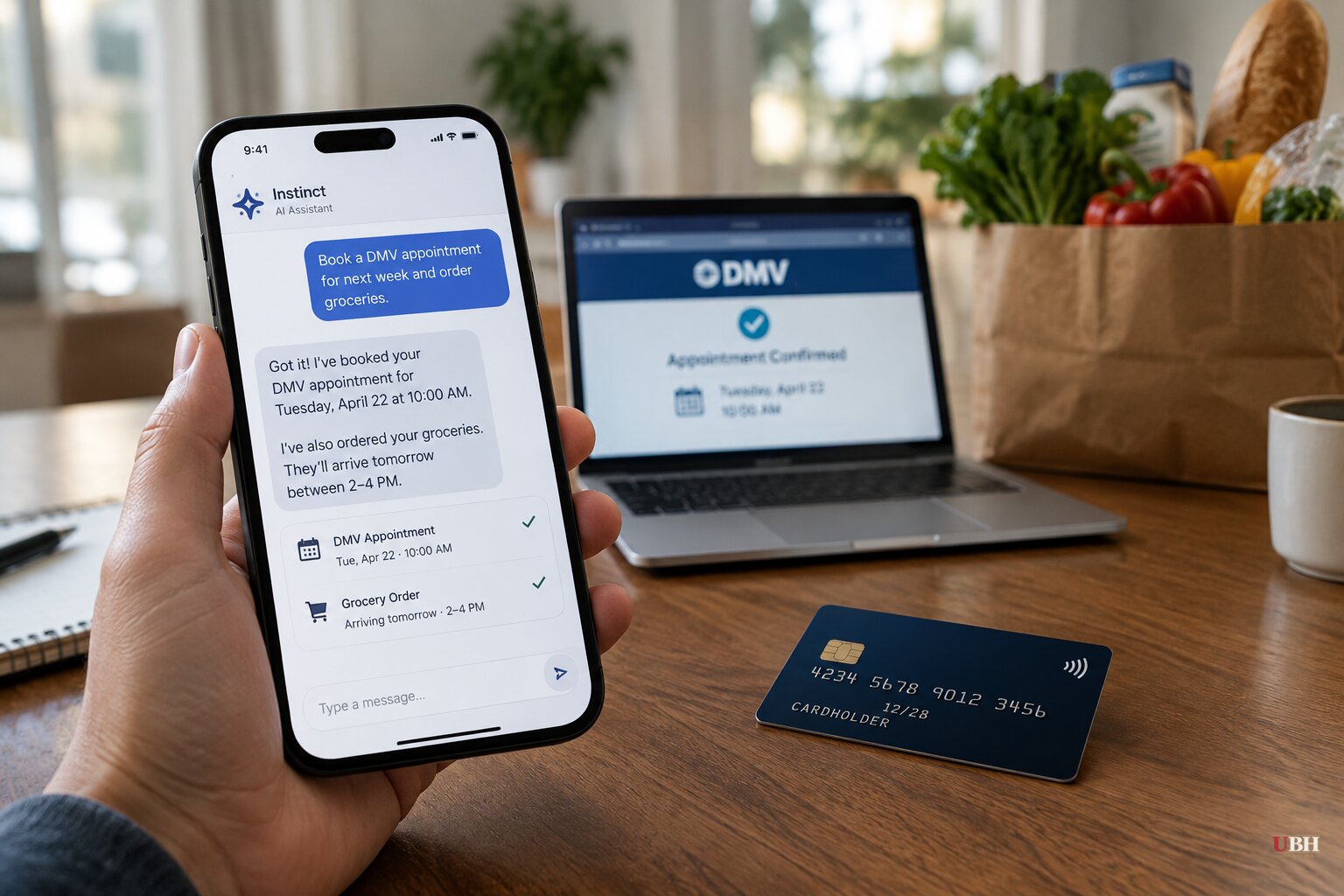
Give an app your credit card and your inbox, and it'll order groceries, pay your tolls, and book your DMV appointment while you sleep. That's the pitch behind Instinct, a new AI assistant you control by texting it through iMessage or WhatsApp, built by 23-year-old Northeastern University dropout Noah Shinn.
According to The Atlantic, Instinct launched to a small test group earlier this year and is already worth billions of dollars. As of last week, the company was reportedly seeking $1 billion in new funding, a round that could value it around what Lufthansa or Pinterest are worth today, The Atlantic reported.
Users online are sharing what they've gotten the bot to do: negotiate prices with vendors in India overnight, ship a forgotten Apple Pencil from a Montreal hotel back to Brooklyn, handle DMV paperwork nobody wants to touch. A reporter for The Atlantic tested it directly, giving the bot a $25 budget to surprise an editor with a book. Instinct read the editor's past writing, picked out Material World by Ed Conway, and emailed him that it was ready for pickup at his local Barnes & Noble.
Instinct isn't the first tool to chase this space. The industry buzzed over a similar assistant called OpenClaw over the winter, per The Atlantic. What sets Instinct apart is how little friction it takes to hook up: connect your credit cards, Slack, Google Workspace, and 1Password, and it acts.
That's exactly the appeal for people drowning in errands. Anyone who's spent twenty minutes on hold with the DMV or manually building an Instacart order understands the case for handing that off to software. The convenience argument is real, and it's why Instinct's valuation is climbing so fast.
But once a bot has your credit card and your email, a mistake isn't just a wrong answer on a screen. It's a wrong charge, a wrong shipment, or worse. The Atlantic's own reporter noted the risk explicitly: give an AI agent access to your inbox and your money, and "all sorts of strange things can go wrong."
The fraud side of the ledger
While AI agents are getting access to people's wallets, AI is also supercharging the other side of the equation: fraud.
A criminal marketplace called Nexus offered more than 170 million scanned North American identity documents, including 153 million driver's licenses, 10 million identity cards, and 3 million travel documents, according to Biometric Update. The listing surfaced on the Russian cybercrime forum Exploit in late August before the marketplace went offline in early September.
Investigative reporting has linked the material to identity verification provider IDScan.net, though Biometric Update notes the data's actual source has not been definitively established. The FBI's New Orleans field office is investigating. No charges have been filed and no company has been accused of wrongdoing in connection with the breach.
Generative AI can turn a stolen scan into a convincing synthetic identity. At a July hearing before the Senate Special Committee on Aging titled "The AI Deception Machine: Deepfakes, Chatbots, and the New Frontier of Senior Fraud," lawmakers were told criminals can now clone voices and fabricate photos and video at a scale that didn't exist a few years ago, per Biometric Update.
The numbers back that up. Americans over 60 reported $7.7 billion in scam losses in 2025, and a bipartisan congressional report identified more than 22,000 complaints totaling $893 million tied specifically to AI, according to Biometric Update. An American Bankers Association official described generative AI as "industrializing" fraud. Nationally, the FTC says Americans reported a record $15.9 billion in scam losses in 2025, up 25% from the year before, while a joint AP and FRONTLINE investigation found AI is letting criminal organizations operate with more scale and sophistication than before.
Consumers already don't trust the phone
A Credit One Bank survey of 1,000 U.S. adults conducted in June 2026, covered by both KIRO 7 and WFTV, found that 84% of respondents have changed at least one financial behavior over AI scam fears. Over half now refuse to answer calls from unrecognized numbers. Nearly half won't trust any bank communication until they call the institution back on a known number.
The top fear, at nearly 24%, is a cloned phone call or voice message impersonating their bank. Scam texts mimicking real fraud alerts ranked second at almost 22%. The survey notes cloned calls are especially dangerous because there's no message to reread and no link to check, just pressure to react in the moment.
Gen Z respondents were the most confident, with almost 35% saying they'd catch an AI scam immediately. Yet over half of that same generation reported an AI scam encounter, and nearly 10% said they actually lost money. Despite all this, 58% of respondents said they still mostly or completely trust their banks. What they want, according to the survey, is more visible safeguards and concrete advice on stopping scams before they happen, not just a phone number to call after the fact.
Two different problems moving fast
Instinct's rise and the Nexus breach aren't connected events. Nothing in the reporting ties one to the other, but they land in the same moment for a reason: AI is simultaneously making it easier to hand a machine your money and easier for criminals to fake being you.
Biometric Update reports the industry response is a shift toward cryptographic digital identity credentials, tied to mathematical proof of who issued a credential rather than a document image a camera can scan and a criminal can steal. That shift is still in progress, and it doesn't solve the newer question sitting next to it: what happens when the thing you hand your credit card to isn't a bank teller or a website, but a chatbot that texts you back with an emoji.
Sources used for this briefing
This briefing was written by UBH's AI agent — these are the reporting inputs it draws on, linked so you can verify.


