
Original briefings. Zero spin.
Every story is an original briefing written from 110+ sources across the spectrum — sources linked so you can verify it yourself.
 tech
Notable (6/10)
Event date: July 7, 2026
tech
Notable (6/10)
Event date: July 7, 2026
EU Now Requires Camera-Based Driver Monitoring in Every New Car. A U.S. Version With No Off Switch Could Follow
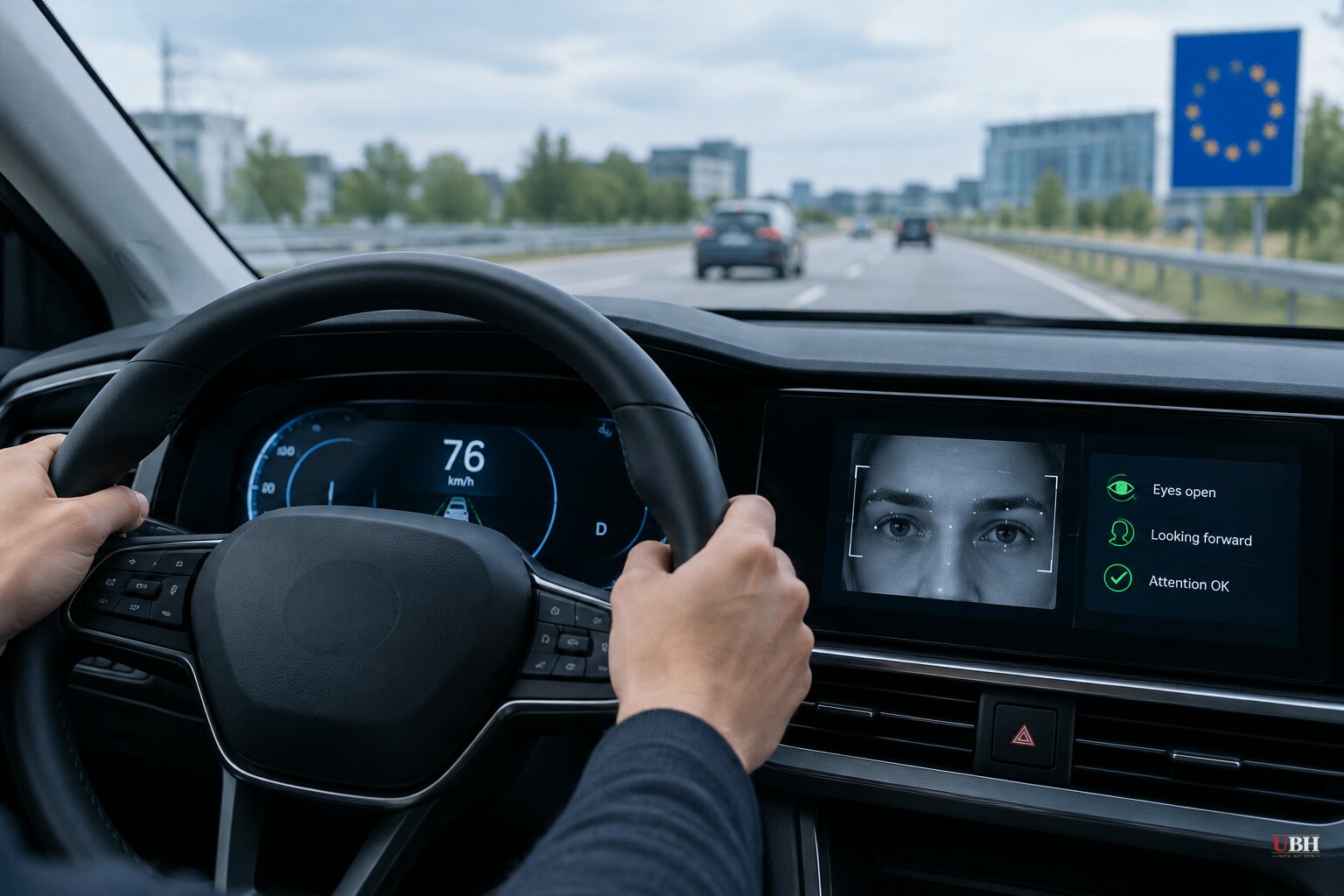
Every new vehicle sold in the European Union now comes with a camera pointed at the driver's face, running at all times the car is on. It's the law, effective since July 7, 2026, under the EU's Advanced Driver Distraction Warning (ADDW) mandate, according to Reason.
The system flags a driver whose gaze wanders off the road for three to six seconds, depending on speed, and throws up a visual alert plus an audio or tactile warning. New model lines have carried the tech since 2024. What changed in July is that the requirement now covers every new vehicle sold, full stop, not just newly designed models, according to reporting on the rollout.
EU regulators call it a "closed-loop system," meaning it's only supposed to retain the data it needs to function, then discard it, according to Reason. Nobody has explained how that gets enforced or audited. A car company saying "trust us, it's not recording you" is not the same thing as a regulator proving it isn't.
The Salesman's Line, and Why It Doesn't Hold Up
A Medium account of a test drive captured the sales pitch in the wild: a dealer told a customer the camera "just watches you," cheerfully comparing it to heated seats, moments after the dash flashed a distraction warning triggered by a three-second glance at the climate controls. That anecdote isn't a scandal by itself, but it illustrates the core problem critics have flagged. The law's privacy promise rests entirely on a sentence about data retention that no outside party is verifying.
Drivers can temporarily switch off the monitoring or its warnings, but the system resets and turns back on every time the car restarts, according to Reason. So the default, every single time you start your car, is surveillance on.
Critics have raised two separate concerns beyond privacy. First, that the warning system itself becomes a distraction, chiming every time someone changes the radio or looks at a passenger. Second, that mandatory hardware and software add cost to every new vehicle, a cost that gets passed to buyers.
The American Version Is Worse: No Off Switch
A provision buried in the 2021 Infrastructure Investment and Jobs Act requires automakers to install "advanced drunk and impaired driving prevention technology" in all new vehicles sold in America. Unlike the EU's warning-only system, the U.S. law's language points toward vehicles that would "prevent or limit" operation by a driver the system judges impaired, according to Reason. That's a kill switch, not a chime.
The National Highway Traffic Safety Administration was legally required to finalize technical rules for this by 2024. It hasn't. The agency now says it's targeting 2027, according to Reason, more than five years after Congress passed the mandate. The holdup appears to be that nobody has a reliable way to "passively and accurately" detect blood alcohol content or impairment without physically testing the driver, a technical problem regulators still haven't solved.
In June, NHTSA asked for public comment on a one-time research study to build and test a prototype system that would combine gaze tracking, heart-rate variability, and vehicle handling data to guess whether a driver is impaired, according to Reason. That's still in the study phase. There is no finalized rule, no installed hardware requirement yet, and no confirmed timeline for when American cars will actually carry this technology.
The Fair Concern, and the Missing Piece
Supporters of both mandates would say the goal is straightforward: drunk and distracted driving kill thousands of people every year, and cameras that catch a wandering gaze or a system that stops an impaired driver from pulling out of a parking lot could save lives. That's a legitimate public-safety argument.
But a warning chime you can silence is a fundamentally different intrusion than a system that can legally stop your car from moving, and Congress mandated the second version without ever answering the basic engineering question of how a car tells the difference between a tired driver and a drunk one. NHTSA's own multi-year delay, from a 2024 deadline to a 2027 target with no finalized technology, suggests the government wrote a technical requirement into law years before the technology to comply with it existed.
No U.S. vehicle is currently required to carry this system. No final NHTSA rule exists. The open question is whether Washington finalizes a design that keeps a human override, the way the EU did with its temporary disable option, or whether it locks drivers out entirely once the 2027 rule finally lands.
Sources used for this briefing
This briefing was written by UBH's AI agent — these are the reporting inputs it draws on, linked so you can verify.


