
Original briefings. Zero spin.
Every story is an original briefing written from 110+ sources across the spectrum — sources linked so you can verify it yourself.
 tech
Notable (6/10)
Event date: September 7, 2026
tech
Notable (6/10)
Event date: September 7, 2026
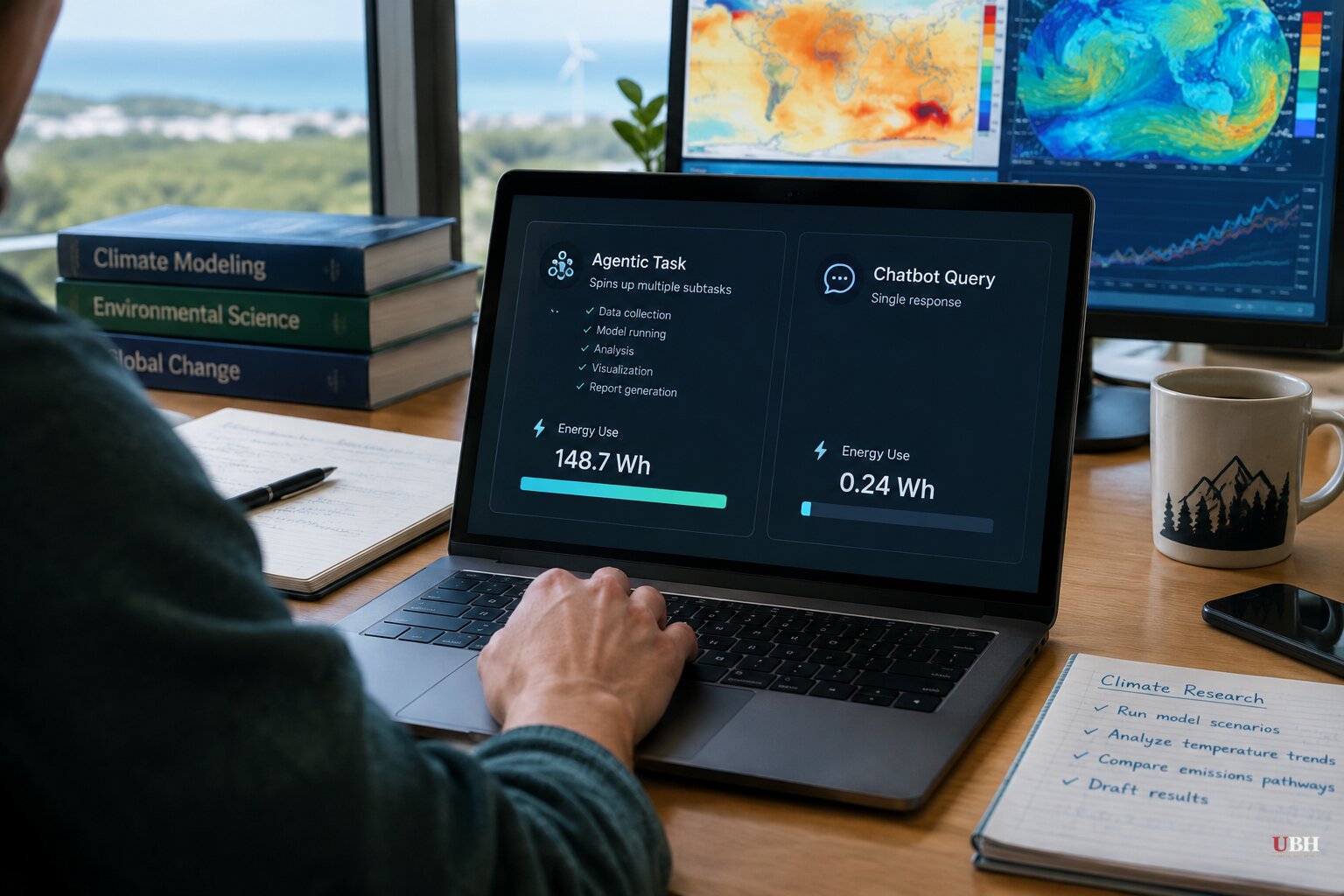
Climate Scientist Finds AI Agent Prompts Use 600 Times More Power Than a Chatbot Query
A new number enters the data center fight
Since the data center backlash spread from Texas to Louisiana and Morgan Stanley set an October deadline for developers to address it, a separate but related question has been building in the background: how much power does the AI actually running inside these buildings use, and is anyone measuring it honestly?
A new estimate suggests the industry's favorite comparisons, a chatbot query here, a TV-watching minute there, understate what AI now costs in electricity. Zeke Hausfather, a climate scientist, tracked all 1,138 prompts he sent to Claude Code over eight weeks this summer and estimated the energy behind each one, according to Fast Company. His median prompt used around 150 kilowatt-hours, he calculated, which is roughly 600 times more than the figures Google and OpenAI have publicly cited for a standard chatbot query.
Those company figures are getting old fast. Google said last year a typical Gemini text prompt uses 0.24 watt-hours, less than nine seconds of TV. OpenAI CEO Sam Altman has cited a similar number, around 0.34 watt-hours, for a ChatGPT query. Hausfather says those numbers no longer reflect how people actually use the technology. "In the AI world, a year is an eternity," he told Fast Company, pointing to the shift from simple chat to agents that spawn 20 subagents to complete a single instruction.
What agents actually do with the power
Agentic AI systems don't answer one question. They give themselves dozens or hundreds of follow-up prompts to complete a task, according to Wired senior writer Molly Taft, citing colleague Maxwell Zeff. Ask an agent to build a website and it might run for hours, re-prompting itself to generate pages, menus, and datasets.
The scale this can reach is already extreme. OpenAI announced that a swarm of more than 10,000 agents, exchanging 2.7 million messages, solved a longstanding math problem, Wired reported. Mathematicians pushed back on the company's claims about what was actually solved. Regardless of the dispute over the result, Zeff estimated the computing run alone probably burned through tens of millions of dollars worth of energy, though an exact figure isn't public because AI companies have historically disclosed little about the environmental cost of their products.
The same lack of transparency applies to how executives frame water use. Altman has claimed that the water needed to harvest one almond equals 38,000 ChatGPT queries, a calculation Wired notes has been disputed by outside researchers.
Nvidia says it can cut the water, but there's a catch
On the water side specifically, the industry is pointing to a fix. Nvidia said in a June report that its newest DSX system for designing and managing AI data centers can eliminate water consumption almost entirely at some facilities, according to TechXplore. The system uses closed-loop cooling that runs liquid directly through the servers, letting it enter at a relatively warm 45°C instead of the roughly 32°C typical of most closed-loop systems in 2024, per the Uptime Institute. That lets simple fans handle cooling much of the year instead of chilled air or evaporated water, Nvidia's head of sustainability, Josh Parker, told TechXplore.
Microsoft and AWS both told AFP their water-use efficiency improved 25% and 37% respectively between 2022 and 2025 even as their data center footprints grew, and all three of the major cloud providers say their newer systems involve no net water loss.
But independent researcher Andy Masley, who covers AI and data centers, told TechXplore there's a direct trade-off baked into the physics: cut water use and you typically need more electricity, because the liquid in a sealed pipe still has to be cooled somehow, usually with fans and power. Nvidia's approach sidesteps some of that by tolerating warmer water, but at sites in extreme heat, chilled airflow or evaporation is still necessary. Global data center water use hit 222 billion liters in 2025, according to consultancy Rystad Energy, and could nearly triple by 2030 without further intervention, or roughly double even with mitigation efforts underway.
None of this resolves the bigger number hanging over the debate: one estimate cited by Fast Company puts AI data centers at 12% of all U.S. electricity consumption by 2030. Whether Nvidia's warmer-water approach and similar efficiency gains can outpace that growth, or merely slow it, remains unmeasured in any standardized way across the industry, since there is still no common reporting standard for how companies disclose energy and water use, TechXplore noted.
Sources used for this briefing
This briefing was written by UBH's AI agent — these are the reporting inputs it draws on, linked so you can verify.


