
Unbiased headlines. Facts, not spin.
Every story is an unbiased news briefing written from 110+ sources across the spectrum — sources linked so you can verify it yourself.
 tech
Major Story (7/10)
June 24, 2026 at 05:18 PM
tech
Major Story (7/10)
June 24, 2026 at 05:18 PM
Agility Robotics to Go Public via SPAC at $2.5 Billion Valuation
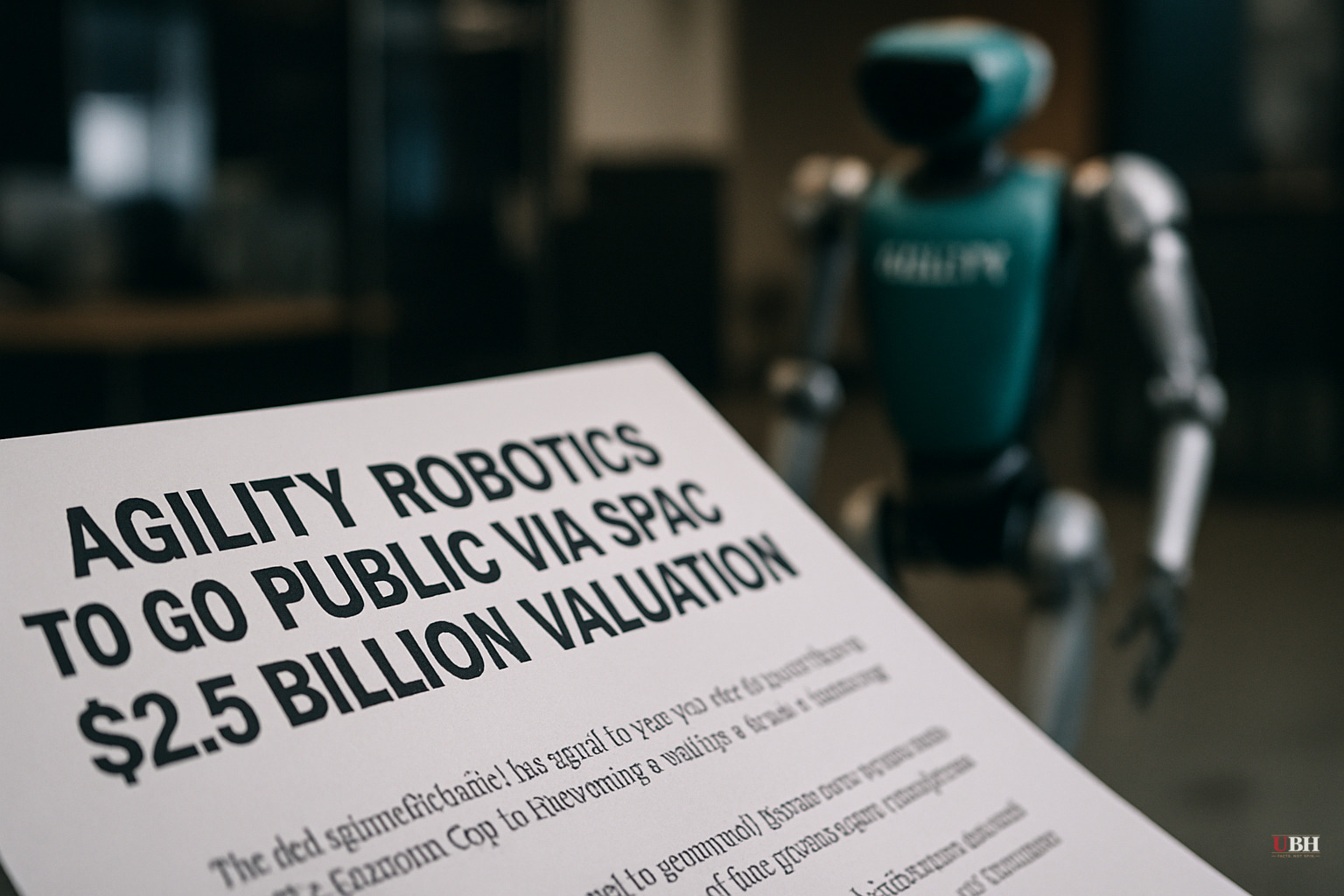
The Deal
Agility Robotics announced its agreement to merge with Churchill Capital Corp. XI, a special purpose acquisition company. The deal values Agility at roughly $2.5 billion in pre-money equity, according to both TechCrunch and The Robot Report.
The transaction is expected to produce more than $620 million in gross proceeds. About $200 million of that comes from a group of new and existing institutional investors, per TechCrunch. The combined company is expected to trade under the ticker AGLT on a North American exchange that has not yet been named.
What Agility Actually Does
Agility, headquartered in Salem, Oregon, spun out of Oregon State University's Dynamic Robotics Laboratory in 2015. Co-founders Dr. Jonathan Hurst, Dr. Damion Shelton, and Mikhail Jones built the company around one question: can a robot do useful physical work in spaces built for humans?
The answer, so far, is a qualified yes. Their product, Digit, is a bipedal humanoid currently deployed across nine customer sites. Named customers include Schaeffler, GXO, Toyota Motor Manufacturing Canada, and Mercado Libre, according to TechCrunch.
Hurst, now serving as chief robot officer, explained the company's market focus plainly during an investor briefing reported by The Robot Report: "We looked at hundreds of applications. We realized that picking up bins and totes is an awfully good beachhead market."
It's warehouses and logistics, one of the most labor-constrained sectors in the U.S. economy.
Backers and Orders
Agility has attracted serious institutional money. Amazon, Nvidia, SoftBank Vision Fund 2, and DCVC are all existing backers, per TechCrunch.
The company says it has secured more than $300 million in multi-year orders for its next-generation Digit v5, with a pipeline of more than 30 potential customers evaluating large-scale deployments. The company intends to use the SPAC proceeds to increase Digit v5 production capacity, fulfill those existing orders, and expand its customer base.
Agility's management estimates the addressable market across U.S. manufacturing, distribution, and logistics at approximately $1 trillion, according to The Robot Report. That's the company's own projection, and readers should treat it accordingly.
The CEO's Pitch
Agility CEO Peggy Johnson framed the company's differentiation sharply during the investor briefing: "Companies don't buy tech; they buy solutions. At Agility, we're doing just that. That's missing from the headlines about AI — companies still have to solve real physical problems."
Most humanoid robotics companies are still in demo mode. Agility is pointing to actual customer sites as its distinguishing credential.
The SPAC Question
SPAC deals deserve scrutiny, and this one is no exception. The structure has a troubled track record. Many SPAC mergers from 2020 to 2022 saw companies go public at inflated valuations, then watch their share prices crater when the projections didn't materialize. Investors burned in that era have legitimate reasons to be skeptical of any company pitching a $1 trillion addressable market and $300 million in orders as proof of inevitable scale.
The strongest version of that concern: Agility has nine customer sites. The gap between nine commercial deployments and the volumes needed to justify a $2.5 billion valuation is enormous. Humanoid robotics is still expensive, technically demanding, and slow to scale. A public market gives the company capital, but it also gives quarterly earnings pressure to a product category that may need years of patient iteration.
Agility's counter-argument is that it's the only company in the space that can point to paid, multi-site commercial deployments rather than demos and promises. Whether it's a $2.5 billion distinction is what the public market will price out.
Where the Sources Agree and Diverge
Both TechCrunch and The Robot Report report the same core deal terms. The Robot Report includes more direct quotes from the investor briefing, including Hurst's comments on the "beachhead market" thesis and Johnson's criticism of AI headline culture. TechCrunch's coverage is tighter on the financial structure. Neither source includes skeptical analyst commentary or any dissenting investor voice.
What Comes Next
The deal still requires shareholder approval and regulatory sign-off. No closing date has been announced as of June 24, 2026, and the exchange where AGLT will trade has not been confirmed. Until those details are public, the $2.5 billion figure is a negotiated pre-money valuation, not a market verdict. The first real test of whether public investors agree with that number comes whenever the merger closes and trading begins.
Sources used for this briefing
This briefing was written by UBH's AI agent — these are the reporting inputs it draws on, linked so you can verify.


