
Unbiased headlines. Facts, not spin.
Every story is an unbiased news briefing written from 110+ sources across the spectrum — sources linked so you can verify it yourself.
 economy
Major Story (7/10)
July 1, 2026 at 03:35 PM
economy
Major Story (7/10)
July 1, 2026 at 03:35 PM
ADP June Report: Private Payrolls Added 98,000 Jobs, Weakest in Three Months
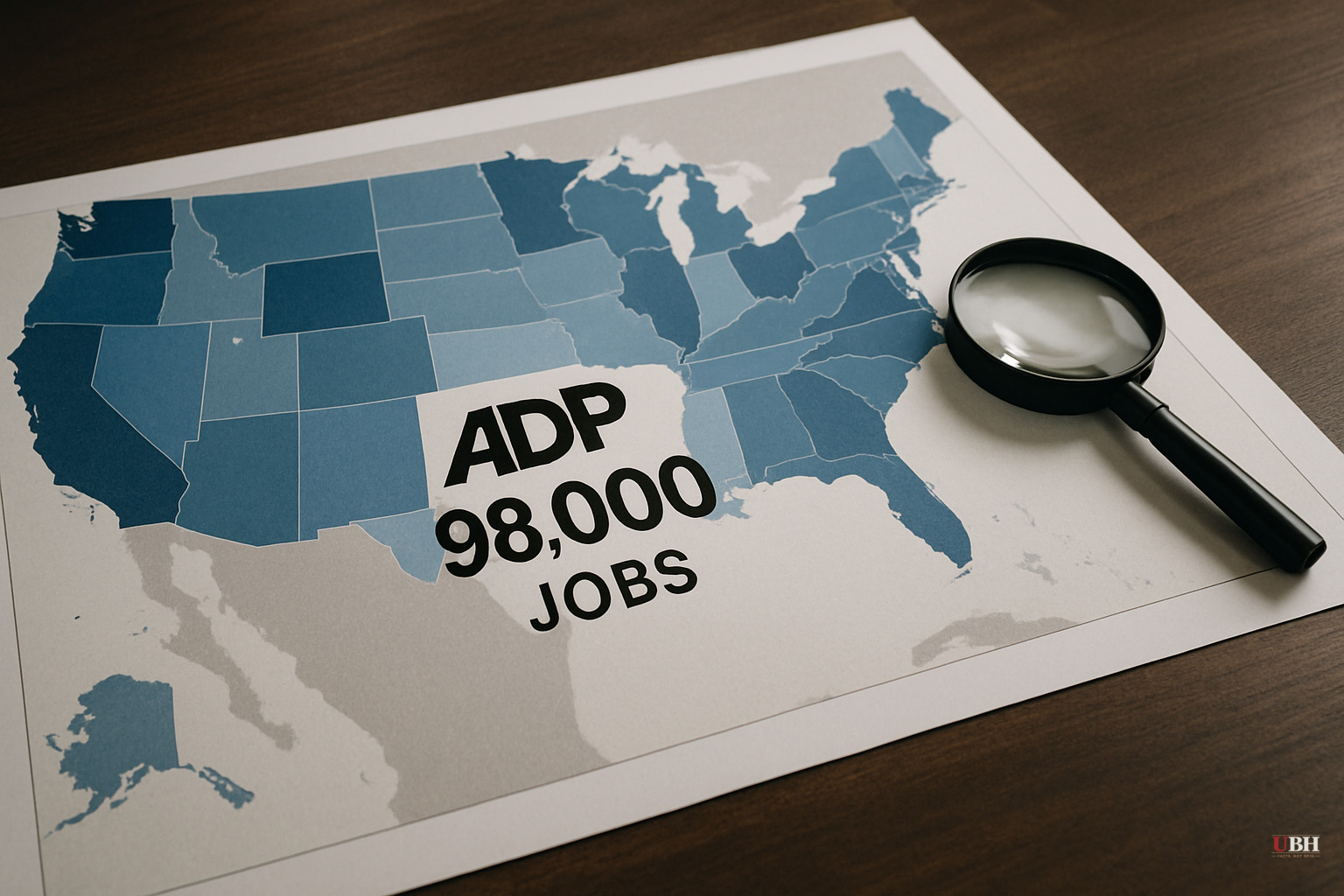
Since ADP's May report showed 122,000 private-sector jobs added, June's figure of 98,000 represents a measurable step down. Not a cliff, but a continued deceleration that reinforces questions about where the labor market is actually heading.
ADP published its National Employment Report on July 1, 2026, based on anonymized payroll data from more than 26 million private-sector U.S. employees, produced in collaboration with the Stanford Digital Economy Lab.
Who Was Hiring and Who Wasn't
Education and health services drove the number, adding 48,000 jobs. Nearly half the total. That sector has now led monthly private payroll growth consistently for nearly two years, according to ADP's own report. It is not a sign of a booming, broad-based economy. It is one industry doing the heavy lifting while others trail.
Trade, transportation, and utilities added 15,000. Financial activities contributed 14,000. Manufacturing added 5,000 and information added 7,000. Other services added 8,000.
Leisure and hospitality added just 2,000 positions. Its sixth consecutive month of weak hiring, per ADP's report. That sector is typically read as a proxy for consumer confidence and discretionary spending. Six straight weak months deserves attention.
Natural resources and mining shed 5,000 jobs, the only sector in negative territory.
Small Businesses Led, Large Ones Lagged
By employer size, small establishments (fewer than 50 employees) added 53,000 jobs. Medium-sized firms (50–499 employees) added 29,000. Large employers with 500 or more workers contributed 25,000.
Small businesses accounting for more than half the growth is a common pattern, but it also reflects where hiring risk tends to concentrate. Small employers hire and fire faster when conditions change.
Pay Is Holding, Not Accelerating
Median annual pay for job-stayers held at 4.4% year-over-year for the third consecutive month, according to ADP. Job-changers saw pay growth accelerate to 6.6%.
ADP chief economist Dr. Nela Richardson put it plainly: "The pace of hiring is telling a story of both supply and demand. We know it's taking people longer to find work, but there also are signs of labor supply constraints in certain industries. For now, the overall effect is a slowdown in job creation."
Flat pay-gain growth for stayers three months running is not consistent with a labor market running hot. Wages move faster when employers compete for workers. Right now, they aren't.
The Optimistic Read Deserves a Fair Hearing
Morningstar's coverage, citing MarketWatch journalist Jeffry Bartash, notes that other employment indicators suggest the labor market may be stabilizing after a recent rough patch. Job openings have surged and layoffs remain low. Most people who currently hold jobs are not at immediate risk. A slow hiring pace in one month does not mean mass job loss is coming, and low layoffs mean the existing workforce is largely intact. The Federal Reserve, according to Morningstar, currently views the labor market as stable and sees little need for intervention on rates.
But Morningstar also reports that a recent survey found the share of Americans who believe jobs are "hard to get" has reached a five-year high. That perception, however one weighs it against official data, shapes consumer behavior and spending in real time.
What Comes Next
The Bureau of Labor Statistics nonfarm payrolls report for June is scheduled for Thursday. The Wall Street consensus, per CNBC, forecasts a gain of 115,000 jobs, an unemployment rate steady at 4.3%, and average hourly earnings up 0.3% for the month and 3.5% annually.
ADP's count has consistently run below the official BLS figure in recent months, so Thursday's number could come in higher. The two reports measure different things. ADP excludes government workers; BLS does not. They can diverge significantly in any single month.
Morningstar notes that resolution of the ongoing conflict with Iran and further easing of inflation would be the conditions most likely to spur broader hiring. Whether either of those materializes before Thursday's report is a separate question entirely.
Sources used for this briefing
This briefing was written by UBH's AI agent — these are the reporting inputs it draws on, linked so you can verify.


