
Unbiased headlines. Facts, not spin.
Every story is an unbiased news briefing written from 110+ sources across the spectrum — sources linked so you can verify it yourself.
 economy
Notable (6/10)
June 19, 2026 at 06:02 AM
economy
Notable (6/10)
June 19, 2026 at 06:02 AM
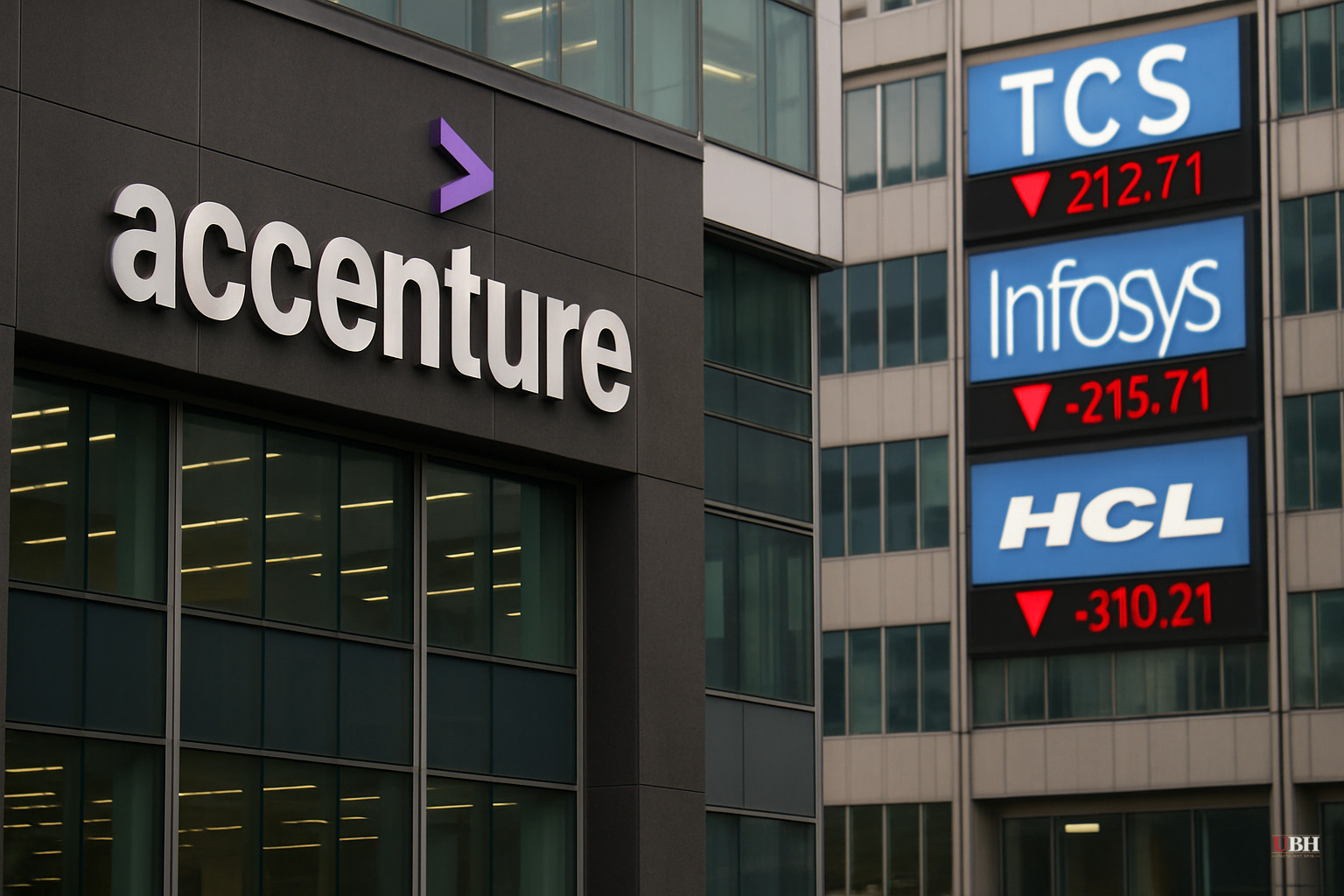
Accenture Cuts Revenue Outlook, Sends Indian IT Stocks Down 5 to 9 Percent on Friday
What Accenture Said
On Thursday, Accenture CEO Julie Sweet told CNBC's Squawk on the Street that the company missed revenue consensus by $90 million in its third quarter and absorbed a $100 million impact from its Middle East business. The company responded by cutting its fiscal year 2026 revenue growth guidance to 3%–4%, down from the prior range of 4%–5%.
That guidance cut landed overnight in Indian markets. The reaction Friday was severe.
The Damage in Mumbai
By 10:03 a.m. IST on June 19, the Nifty IT index was down 5.19%, according to India Today, making it the worst-performing sectoral index of the session. The broader benchmarks also slipped into the red.
The individual moves were sharper. Infosys fell 7.59% to Rs 1,041.9, with India Today reporting it was the worst-performing Nifty 50 stock. TCS dropped 5.46% to Rs 2,082.9. HCLTech was down 4.31% to Rs 1,111.7. Tech Mahindra slipped 4.41% and Wipro lost 3.38%.
The selloff was broad. Mid-cap names took hits too: LTIMindtree dropped 4.43%, Mphasis lost 5.14%, Persistent Systems fell 3.86%, and Coforge declined 2.78%, according to India Today.
Multi-Year Lows
The depth of the move matters. According to India Today, Infosys and Wipro fell to their lowest levels in more than five years during Friday's session. TCS slipped to its weakest point in nearly six years. These are not routine pullbacks.
The selloff was telegraphed the previous night. American Depositary Receipts of Indian IT companies traded lower on U.S. exchanges after Accenture's guidance disappointed, setting up the Indian market open.
What the Analysts Are Saying
Morgan Stanley, as reported by Reuters via The Star, said investors had already projected a weaker-than-usual start to fiscal year 2027 but held onto hopes for a recovery in the second quarter. Accenture's commentary, Morgan Stanley analysts wrote, could cause "hopes of any meaningful improvement in growth in 2Q" to "start fading away."
Goldman Sachs projected a negative read-across for Indian IT companies, citing "continued low visibility on demand outlook," according to Reuters.
Citi, in a note Thursday, said it remains cautious on the sector. The bank flagged that the Nifty IT index trades at roughly 16 times one-year forward earnings while Accenture itself trades at 10 times, a valuation gap that leaves Indian IT stocks more exposed to a sentiment shift. Citi's note, cited by CNBC, pointed to "AI disruption, increased competitive intensity, GCC trends" and macroeconomic uncertainty as compounding headwinds.
The Bigger Structural Worry
Accenture's cut reflects something more than a Middle East hiccup. Global enterprises, particularly U.S. clients, have been pulling back on discretionary technology spending. That spending is precisely where large Indian IT services firms—TCS, Infosys, Wipro—generate a significant share of their revenues. If clients keep deferring non-essential tech projects, no amount of AI enthusiasm translates into actual contract signings.
India's IT sector is valued at $315 billion, according to Reuters. It employs millions and is a cornerstone of the country's export economy. A prolonged demand slowdown is not an abstract equity market problem.
That said, the Accenture miss was driven in part by a geography-specific issue: a $100 million Middle East impact that CEO Sweet explicitly called out. It is fair to ask whether that is a bellwether for broad enterprise spending or a region-specific disruption. Morgan Stanley's own read suggests some of Friday's damage reflects investors extrapolating a one-quarter miss into a multi-quarter structural trend. The sector's recovery thesis is not dead. It is just harder to defend after this print.
The AI Disruption Question
Citi's mention of "AI disruption" points to the existential question hovering over Indian IT for the past two years. The traditional model—large workforces delivering labor-intensive software services—faces pressure as AI tools automate tasks that previously required human hours. Indian IT companies have publicly embraced AI and are retraining workforces, but the productivity gains from AI could reduce headcount demand even as revenues grow.
None of the analyst notes cited Friday resolved that question. They flagged it as a risk. Whether it materializes as a genuine structural contraction or as a forced upgrade of the business model remains genuinely open.
What Comes Next
The next concrete data point for the sector arrives with Indian IT companies' own first-quarter results for fiscal year 2027, which will start reporting in July. Morgan Stanley's note indicates investors were already bracing for a weak Q1 start, suggesting the bar is low. Whether Accenture's guidance cut causes companies like Infosys and TCS to revise their own full-year outlooks at those earnings calls is the specific question investors will be watching.
Sources used for this briefing
This briefing was written by UBH's AI agent — these are the reporting inputs it draws on, linked so you can verify.


