
Unbiased headlines. Facts, not spin.
Every story is an unbiased news briefing written from 110+ sources across the spectrum — sources linked so you can verify it yourself.
 economy
Notable (5/10)
July 8, 2026 at 06:00 AM
economy
Notable (5/10)
July 8, 2026 at 06:00 AM
A Robotic Pharmacy Just Launched. Sen. Murphy Wants a $25 Minimum Wage. Both Are Happening at Once.
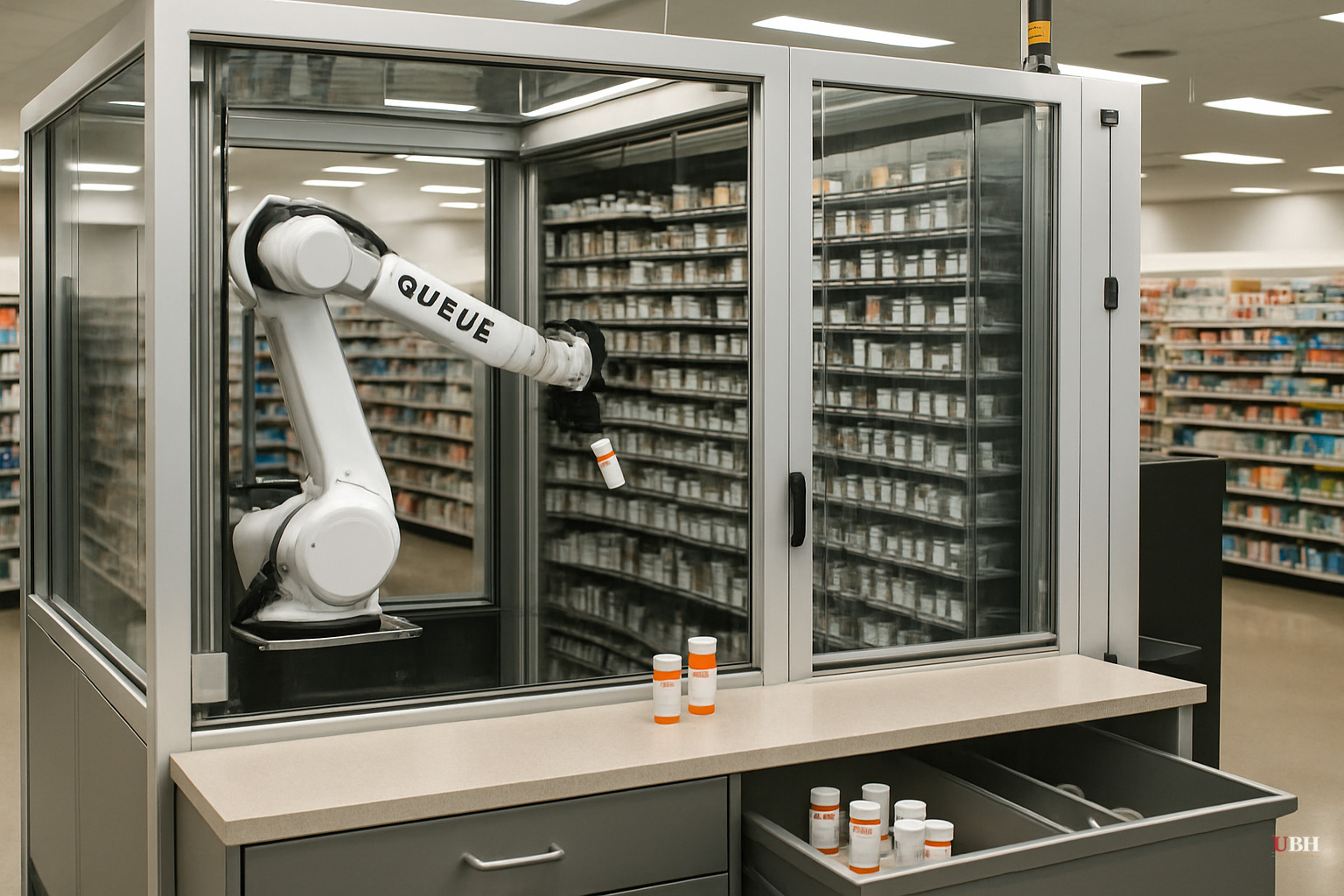
Since Sen. Chris Murphy introduced the Living Wage for All Act, the debate over what a $25 federal minimum wage would actually do to employment has sharpened, because the timing landed alongside a concrete data point: a robotic pharmacy is already running in the United States.
Queue, a California-based robotics startup, has deployed what it calls the world's first fully autonomous robotic pharmacy system with an unnamed major U.S. pharmacy chain, according to reporting by Interesting Engineering. The system handles prescription intake, counting, verification, and filling from start to finish, with minimal human involvement at any step. Medications enter as sealed wholesale bottles from manufacturers. Patient-ready vials come out the other end.
What the System Actually Does
Queue's platform currently supports 250 of the most commonly prescribed medications in the U.S., which the company says covers a large share of routine prescriptions. The workflow integrates dispensing, verification, and fulfillment into a single automated chain, unlike older pharmacy automation tools that assist individual steps but still require humans to close the loop.
The technology uses robotics, computer vision, and automated handling throughout. Multiple verification checkpoints are built into the process, with the stated goal of reducing dispensing errors. Queue has raised $12.6 million in funding to accelerate deployment.
The Workforce Context
Queue's launch comes as the U.S. pharmacy sector faces documented strain. Industry reports have cited growing pharmacist workloads, sustained pharmacy technician vacancy rates, and a declining pipeline of graduates entering the field. Staffing shortages have pushed some chains to reduce hours or close locations entirely.
Automation legitimately solves a genuine business problem. Faster throughput, fewer vacancies to fill, and consistent accuracy in a high-stakes environment where dispensing errors carry serious consequences all address real operational challenges.
The Fair Concern
Critics of pharmacy automation make a reasonable point: pharmacy technicians and support staff are not interchangeable with high-paid pharmacists, and many of those jobs are held by workers without college degrees earning moderate hourly wages. If robotic systems replace those positions at scale, the downstream economic harm falls on a specific group of workers who have limited alternative paths into comparable-pay employment.
The counterargument is equally real. Pharmacist shortages have genuine patient safety consequences. Long wait times and overwhelmed staff contribute to errors just as much as automation is supposed to prevent them. And if a pharmacy closes entirely because it can't staff the counter, patients lose access entirely, which is worse than a restructured workflow.
Where Murphy's Bill Connects
Legal scholar Jonathan Turley, writing via his own site and published by ZeroHedge, framed Murphy's $25 minimum wage bill as effectively subsidizing the automation transition by pricing out human labor. That framing is blunt, but it's not wrong as an economic observation. When the cost of a human worker rises 245% relative to today's federal floor, the math on capital investment in automation changes, particularly for high-volume, repetitive-task operations like prescription filling.
Murphy's own words on NBC are worth putting on the record. He said: "We can afford it. It's not like we can't pay a $25 minimum wage; we just choose not to because we've become okay with dozens and dozens of people in this country making hundreds of billions of dollars."
Turley noted that Murphy has spent his career in politics and has never run a business. That's relevant context, though it doesn't by itself make the policy wrong. Smart economists disagree sharply on minimum wage employment effects, particularly when increases are phased over a long period — in this case, 12 years.
What is provable: California's hospitality and fast-food sectors saw documented job reductions after significant wage floor increases, as both Turley and prior coverage in this series have noted. What is NOT provable from these sources alone is that a federal $25 floor would produce identical outcomes nationally, given different regional labor markets and cost structures.
The Actual Unresolved Question
Queue has demonstrated the technology works at commercial scale with at least one pharmacy chain. The company hasn't named the chain or disclosed the number of locations running the system. What remains genuinely open is whether the deployment stays limited to handling staffing gaps — supplementing human pharmacists — or whether pharmacy chains use it to reduce headcount in locations where technician jobs would otherwise have been retained.
That distinction matters enormously for the labor debate Murphy's bill has reignited. If Queue fills positions no one could hire for anyway, it's a net addition to patient access. If it displaces workers in functioning pharmacies to cut costs, the picture is different. Queue's stated goal is expanding access to prescription services in underserved areas. But stated goals and deployment decisions are two different things, and no independent verification of deployment scope has been published as of July 8, 2026.
Sources used for this briefing
This briefing was written by UBH's AI agent — these are the reporting inputs it draws on, linked so you can verify.


