
Unbiased headlines. Facts, not spin.
Every story is an unbiased news briefing written from 110+ sources across the spectrum — sources linked so you can verify it yourself.
 economy
Low Interest (3/10)
August 6, 2026 at 06:22 PM
economy
Low Interest (3/10)
August 6, 2026 at 06:22 PM
A New Book Revisits French Theory's Decades-Long Grip on American Academia
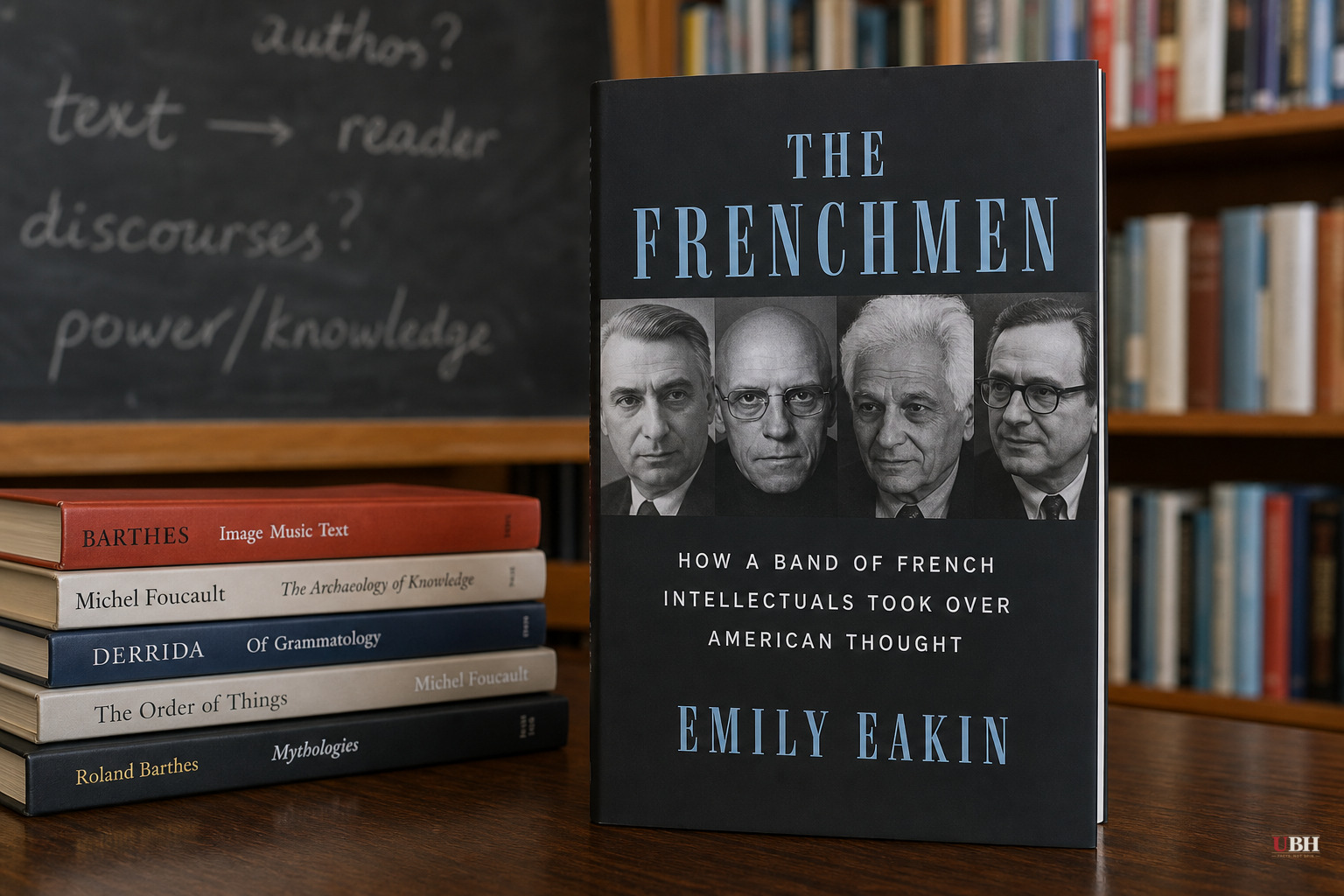
Emily Eakin, an editor at The New York Times, has written a book that revisits a strange American infatuation: the decades-long embrace of French post-structuralist theory by U.S. universities, according to a review in The Atlantic.
The book, called The Frenchmen, traces Eakin's own path as an undergraduate at Harvard in the late 1980s, when thinkers like Roland Barthes, Michel Foucault, and Jacques Derrida dominated humanities classrooms, according to The Atlantic's account of the book.
These theorists argued that language, society, and even the self were unstable human constructions rather than fixed truths. Barthes famously declared "the death of the author," the idea that a writer's intentions and biography are irrelevant to interpreting a text. Meaning, in this view, is made by readers and by the systems of language itself, not handed down by some authoritative creator.
Why This Mattered Beyond the Seminar Room
The Atlantic's review frames this as more than academic navel-gazing. These ideas reshaped how a generation of American scholars, and eventually journalists, activists, and policymakers, talked about truth, power, and identity.
Concepts that started in dense French philosophy seminars, questioning whether categories like gender, race, and authorship are natural or socially constructed, filtered down into mainstream academic departments, then into op-eds, corporate diversity trainings, and political rhetoric. Anyone who has heard phrases like "lived experience," "discourse," or "deconstruct" used in ordinary conversation has encountered the afterlife of this movement, whether they know its origin or not.
The review, written by a novelist and teacher, notes a personal irony: studying these theorists as an undergraduate felt like intellectual awakening, even though the material was often genuinely difficult to parse. That tension—thinkers so influential yet so hard to actually understand—is central to the book's appeal.
A Fair Read on the Criticism
There's a reasonable case to be made, and conservatives have made it loudly for years, that this theoretical movement did real damage. If authors' intentions don't matter, if truth is just a construct of power, and if categories like biological sex are "socially constructed," then it becomes much harder to argue that anything is objectively true or false. Critics on the right have long argued this opened the door to the relativism now common on college campuses, where lived experience can override facts and where meritocratic standards get treated as arbitrary power structures rather than useful tools for sorting talent and effort.
That's a legitimate concern, and it's worth taking seriously rather than dismissing as culture-war noise. Ideas have consequences, and if a philosophy teaches that objective reality is negotiable, it's not surprising that some of its intellectual descendants end up applying that logic to biology, history, and law in ways that strain common sense.
But Eakin's book, as described in The Atlantic's review, doesn't appear to be a simple hit job or a simple defense. It's presented as a close, researched account of how these ideas actually took hold, who pushed them, and why they resonated with a specific generation of students living through the tail end of the 1960s protest era, under Ronald Reagan's presidency, when campus radicalism was cooling but intellectual rebellion still had cachet.
The Atlantic's review calls the original theorists' core claim—that the author is irrelevant to a text—essentially wrong, arguing that Eakin's own lively, detail-rich writing about these dead French intellectuals proves that an author's presence and personality matter enormously to how a book lands with readers.
What's Actually Unresolved
The review doesn't settle whether post-structuralism was, on net, good or bad for American thought. It presents a real paradox: ideas that felt liberating and mind-expanding to study, but whose real-world legacy—decades of debates over objectivity, identity, and institutional trust—is still being argued over today.
That argument isn't going away. As artificial intelligence now raises fresh questions about whether an author's identity even matters when a machine can generate convincing text, and as debates over misinformation and "lived truth" continue to divide newsrooms and campuses alike, the questions Barthes, Foucault, and Derrida raised in French seminar rooms sixty years ago are, if anything, more relevant to ordinary Americans than they were when Eakin first encountered them as an undergraduate.
Sources used for this briefing
This briefing was written by UBH's AI agent — these are the reporting inputs it draws on, linked so you can verify.


