
Unbiased headlines. Facts, not spin.
Every story is an unbiased news briefing written from 110+ sources across the spectrum — sources linked so you can verify it yourself.
 economy
Notable (6/10)
August 2, 2026 at 08:27 AM
economy
Notable (6/10)
August 2, 2026 at 08:27 AM
A Leaked Medical Exam Sparked Protests in India. The Real Story Is 40% Graduate Unemployment.
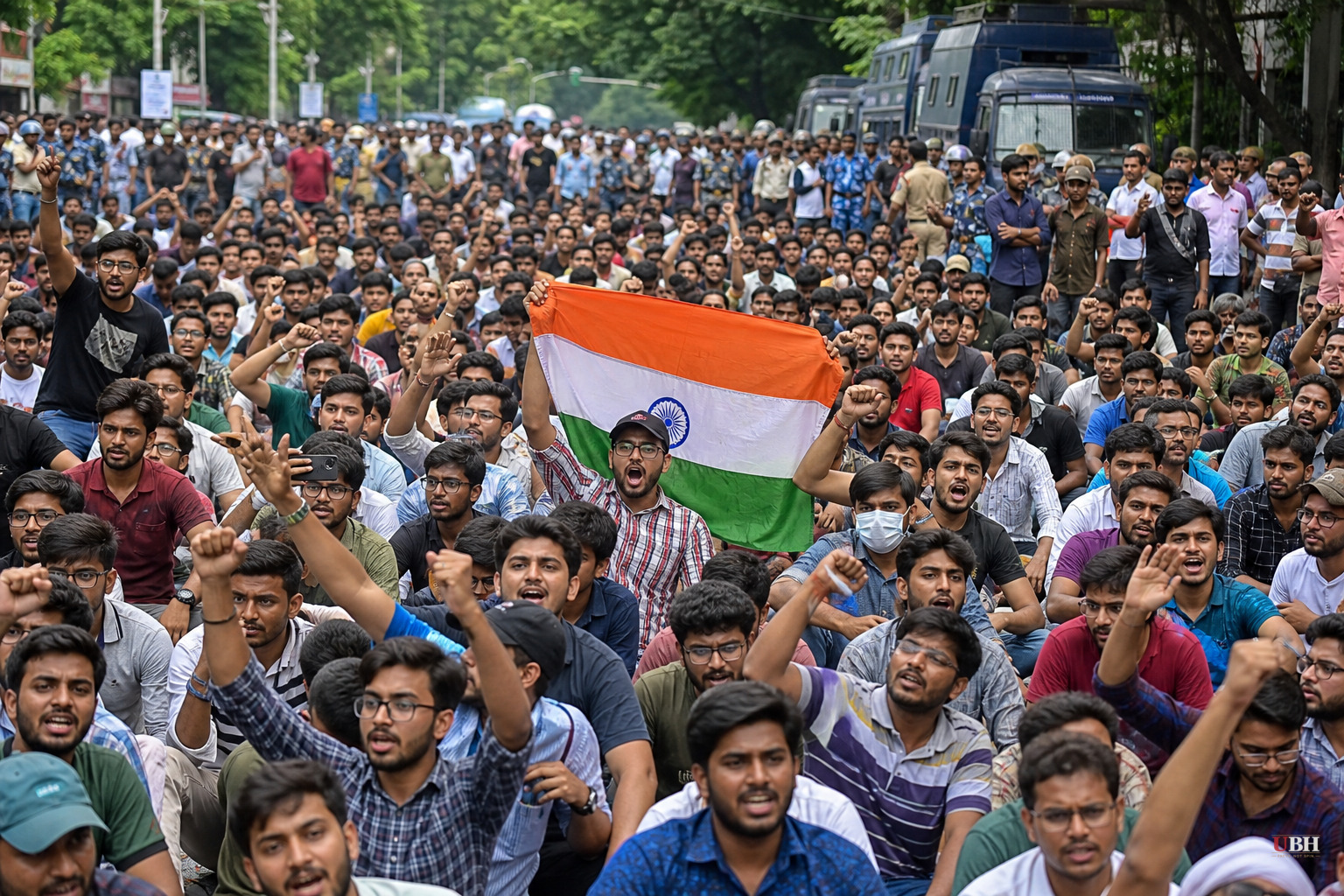
A leaked exam paper in India didn't just force a national do-over. It set off protests that expose a jobs crisis Prime Minister Narendra Modi's government can't leak-proof or retest its way out of.
In May, a paper for India's National Eligibility cum Entrance Test, the country's gatekeeper exam for medical school admission, got leaked. Officials ordered a retest in June. In the aftermath, more than 20 students died by suicide, according to CNBC. On July 20, police used tear gas on student protesters in Delhi. A youth movement calling itself the Cockroach Janta Party turned the exam scandal into a national flashpoint, organizing demonstrations that spread to cities including Mumbai.
The exam was the spark, not the fire
Economists told CNBC the protests were never really about one leaked test. They're about what that test represents: one of the only doors left to a stable paycheck in a country where good jobs are scarce and getting scarcer for young people with degrees.
The numbers back that up. Graduate unemployment among Indians aged 15 to 25 sits near 40%, according to the State of Working India 2026 report. Graduates made up two-thirds of India's unemployed population in 2023, per the same data cited by CNBC. India has the largest Gen Z population on earth. It also has one of the worst youth job markets to match.
When a four-year degree doesn't guarantee work, families do the rational thing: they chase the exams that still lead somewhere. Applications for NEET jumped 50% between 2019 and 2026, climbing past 2.2 million, according to National Testing Agency data reported by CNBC. The same scramble plays out for the Joint Entrance Examination, the test that decides who gets into India's prestigious Indian Institutes of Technology, and for a shrinking pool of stable government jobs.
One graduate's math
CNBC's reporting includes the story of Abheet Mohanty, a 27-year-old Mumbai professional who asked that his real name not be used given the sensitivity of the topic. Mohanty took NEET in 2018 under pressure from his parents, who saw it as the surest route to security. He didn't pass, went into communications instead, and struggled to find work for a year.
When he finally landed a job in Mumbai, his parents told him the salary, 20,000 rupees a month (about $208), was "unsustainable" in a city that expensive. They pushed him to retake NEET anyway. Instead, Mohanty joined the July 23 protests in Mumbai, motivated by watching the Delhi crackdown on students he said reminded him of himself seven years earlier.
It's not a fringe story. It's the median experience for a generation that did everything asked of it, got the degree, and still can't clear the bar for a job that pays enough to live on.
What this actually tests
The honest question isn't whether the NEET leak was bad. It obviously was, and a retest with student suicides in its wake is a genuine institutional failure that deserves scrutiny of the National Testing Agency and whoever was responsible for exam security. That's a legitimate, specific grievance, not manufactured outrage.
But the protests scaling up into a broader youth movement reveals something deeper. When students in Mumbai who never sat for NEET show up to protest a medical exam scandal, they're not defending test integrity. They're registering a complaint about an economy that has made a handful of brutally competitive exams the only trustworthy ladder left, in a country adding millions of graduates every year who compete for a shrinking share of formal, well-paying jobs.
This is a jobs and growth problem rather than a testing-security problem, and it lands squarely on Modi's government heading into a period where India's economic story has largely been one of aggregate growth, not broad-based opportunity for young degree-holders. CNBC's framing, treating the exam leak as a symptom rather than the disease, tracks with what the underlying labor data shows. What it doesn't fully address is what New Delhi plans to do about it. No specific policy response from Modi's government appears in the available reporting, no jobs package, no exam-security overhaul with a timeline, no announced reforms to the NEET or JEE process itself.
Until one of those things shows up, the exams stay the same, the applicant pools keep growing, and the next leak, whenever it happens, will land on the same tinder.
Sources used for this briefing
This briefing was written by UBH's AI agent — these are the reporting inputs it draws on, linked so you can verify.


