
Unbiased headlines. Facts, not spin.
Every story is an unbiased news briefing written from 110+ sources across the spectrum — sources linked so you can verify it yourself.
 defense
Major Story (8/10)
August 8, 2026 at 10:43 AM
defense
Major Story (8/10)
August 8, 2026 at 10:43 AM
A Convicted Money Launderer Built Russia's $100 Billion Sanctions-Busting Payment Network
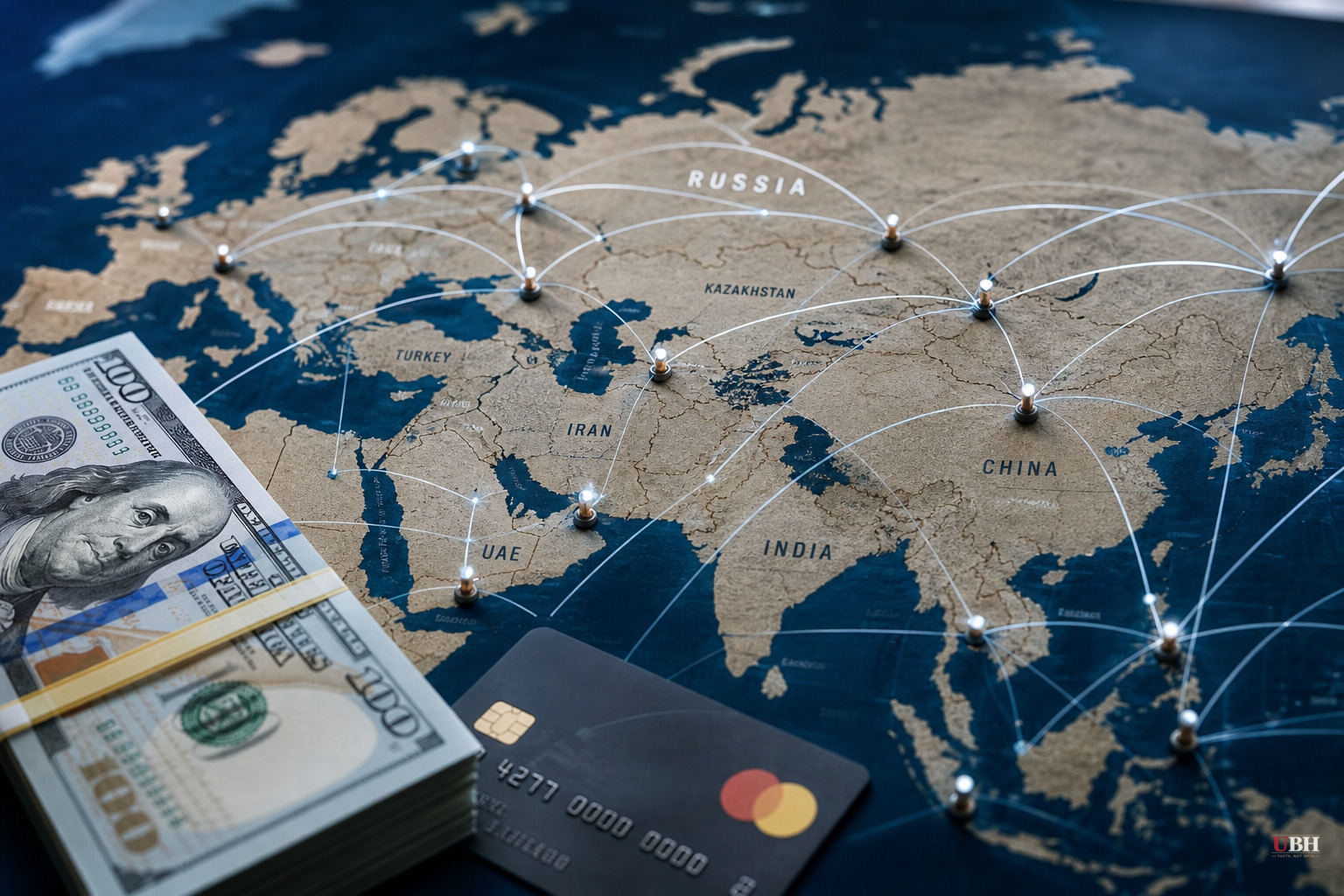
Russia has a sanctions problem. A convicted fraudster may have solved it.
A7, a state-backed payment network launched less than two years ago, now moves more than $100 billion annually, according to the Wall Street Journal's reporting cited by Mint. That's roughly 20% of all Russian foreign trade payments. The company uses a blend of cryptocurrency and traditional banking to pay for everything from drone parts to imported fruit to luxury cars, according to researchers cited in that reporting.
The man behind it is Ilan Shor, a 39-year-old fugitive businessman who goes by "Travolta" in A7's internal company chat, according to leaked messages circulated by hackers last year. Shor was convicted by a Moldovan court of fraud and money laundering for his role in extracting $1 billion from three Moldovan banks in 2014, one of the largest bank heists in modern European history. He fled the country while under house arrest and now lives near Moscow, married to a Russian pop singer.
Shor has denied the allegations and called them politically motivated. Neither Shor nor representatives of A7 responded to requests for comment for the Mint report.
Putin's Personal Stamp of Approval
This isn't some rogue operation Moscow tolerates. President Vladimir Putin personally blessed A7's rise, appearing by video link last year at the opening of an A7 branch office. This signals clearly that the Kremlin views this network as state business, not private enterprise skating on the edges of legality.
The U.S., U.K., and European Union have all sanctioned A7. The company's response has been to lean into it. At Russia's flagship economic forum in St. Petersburg in June, A7's booth featured a giant roly-poly toy stamped with its logo, a Russian symbol for something that always springs back upright no matter how hard you knock it down.
Shor made the pitch explicit in July, telling TASS, Russia's state news agency: "Before, the Western system essentially enslaved the whole financial world, allowing the West to flip a switch at any time and stop any country from being able to make payments. We give companies and countries freedom, because our system is immune to sanctions."
That claim comes from a man convicted of stealing a billion dollars from some of Europe's poorest bank depositors. According to the sourcing here, it is not entirely wrong about the mechanics. A7 has adapted to Western sanctions rather than folding under them, and it's now expanding: fresh offices in Nigeria and Zimbabwe, with Latin America and the Middle East next on the list. The company isn't shy about its target market, either. Executives want to serve countries the West has treated as pariahs.
The Bigger Game: A Crypto Cold War
A7 isn't happening in a vacuum. It's one front in a larger contest over who controls the plumbing of global finance, according to analysis from the Bitcoin Foundation. Washington is betting on dollar-backed stablecoins to extend American financial reach, backed by the GENIUS Act signed in July 2025, which explicitly designates payment stablecoins as tools "to promote the international use and prestige of the U.S. dollar." Per a 2025 U.S. Treasury presentation cited in that analysis, more than 99% of stablecoin market capitalization by value is dollar-backed, and the total stablecoin market hit roughly $320 billion by the end of May 2026.
Beijing is pursuing a different model: state-led payment systems and tightly regulated blockchain infrastructure, keeping Communist Party control at the center. Moscow's approach, per the same analysis, treats mining, digital assets, and the digital ruble as strategic tools to blunt the pain of economic isolation. A7 is the sharpest practical expression of that strategy so far: a hybrid crypto-and-banking network built specifically to route around sanctions enforcement.
The Case for Taking the Threat Seriously, and the Case Against Overreacting
There's a legitimate argument that A7 represents a real crack in the sanctions regime. If a network founded by a convicted fraudster can move $100 billion a year and keep expanding into new countries despite being sanctioned by three major Western jurisdictions, that's a policy failure worth scrutinizing. Sanctions only work if they're actually enforced, and a system that can dodge them at scale undermines the entire point of imposing them in the first place.
At the same time, $100 billion moving through a workaround doesn't mean sanctions have failed outright. Russia's economy has still absorbed massive strain since 2022, and needing an elaborate crypto-and-banking evasion network run by a fugitive money launderer is itself evidence that direct access to Western financial systems remains cut off. A7's existence is a sign Moscow is struggling to find legitimate channels, not proof the isolation strategy is broken.
What's unresolved is whether U.S. and European regulators can meaningfully choke off A7's newest expansion points in Nigeria and Zimbabwe before the network embeds itself there the way it has in Russian trade. No new sanctions enforcement action against A7's African offices has been announced in the sourcing reviewed here. That leaves an open question for Treasury and its European counterparts: does existing sanctions authority reach a network expressly designed to outrun it, or does closing this loophole require entirely new legal tools?
Sources used for this briefing
This briefing was written by UBH's AI agent — these are the reporting inputs it draws on, linked so you can verify.


