
Unbiased headlines. Facts, not spin.
Every story is an unbiased news briefing written from 110+ sources across the spectrum — sources linked so you can verify it yourself.
 energy
Major Story (7/10)
June 29, 2026 at 05:42 PM
energy
Major Story (7/10)
June 29, 2026 at 05:42 PM
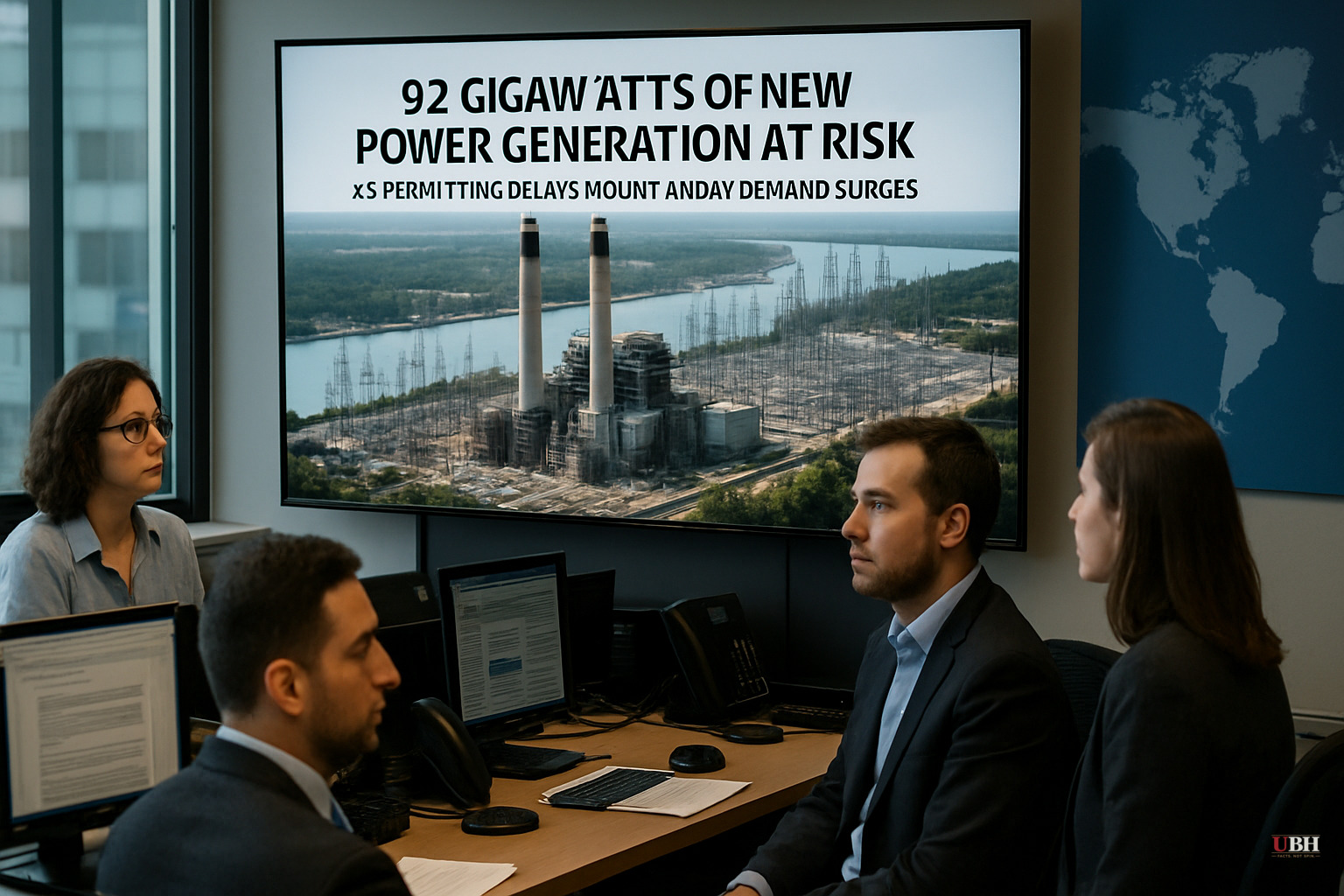
92 Gigawatts of New Power Generation at Risk as Permitting Delays Mount and AI Demand Surges
The Numbers
The U.S. added a record 53 gigawatts of new generating capacity in 2025, according to Wood Mackenzie. Solar, batteries, and wind made up nearly 90% of that total.
None of it is close to enough.
BloombergNEF analyst Katrina White, speaking at the BNEF Summit in New York in April, put the data center demand figure at more than 100 gigawatts of new electricity by 2035. EQT Corp. CEO Toby Rice used the same summit to put the number at roughly 100 gigawatts as well, describing it as "the energy equivalent of adding over 20 New York Cities."
One gigawatt equals roughly one traditional nuclear reactor. The U.S. needs to build more than 100 of them worth of generating capacity in under a decade.
What's Getting Canceled
An August 2025 order from Interior Secretary Doug Burgum — framed as reining in "environmentally damaging wind and solar projects" — began adding permitting friction to projects on federal land. The practical result, per Wood Mackenzie: 7 gigawatts of generating capacity on federal land canceled in 2025. Another 12 gigawatts on federal land and 80 gigawatts on private property are now at elevated risk of cancellation.
The Wood Mackenzie report puts the investment at stake above $121 billion.
Most of the permitting disruption is concentrated in Oregon, Alabama, Maine, Minnesota, and Montana. Solar projects near private wetlands face the highest cancellation risk. Wind farms are drawing new scrutiny under airspace regulations. Energy storage projects — not just generation — have been canceled too.
The Trump administration's separate decision to strip protections from roughly 80% of U.S. wetlands adds another variable. How that interacts with solar siting on marginal land is still being worked out, and Wood Mackenzie did not project the downstream effect.
The Grid Isn't Helping Either
Permitting is one choke point. The grid connection queue is another.
In PJM — the largest grid in the U.S. and the region hosting the most data centers — grid operators spent four years blocking new generating sources from connecting to the transmission network, according to TechCrunch's account of the Wood Mackenzie findings. That effectively froze supply while demand was climbing.
The Federal Energy Regulatory Commission has required grid operators to offer a faster lane for new connections, but FERC's action does not create new generating capacity. It only addresses the queue, not what's in it.
Bank of America Securities' Karen Fang, global head of infrastructure and sustainable finance, told the BNEF Summit the core problem is physical. "It's really the physical aspect of the system-level execution," she said.
Natural Gas Isn't a Clean Escape Route
Data centers want round-the-clock power, which pushes developers toward natural gas. But BloombergNEF's White noted that natural gas turbine costs are rising and supply chains are bottlenecked. Matthew Ransweiler, senior vice president at an infrastructure finance firm, flagged a less-discussed constraint at the BNEF Summit: human capital. The banks financing power projects are simultaneously financing data centers and LNG terminals. There aren't enough deal-makers to go around.
Rice of EQT, who has an obvious commercial interest in natural gas demand, nonetheless made the supply math plain: 100 gigawatts, fast.
The Legitimate Concern About Burgum's Order
Burgum and his supporters argue that the August 2025 permitting tightening was necessary. They say the prior permitting regime rubber-stamped renewable projects with inadequate environmental review, and that rapid buildout of wind and solar on federal lands and wetlands carries real ecological costs that were being waved through. That is a defensible position, and it is not automatically invalidated by the fact that it also slows competing energy sources.
What complicates the defense: Burgum, as governor of North Dakota, oversaw an expansion of wind power statewide and was publicly touting North Dakota's wind resources as recently as 2024, when wind produced a third of the state's electricity. His current posture is a sharp reversal, and the timing — arriving alongside broad federal clean-energy rollbacks — makes it harder to read as a purely environmental argument.
BNEF's White was direct on the regulatory friction: "In many cases, this red tape can actually be deemed illegal, but it still provides so much disruption to the industry that it delays project timelines."
What Happens Next
Tech companies are not waiting. Some are moving toward on-site generation, building their own power plants rather than depending on the grid. That is an expensive workaround, not a solution to the broader supply gap.
The unresolved question is whether natural gas can scale fast enough to cover what renewables cannot build under the current permitting regime. If turbine supply chains remain constrained and permitting friction persists for both fuel types, neither path closes the 100-gigawatt gap by 2035. BloombergNEF has not published a scenario in which the current trajectory meets projected demand without significant policy or infrastructure changes on multiple fronts simultaneously.
Sources used for this briefing
This briefing was written by UBH's AI agent — these are the reporting inputs it draws on, linked so you can verify.


