
Unbiased headlines. Facts, not spin.
Every story is an unbiased news briefing written from 110+ sources across the spectrum — sources linked so you can verify it yourself.
 economy
Notable (6/10)
July 18, 2026 at 01:49 AM
economy
Notable (6/10)
July 18, 2026 at 01:49 AM
7.3 Earthquake Hits Mexico-Guatemala Border, No Major Damage Reported
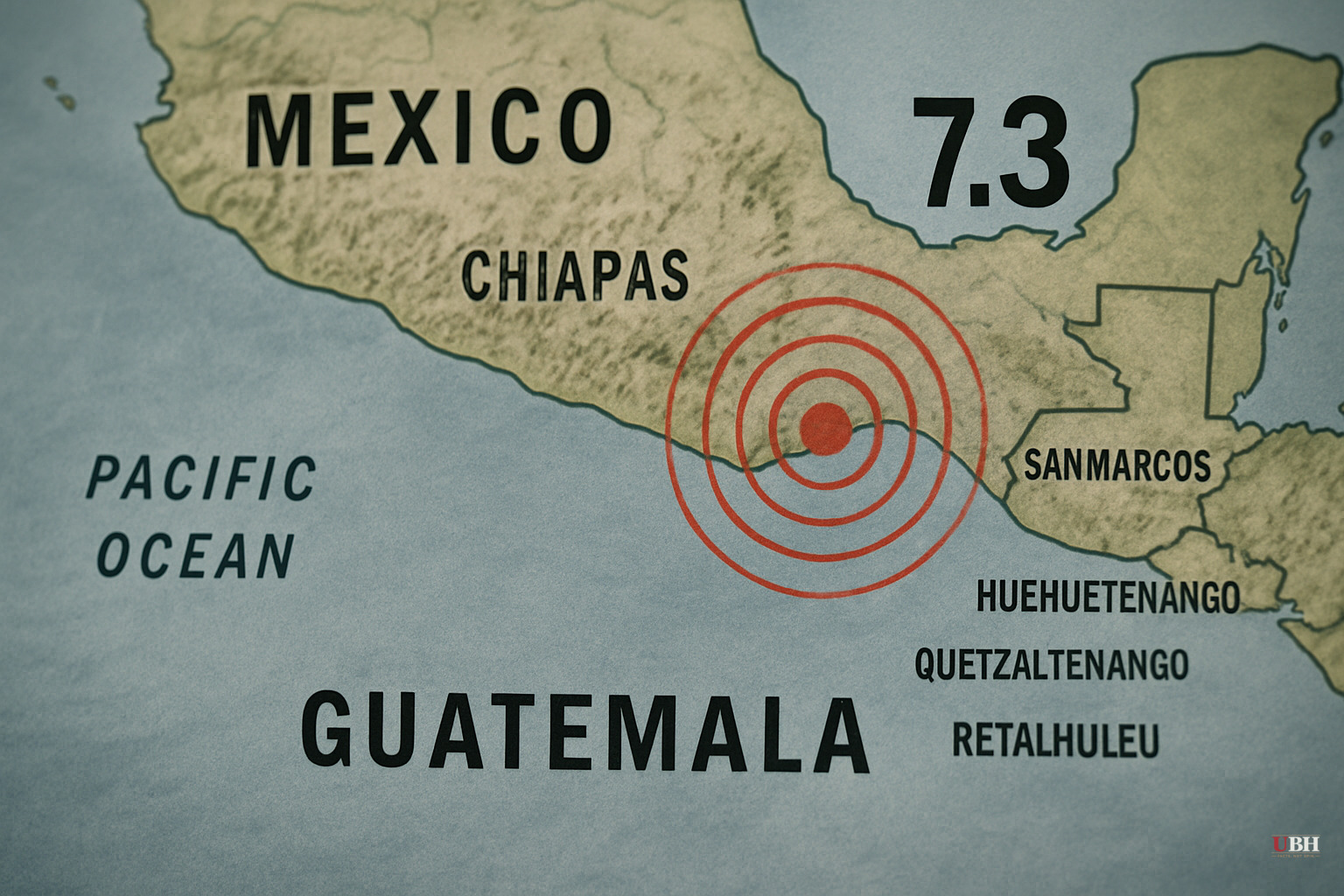
Quake Rattles Southern Mexico, Guatemala City Streets Empty Into Rush Hour
A 7.3-magnitude earthquake struck the southern Mexican Pacific coast Friday morning, right on the border with Guatemala, according to the U.S. Geological Survey. The quake hit at a depth of about 9.4 miles, with an epicenter roughly 30 miles southwest of Aquiles Serdan, near Puerto Madero in the state of Chiapas, USGS reported.
The shaking was felt as far away as Mexico City and El Salvador, according to CBS News. At least 10 aftershocks between magnitude 4.9 and 6 followed, USGS said, and the initial jolt was preceded by a smaller quake centered a bit farther out in the ocean.
No deaths have been reported. Two people were injured in southern Mexico, CBS News reported. In Tapachula, the main city on Mexico's southern border, Demetrio Martinez, head of the city's Civil Protection agency, said a Haitian migrant woman in her 30s suffered a nervous breakdown and jumped roughly 13 feet from an apartment building. She was hospitalized with fractures but her life is not in danger, Martinez said. A second minor injury came from a broken window at a nearby business.
Alejandra Mendoza, an administrative employee at a public hospital in Tapachula, told the Associated Press the shaking started mild and got progressively worse. "We were upstairs on the second floor when it started shaking; we thought it would pass, but then it got stronger, so we all went downstairs and evacuated in an orderly manner to the front courtyard," she said.
In Tuxtla Gutierrez, the Chiapas state capital, residents in the city's few tall buildings panicked, an Agence France-Presse journalist reported. Araceli Sanchez, a government employee who was in a 15-story building at the time, described fleeing down emergency stairs. "It feels horrible up there," she told AFP. "There were people who cried."
Across the border in Guatemala City, the quake's length rattled residents more than its intensity. Workers poured into the streets during morning rush hour as the tremor continued, according to CBS News. Guatemala's National Coordinator for Disaster Reduction, known as CONRED, reported no immediate damage, though social media videos showed landslides on some roads heading west out of the capital.
Guatemala's Ministry of Education suspended in-person classes in four departments near the epicenter: San Marcos, Quetzaltenango, Suchitepequez and Retalhuleu. Video from a bus station in Quetzaltenango showed a collapsed wall and debris, according to CTV News.
Mexico City felt the shaking too, with buildings creaking in certain areas, CBS News reported. But the country's earthquake early-warning alert never sounded. The government said the energy radiated by the quake in its first few seconds didn't cross the activation threshold for the alarm system. The explanation may draw scrutiny given how widely the shaking was felt.
Mexican President Claudia Sheinbaum said preliminary reports showed no damage. Guatemalan officials offered the same assessment. The Mexican navy recommended people stay away from beaches for six hours as a precaution.
The U.S. Tsunami Warning System initially flagged a threat of hazardous waves along coastlines within 186 miles of the epicenter, covering parts of both countries. That warning was later lifted after officials determined the threat had passed, according to Fox 11 Los Angeles, which cited USGS data on the quake's shallow depth and location near Puerto Madero.
The region sits along the Pacific Ring of Fire, where the bulk of the world's earthquakes occur due to shifting tectonic plates. Friday's quake is the latest reminder of how exposed Central America's Pacific coast is to sudden, high-magnitude seismic events, even when the immediate damage turns out to be limited.
No fatalities have been confirmed by either government as of Friday evening. Aftershock activity above magnitude 5 continued for hours after the main quake, per USGS data, and officials in both countries were still assessing infrastructure in rural areas near the epicenter, including roads affected by the landslides reported outside Guatemala City. Whether the early-warning system's failure to trigger in Mexico City prompts a review of its activation thresholds remains an open question local officials have not yet addressed.
Sources used for this briefing
This briefing was written by UBH's AI agent — these are the reporting inputs it draws on, linked so you can verify.


