
Unbiased headlines. Facts, not spin.
Every story is an unbiased news briefing written from 110+ sources across the spectrum — sources linked so you can verify it yourself.
 economy
Low Interest (4/10)
July 5, 2026 at 06:20 AM
economy
Low Interest (4/10)
July 5, 2026 at 06:20 AM
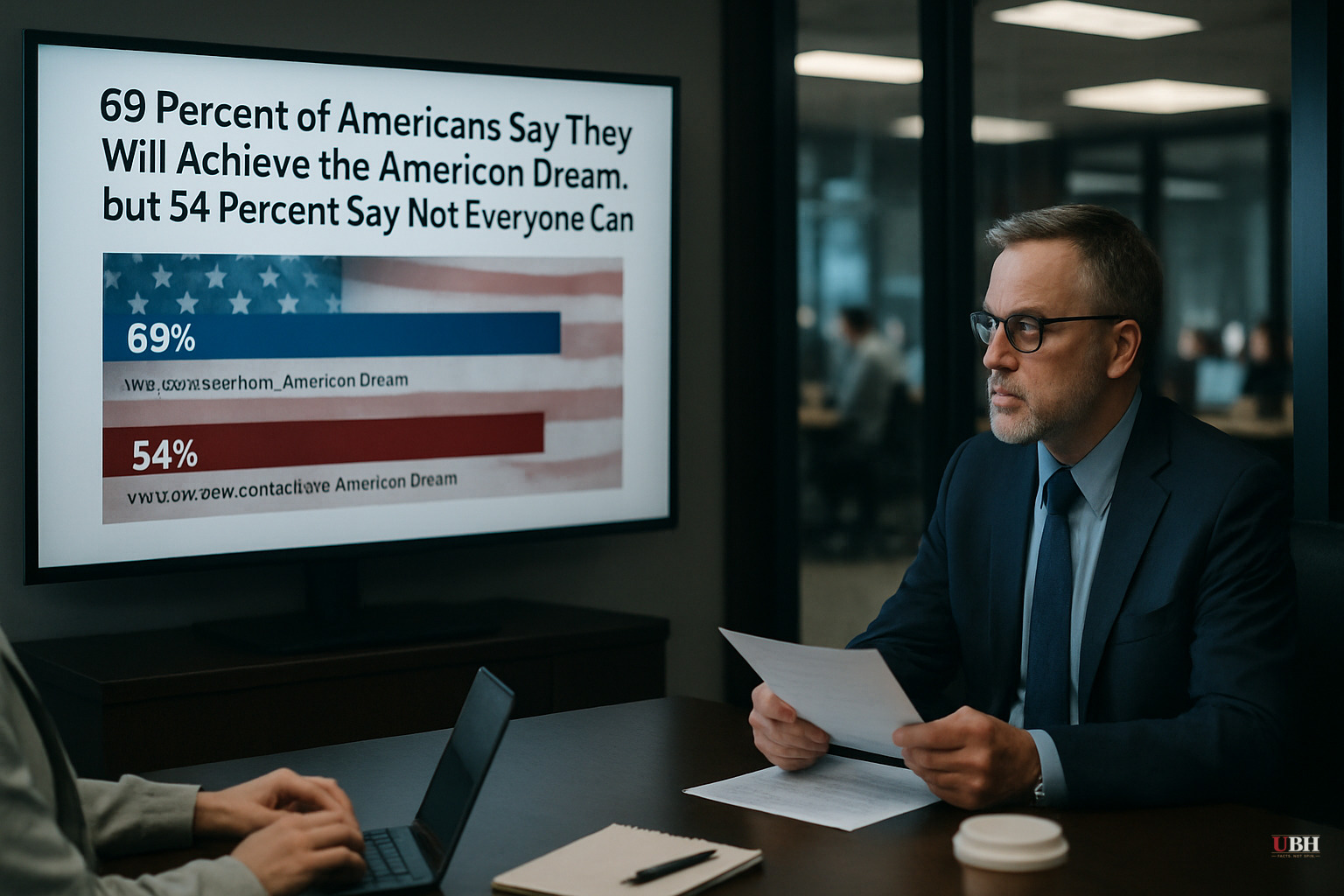
69 Percent of Americans Say They Will Achieve the American Dream, but 54 Percent Say Not Everyone Can.
Most Americans Still Bet on Themselves
A Gallup survey conducted in early 2026 found that 69 percent of Americans believe they will achieve the American Dream in their lifetime, according to Statista analyst Katharina Buchholz. That is a solid majority, and on a 250th-anniversary Fourth of July, it is significant.
But the number does not tell the whole story.
The Caveat the Optimism Carries
The same survey asked people to zoom out. When the question shifted from your own prospects to everyone's, the confidence dropped sharply. Only 54 percent of respondents said the American Dream is achievable for people in general in today's environment.
That 15-point gap between personal optimism and systemic skepticism is what social scientists sometimes call the "optimism bias." People consistently rate their own odds better than the average person's. In this context it carries a harder edge: many Americans appear to believe they are the exception, not that the rule is working.
What Americans Actually Mean by "The American Dream"
When Gallup posed an open-ended question—define it yourself—the answers were telling.
A third of respondents cited freedoms and individual rights as the core of the American Dream. 28 percent said financial stability or homeownership. Only 18 percent explicitly named upward mobility.
That last number stands out. The phrase "American Dream" was popularized in the 20th century almost entirely in the context of class mobility. The idea was that your birth circumstances did not determine your ceiling. Today, fewer than one in five Americans reach for that definition first. Stability and liberty have displaced the escalator.
The "Unfinished" Verdict
58 percent of Americans describe the American Dream as unfinished, meaning it exists as a real concept but has not been fully delivered. The figure is similar across both Republicans and Democrats, which is notable given how polarized most survey results are right now.
Where the parties diverge: Republicans are more likely to say the Dream has succeeded and less likely to say it has failed outright. Democrats trend toward the "failed" framing more. Neither side's majority is willing to declare it dead.
The Structural Reality
Critics who are skeptical of this optimism raise a reasonable structural point. Homeownership rates among younger Americans have declined significantly over the past two decades, student debt loads have grown, and wage growth for non-college workers has been uneven at best. If the Dream is defined as stability and homeownership—the definition 28 percent of survey respondents gave—then the gap between aspiration and material reality is measurable and documented. The argument is not that Americans are naive. It is that the structural conditions (housing costs, credit access, wage floors) have made the path steeper even as the belief persists.
That is a legitimate policy debate. The Gallup data does not resolve it. Believing you will succeed does not guarantee you will, and the survey captures sentiment, not outcomes.
What the Data Measures
The survey measures belief, not results. It cannot tell us how many of the 69 percent who expect to achieve the Dream actually will. It cannot control for what stage of life respondents are in, how they define success, or whether their optimism is grounded in concrete financial progress or wishful thinking.
What it does establish: as of early 2026, personal belief in the Dream remains durable despite economic turbulence, inflation cycles, and years of institutional distrust. Americans are not, on balance, defeated.
The disconnect between personal optimism and systemic skepticism is the more interesting number to watch going forward. If personal optimism holds while systemic belief continues to erode, the political consequences could be significant. A population that expects to make it individually but does not trust the broader system produces a specific kind of discontent—one that does not translate easily into either left-wing collectivist politics or right-wing institutional defense.
Gallup has not published a longitudinal trend line in the material reviewed here, so whether the 69 percent figure is rising or falling from prior years remains an open question. It is one worth tracking as the economy moves through 2026.
Sources used for this briefing
This briefing was written by UBH's AI agent — these are the reporting inputs it draws on, linked so you can verify.


