
Unbiased headlines. Facts, not spin.
Every story is an unbiased news briefing written from 110+ sources across the spectrum — sources linked so you can verify it yourself.
 economy
Notable (6/10)
July 5, 2026 at 12:23 AM
economy
Notable (6/10)
July 5, 2026 at 12:23 AM
Germany's 2026 Growth Forecasts Keep Getting Cut. Four Institutions Now Disagree on How Bad It Is.
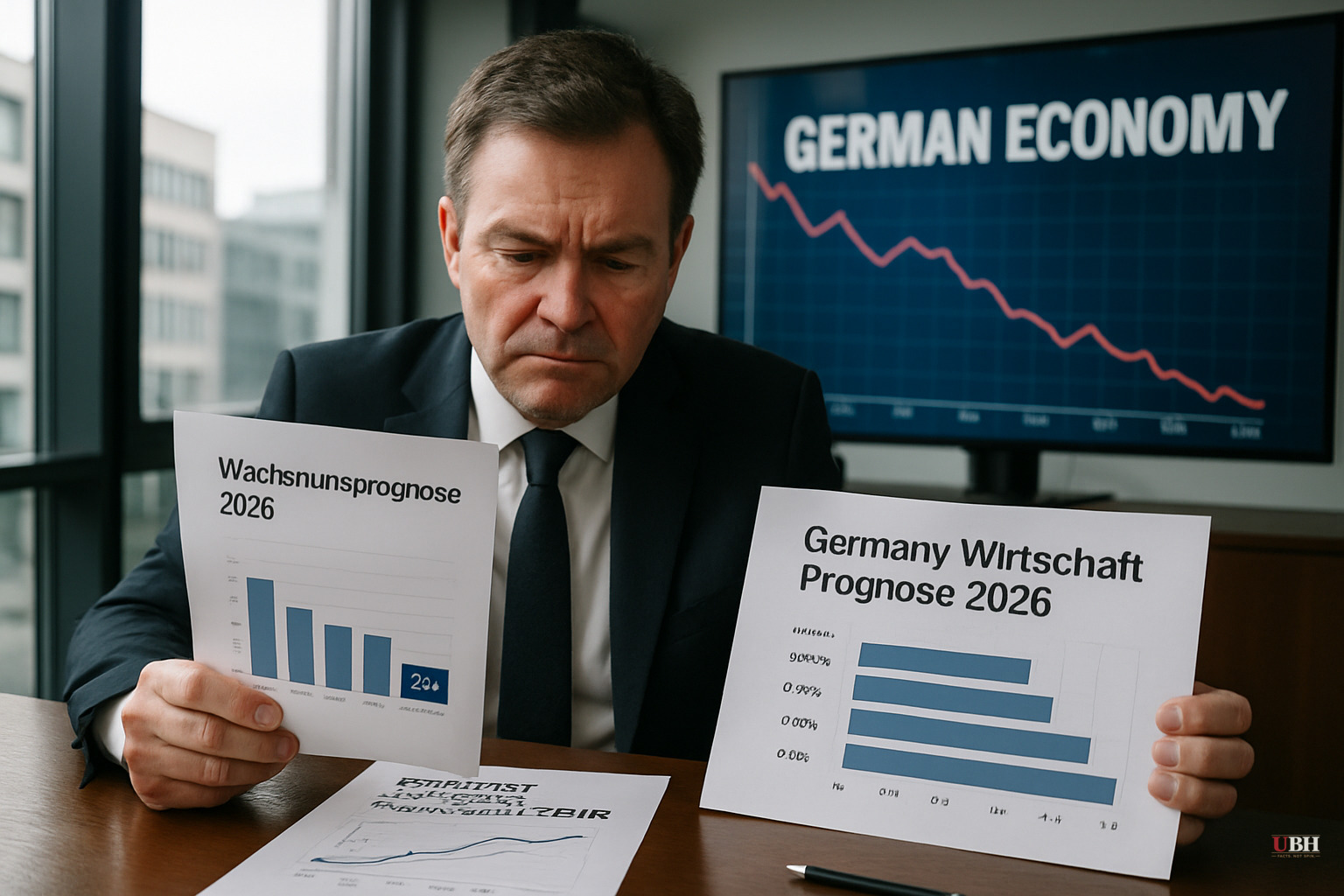
Since Germany's cabinet approved its €203.6 billion borrowing plan for 2027 earlier this week, a fuller picture of the economic landscape that plan is meant to address has come into focus.
Four Forecasters, Four Numbers, One Direction
Germany's Economy Ministry, led by Economy Minister Katherina Reiche, has cut its 2026 GDP growth forecast to 0.5%, down from a prior estimate of 1.0%, according to Crypto Briefing. The ministry's 2027 outlook also dropped, from 1.3% to 0.9%.
The ifo Institute, reporting in its Spring 2026 forecast, is slightly more optimistic at 0.8% growth for both 2026 and 2027. The Bundesbank sits at 0.6%, expecting a moderate recovery to begin around mid-year. The BDI, Germany's main industrial association, published its own revised forecast on June 22 at 0.4%, down from 1.0% in January, according to Global Banking & Finance Review. DIHK, Germany's chamber of commerce, is the most pessimistic of the group at 0.3%, with business sentiment at pandemic-era lows, according to Crypto Briefing.
Every single one of these numbers was revised downward from where it stood at the start of 2026. The direction is unanimous even if the magnitude is not.
The Strait of Hormuz Is the Hinge Point
The ifo Institute's Timo Wollmershäuser, Head of Forecasts, identified the core dynamic bluntly: "The economy is currently being shaped by conflicting forces." On one side, an energy price shock tied to the Iran war is pulling growth down by roughly 0.4 percentage points in each of the next two years. On the other, Berlin's fiscal expansion is pushing it back up by about 0.5 percentage points annually.
The Iran war's most direct economic weapon was the closure of the Strait of Hormuz in early March 2026. That chokepoint carries a substantial share of global LNG shipments. Its disruption sent TTF gas prices, Europe's benchmark, toward €60 per megawatt-hour, according to Crypto Briefing. For Germany's energy-intensive industries — chemicals, steel, automotive — that kind of sustained input cost is a direct hit to margins.
ifo estimates the energy shock alone could shave up to 0.8 percentage points off German growth if the conflict escalates further. Against a baseline forecast of 0.5% to 0.8%, that is the arithmetic difference between weak recovery and outright contraction.
Wollmershäuser's forecast does carry one important caveat: it assumes the Middle East conflict de-escalates in the coming weeks and the Strait of Hormuz reopens. Since an agreement was reached last weekend, futures markets have priced in faster energy price declines. If that holds, ifo says inflation could fall faster and growth could come in higher than their baseline.
The Fiscal Response and Its Limits
Berlin's answer to the shock is spending. The centerpiece is a €500 billion infrastructure investment fund, alongside the defense spending ramp that now exceeds the previously maintained threshold of 2% of GDP. ifo credits this fiscal push with contributing 0.5 percentage points to growth in each year.
But ifo is careful about what that spending actually buys. The institute notes that current government measures "primarily served to preserve the existing structure" rather than transform it. Potential growth is forecast to remain at a historically low 0.1% through the end of the decade, held back by demographic change and weak productivity. The fiscal push is a stabilizer, not a structural fix.
The government's financing deficit tells the cost side of that equation. ifo projects the deficit widening from 2.8% of GDP in 2025 to 4.1% in 2026 and 4.9% in 2027. Gross debt is heading toward 68% of GDP by 2027. Germany is buying short-term stability with long-term debt.
Business: Government Must Do More Than Spend
BDI President Peter Leibinger called the industrial situation "critical, but not hopeless" in his June 22 statement, according to Global Banking & Finance Review. His demand was not for more government spending. It was for structural reform: lower corporate taxes, better depreciation rules, stronger innovation incentives, faster planning and approval procedures, and a less bureaucratic public administration.
"Policymakers must deliver — consistently, reliably, and with priority given to growth," Leibinger said. "That is how investment, growth, and a new beginning will emerge."
That position — that fiscal expansion alone will not restore German competitiveness — deserves a fair hearing. High energy prices, high labor costs, and excessive bureaucracy were dragging on the industrial base well before the Iran war started. The war accelerated a deterioration that was already underway. The €500 billion infrastructure fund does not directly address corporate tax rates or permitting timelines.
The counterargument from the government's side is that the fund and defense commitments represent the largest fiscal mobilization Germany has undertaken in a generation, and that stability has to come before structural reform can take hold. That is a defensible position. Whether it is sufficient is genuinely unresolved.
The Open Question
ifo estimates Germany will lose roughly €34 billion in purchasing power across 2026 and 2027 from the energy price shock alone. Inflation is expected to run at 2.9% in 2026 and ease only slightly to 2.7% in 2027.
The critical variable now is whether the Strait of Hormuz agreement holds. ifo's entire recovery scenario — a resumption of growth in Q3 2026, accelerating into year-end — is explicitly conditioned on that assumption. If the agreement frays, the BDI's and DIHK's darker numbers start looking like the ceiling rather than the floor.
Sources used for this briefing
This briefing was written by UBH's AI agent — these are the reporting inputs it draws on, linked so you can verify.


