
Unbiased headlines. Facts, not spin.
Every story is an unbiased news briefing written from 110+ sources across the spectrum — sources linked so you can verify it yourself.
 economy
Major Story (7/10)
July 5, 2026 at 03:34 AM
economy
Major Story (7/10)
July 5, 2026 at 03:34 AM
Trump Accounts Launch Today with Goldman Sachs Adding $1,000 Match for Employee Children
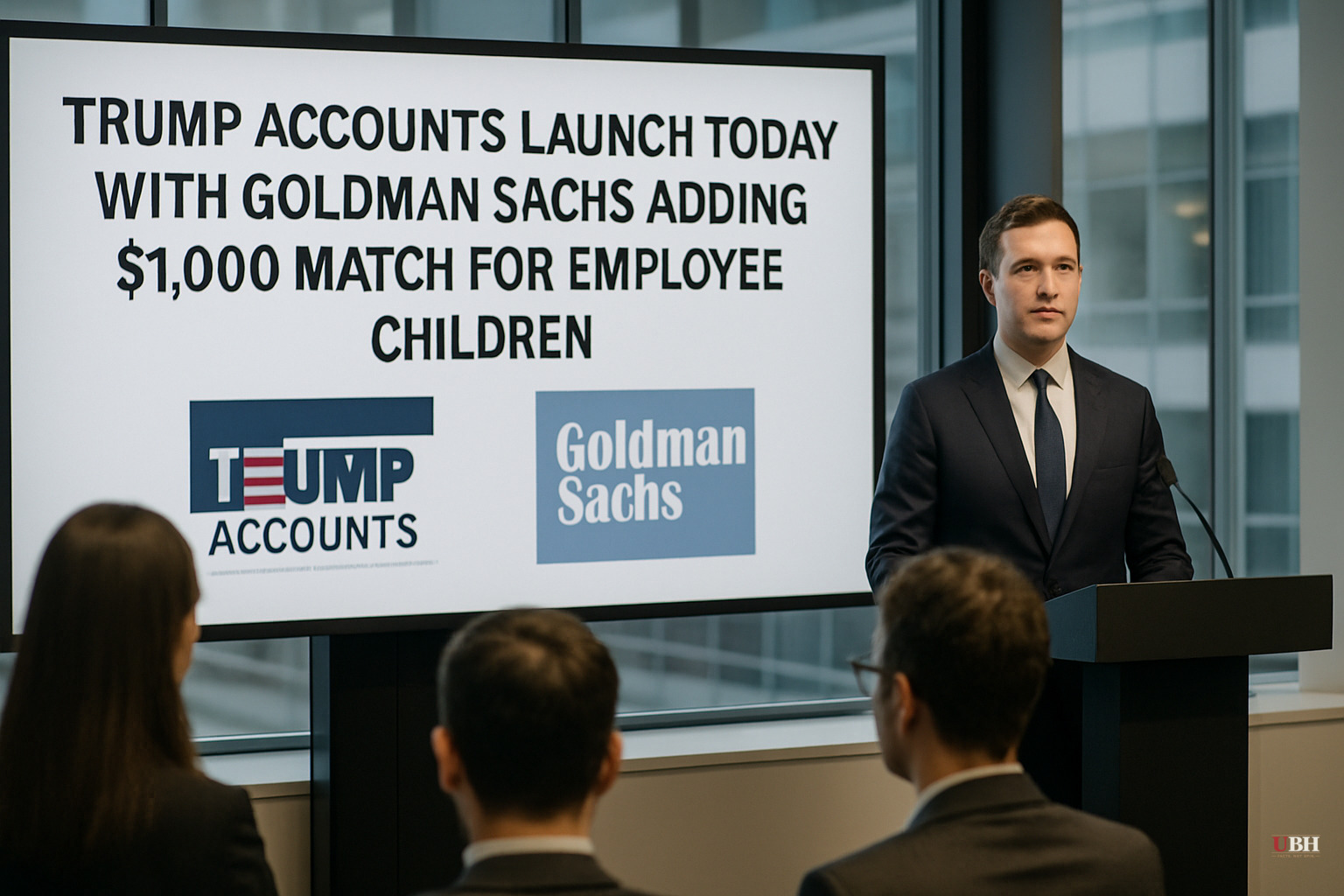
Since the One Big Beautiful Bill Act created Trump Accounts and set today as the launch date, enrollment has climbed past 6 million, according to Fox Business.
What the Program Actually Is
Trump Accounts are tax-advantaged investment accounts for children, seeded with a one-time $1,000 federal contribution for children born between 2025 and 2028. Parents and guardians can contribute up to $5,000 per year, while a parent's employer can contribute up to $2,500 annually without impacting the employee's taxable income. The funds go into low-cost index funds tracking the broad U.S. stock market. No exotic investments, no managed funds with fat fees.
The U.S. Treasury announced the official launch and the accompanying mobile app, which includes eight financial literacy modules families can access.
Goldman Jumps In
Goldman Sachs CEO David Solomon announced Thursday that the firm will match the $1,000 federal seed contribution for eligible employee children born in the same 2025–2028 window. Qualifying Goldman employees' children start with $2,000 on day one.
"Starting early and staying invested for the long term is one of the most reliable ways American families build lasting financial security," Solomon said. Goldman framed the move as reinforcing "the fundamental economic principles of savings and investing in America's next generation."
Goldman is not the only major financial firm doing this. Citi, JPMorgan Chase, Bank of America, and Vanguard have all announced contributions that at least match the $1,000 federal amount for employee children in the eligible birth range, according to Fox Business.
The Dell Money
Michael and Susan Dell separately announced a $6.25 billion donation to seed 25 million accounts for children 10 and under with $250 each. That contribution reaches children who fall outside the federal eligibility window — children born before 2025 — and is a significant private expansion of the program's reach.
The Strongest Counterargument
Critics of the program raise a legitimate concern. Trump Accounts invest in U.S. equity index funds, meaning their value depends entirely on stock market performance over an 18-plus year horizon. Children born into families who most need a financial head start are also the children least likely to have parents who can contribute the additional $5,000 per year. The accounts risk widening wealth gaps rather than closing them if corporate matching only flows to employees of large financial firms. The $250 Dell contribution for broader-eligibility children is real money, but over two decades in an index fund it compounds to something meaningful only if market returns cooperate. These are genuine structural questions the program's architects have not publicly addressed.
The index-fund structure does avoid the management-fee erosion that has historically gutted similar programs — a real structural advantage for account holders who contribute nothing beyond the federal seed.
What the Launch Means Practically
The Treasury app is live as of today. The financial literacy modules are accessible now. Families with children born from 2025 onward can enroll and receive the federal $1,000 seed. Employees at Goldman Sachs, Citi, JPMorgan, Bank of America, and Vanguard should check with their employers on enrollment mechanics to capture the corporate match.
SEC Chair Paul Atkins discussed the accounts' investment value in a segment on Kudlow, according to Fox Business, though no specific claims from that appearance were detailed in available coverage.
As the program goes live, one question remains unresolved: what percentage of the 6 million enrolled accounts belong to children in families with no corporate match available, and what is the Treasury's plan to close that participation gap for lower-income households who stand to benefit most from compounding but are least likely to add contributions on top of the federal seed?
Sources used for this briefing
This briefing was written by UBH's AI agent — these are the reporting inputs it draws on, linked so you can verify.


